The Knowing-Doing Gap: 6 Neuroscience-Backed Fixes for Entrepreneurs Who Can't Execute
You've read 47 business books. You can recite the playbook in your sleep. You know — with absolute certainty — what your next three moves should be. The knowing-doing gap in entrepreneurs isn't laziness. It's a measurable brain malfunction. And you're stuck in it right now.
You're not making those moves.
And the voice in your head says: "You're lazy. You're scared. You're a fraud."
That voice is wrong. Dead wrong. And I can prove it with brain scans.
After spending over a decade working with high-revenue founders who build seven- and eight-figure businesses but still find themselves frozen on known priorities, I've seen this pattern hundreds of times. It's never about laziness. It's always about neurobiology.
Why Can't I Do What I Know I Should?
If you've ever Googled this question at 2am — staring at a to-do list you wrote three weeks ago that hasn't moved — you're not alone and you're not broken. The answer is structural, not motivational. Your brain literally separates the system that knows from the system that does. And specific conditions — ones entrepreneurs face daily — sever the connection between them. Keep reading. This has a fix.
Often the gap isn't willpower — it's a dysregulated nervous system, so start by calming your nervous system with this 7-minute routine before you tackle the task.
Why High-Performing Entrepreneurs Still Get Stuck
I know who you are. You built something from nothing. You believe in radical ownership. You think "mindset work" is what people do instead of actual work.
You've watched people use psychology as a crutch. You've seen founders hide behind "I'm working on myself" while their businesses die. You've rolled your eyes at every neuroscience headline promising an excuse for mediocrity.
Good. Keep that skepticism. I'm not asking you to lower your standards. I'm asking you to apply that same ruthless logic to one question:
If execution is purely a choice, why do you consistently fail to make it — on things you genuinely want?
Not things you're ambivalent about. Things you desperately want. Things you lose sleep over not doing.
Your current framework says: you must not want it enough. But you do. You know you do. So something else is happening.
How the Brain Separates Knowing From Doing: The Two-System Problem
This isn't pop psychology. This is fMRI data.
Princeton researchers put people in brain scanners. They watched what happens when someone knows the right choice but doesn't make it. Two completely separate neural systems light up.
Your prefrontal cortex holds the plan. Your basal ganglia controls action initiation. These are different brain regions. They use different neurotransmitters. They operate on different timelines.
What is the knowing-doing gap? The knowing-doing gap is the neuroscience-backed phenomenon where the brain's knowledge centers (prefrontal cortex) and action-initiation centers (basal ganglia) operate as separate systems that can be disconnected by stress, sleep deprivation, and decision fatigue — making it physically impossible to act on what you know, regardless of motivation or willpower.
Here's the part that should stop you cold: neurologist Antonio Damasio's somatic marker research studied patients with damage to the ventromedial prefrontal cortex. These patients could perfectly describe the right decision in any scenario. They aced every logic test.
They could not act on any of it.
Knowledge and action are not the same system. They never were. You can destroy one while leaving the other completely intact.
This is not a metaphor. It's anatomy.
If the real issue is identity (not tactics), this is the missing layer: the entrepreneur mindset shift that makes self-discipline effortless.

What Causes the Knowing-Doing Gap in Entrepreneurs
Your basal ganglia acts like a gate. Every potential action competes for permission to pass through.
What wins? Not importance. Not logic. Not urgency.
Familiarity wins. Reward certainty wins.
Checking email passes through the gate effortlessly. Your brain has done it 50,000 times. The reward is predictable. The neural pathway is a highway.
Making that difficult sales call? Restructuring your offer? Having the hard conversation with your underperforming team member? These are unpaved roads. The basal ganglia filters them out — not because they're wrong, but because they're uncertain.
Now add what entrepreneurs specifically face:
Chronic sleep debt (averaging 6.3 hours according to a 2019 RAND Corporation study) drops prefrontal-to-action connectivity by 60%
Sustained cortisol from business stress physically shrinks the prefrontal cortex — the dendrites literally retract, as documented in Robert Sapolsky's 30 years of Stanford research.
Decision fatigue from making 100+ choices daily depletes the exact neurotransmitter (dopamine) that the basal ganglia needs to initiate novel action.
Role conflict between founder/parent/spouse/leader creates identity-level paralysis.
You're not failing to execute because you're weak. You're failing because the specific conditions of entrepreneurship systematically attack the specific brain circuit that connects knowing to doing.
You also can't execute through constant noise — here's how to clear the digital overwhelm blocking your focus so action feels possible again.
If your ‘knowing-doing gap’ shows up as repeating the same expensive decision, read why you keep making the same mistakes (and how founders break the cycle).
If this hit a little too close to home, don’t “try harder.”
I put together a free lesson that shows you how to rebuild the bridge between what you know and what you actually do — without willpower, shame, or more productivity hacks: “Closing the Knowing-Doing Gap for High Achievers.”
Take the free lesson here
How Top Entrepreneurs Close the Knowing-Doing Gap
Great question: some entrepreneurs execute perfectly — so what's different about them?
They don't have more willpower. Willpower is a folk concept that doesn't map to any single brain system. Brain scans of "disciplined" people show something else entirely.
They have lower friction in their action-initiation circuits. Here's how:
They sleep more. Not as a luxury. As infrastructure. Jeff Bezos insists on 8 hours. He's not lazy. He's protecting his prefrontal-basal ganglia connection.
They reduce decisions. Zuckerberg's gray t-shirt isn't quirky. It's conservation of the exact neurochemical resource that enables action on important things.
They use environment design. They don't rely on their brain's gate to select the right action. They remove wrong actions from the environment entirely.
They create implementation intentions. Not vague goals. Specific if-then rules. "When I sit at my desk at 9am, I open the sales doc first." This bypasses the basal ganglia's familiarity filter by encoding the action as a pre-decided response rather than a novel choice. Research by psychologist Peter Gollwitzer shows implementation intentions increase follow-through rates by 2-3x compared to standard goal-setting.
High-executors aren't tougher. They're better engineers of the system that connects knowing to doing.
The fix depends on your pattern — take the 3-minute quiz to find your procrastination type and get a strategy matched to how your brain works.
I put together a free lesson that shows you how to rebuild the bridge between what you know and what you actually do — without willpower, shame, or more productivity hacks: “Closing the Knowing-Doing Gap for High Achievers.”
Take the free lesson here
Why Willpower and Discipline Make the Knowing-Doing Gap Worse
Here's what your current approach does to your brain.
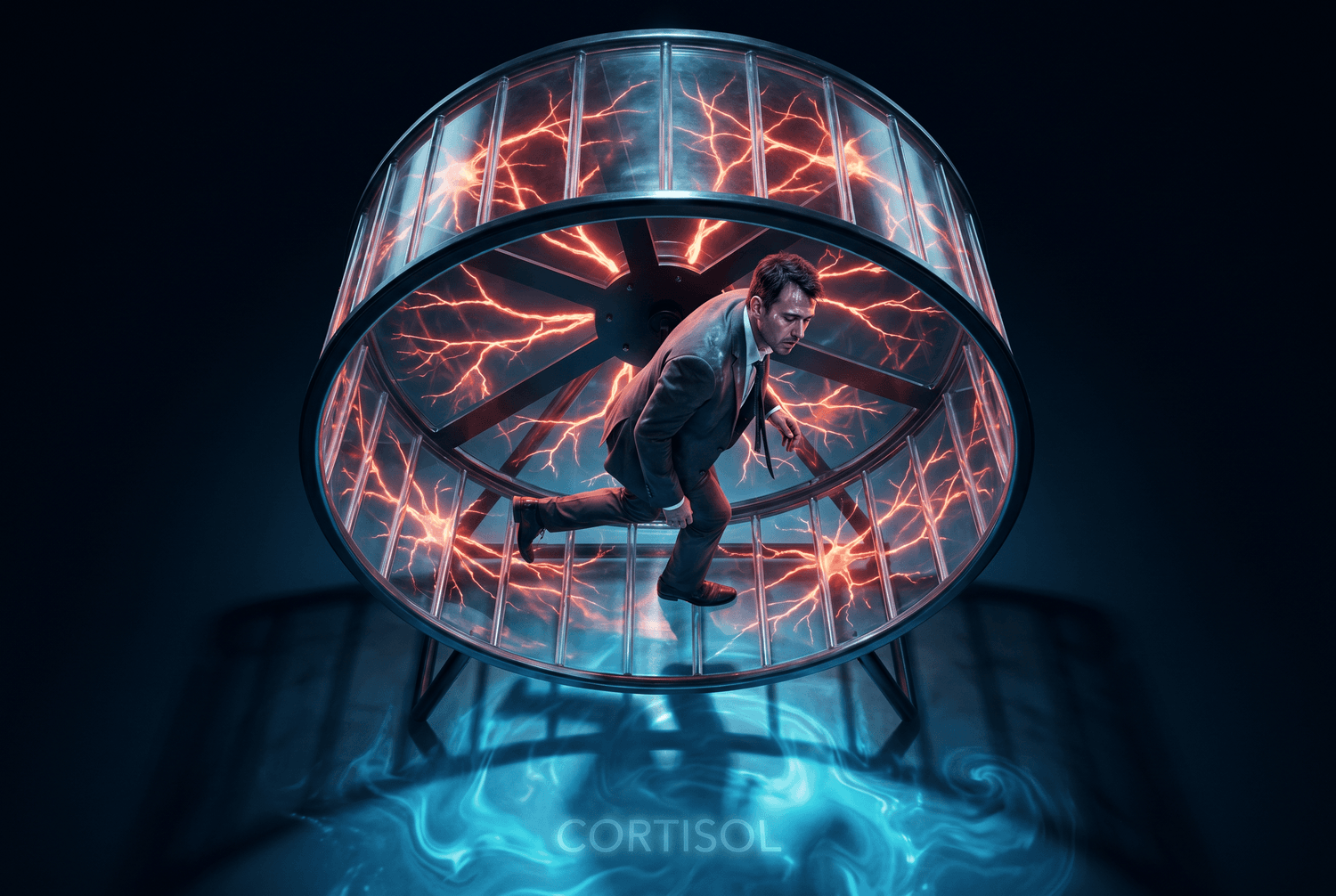
You notice the gap between what you know and what you do. You feel shame. Shame triggers cortisol. Cortisol further shrinks your prefrontal cortex. Your knowing-doing gap widens.
So you bear down. You set your alarm earlier. You make bigger commitments. You add more pressure.
Pressure triggers more cortisol. More cortisol means more prefrontal impairment. The gap widens again.
This is a neurochemical doom loop. The harder you "try," the worse the specific brain system performs. Effort isn't the solution — it's accelerating the problem.
I know this sounds like an excuse to you. It's not. It's a diagnosis. And correct diagnoses enable correct treatments.
If you had a torn ACL, "just run harder" would make it worse. Nobody calls that an excuse. They call it basic logic.
If your gap is driven by identity protection (not laziness), read entrepreneur self‑sabotage: 9 signs your business is stuck because of you.

The Evidence That Disproves the "Just Execute" Model
If the knowing-doing gap is purely about choice and character, explain these:
Why is it universal across cultures? Anthropologists found the identical pattern in Japanese executives, Maasai leaders, Brazilian founders, and Scandinavian CEOs. If it were about discipline, cultural differences would produce different outcomes. They don't.
Why does it correlate perfectly with sleep? Give any entrepreneur 5 nights of 8-hour sleep and their execution improves measurably. Take a great executor and restrict them to 5 hours for a week — they start procrastinating on known priorities. Every time. Predictably. Matthew Walker's UC Berkeley research confirms this pattern with clinical precision.
Why does it worsen under stress but not under difficulty? Hard tasks don't trigger the gap. Stressful tasks do. An entrepreneur will execute brilliantly on a hard problem they find fun. They'll freeze on an easy task that carries social threat. This makes no sense under the "character" model. It makes perfect sense under the neurological model.
Why does it respond to medication? People with ADHD — which is fundamentally a disorder of the action-initiation circuit — can suddenly execute on known priorities when their dopamine system is pharmacologically supported. If execution were purely choice, medication couldn't affect it.
Why do brain lesion patients prove the separation? You cannot explain Damasio's patients under the willpower model. They wanted to act correctly. They knew the right answer. They could not do it. Because the hardware was damaged. The hardware can also be functionally damaged by chronic stress, sleep deprivation, and decision overload — without any lesion needed.
If you’re still trying to brute‑force execution, read why willpower fails (and the habit system that works instead).
6 Neuroscience-Backed Ways To Fix the Knowing-Doing Gap
I'm not telling you to lower your standards. I'm telling you to build the bridge.
The gap between knowing and doing is real, physical infrastructure. You can build it, maintain it, or destroy it. Here's what the research says works:
1. Protect Sleep Like Revenue
Below 7 hours, your execution capacity degrades on a measurable, predictable curve. This isn't optional wellness advice. It's performance engineering.
2. Reduce Daily Decision Volume Ruthlessly
Every decision you eliminate preserves dopamine for the actions that actually matter. Automate, delegate, or eliminate everything that isn't a high-leverage choice.
3. Use Implementation Intentions for Your Highest-Priority Actions
Don't decide what to do in the moment. Pre-decide. Write it down. "At [time], in [location], I will [specific action]." This format has 2-3x the completion rate of standard goals in controlled studies.
4. Design Your Environment for Action, Not Willpower
Remove friction from desired behaviors. Add friction to undesired ones. Don't keep your phone in the room where you do deep work. Open the important document before you close your laptop at night.
5. Manage Cortisol Like a Resource
Brief intense exercise lowers cortisol for 4-6 hours afterward. Use it strategically before your highest-leverage work blocks.
6. Batch Novel Actions With Familiar Ones
Your basal ganglia passes familiar actions easily. Pair new important actions with established routines. Attach the unfamiliar to the automatic.

The Knowing-Doing Gap Is a Systems Problem — Not a Character Problem
You've been carrying shame. Probably for years. You see the gap between who you are and who you "should" be. You interpret that gap as a character failing.
It's not.
You are a biological system operating under conditions it never evolved for. You're making hundreds of decisions daily in a world that didn't exist 100 years ago — on insufficient sleep, under chronic stress, with more competing priorities than any human brain was designed to handle.
The shame doesn't help you. It makes the problem worse. Neurochemically, measurably worse.
The founders who break through aren't the ones who finally "get tough enough." They're the ones who stop treating a systems problem like a moral one.
The knowing-doing gap has a fix. It's not motivation. It's not grinding harder. It's engineering the conditions your brain needs to connect what you know to what you do. Tonight, pick one action from the list above. Do that one thing for seven days. Then watch what happens to the gap. Your brain already has the map — build it the damn road.
Closing this gap permanently is a mindset shift, which is the heart of the CEO thinking playbook.
I put together a free lesson that shows you how to rebuild the bridge between what you know and what you actually do — without willpower, shame, or more productivity hacks: “Closing the Knowing-Doing Gap for High Achievers.”
Take the free lesson here
Frequently Asked Questions
What is the knowing-doing gap?
The knowing-doing gap is the disconnect between what you intellectually understand you should do and your ability to actually do it. Neuroscience shows this isn't a motivation problem — it's a hardware problem. Your prefrontal cortex (where knowledge lives) and your basal ganglia (where action initiates) are separate brain systems that can become disconnected by stress, sleep deprivation, and decision fatigue.
Why do I know what to do but can't do it?
Your brain's action-initiation system (basal ganglia) prioritizes familiar, low-risk behaviors over novel ones — regardless of how important the new action is. When you add chronic stress, insufficient sleep, and the hundreds of daily decisions entrepreneurs face, the neural bridge between knowing and doing degrades further. It's a biological bottleneck, not a character flaw.
Is the knowing-doing gap the same as procrastination?
No. Procrastination is a symptom. The knowing-doing gap is the underlying mechanism. Procrastination implies you're choosing to delay. The knowing-doing gap reveals that your brain's action-initiation circuit is physically unable to fire on uncertain or novel tasks — especially under stress. You're not choosing inaction. Your basal ganglia is filtering it out before conscious choice even enters the picture.
How do I stop knowing what to do and start doing it?
The fastest way is to take the free lesson here
Or use implementation intentions — specific if-then rules like "At 9am at my desk, I will open the sales doc first." Research shows this format bypasses your brain's familiarity filter and increases follow-through by 2-3x. Combine this with protecting sleep (7+ hours), reducing daily decisions, and designing your environment to remove friction from desired actions.
Can willpower fix the knowing-doing gap?
No — willpower actually makes it worse. Bearing down harder triggers cortisol. Cortisol shrinks the prefrontal cortex. A smaller prefrontal cortex weakens the connection to your action-initiation system. The gap widens. This creates a neurochemical doom loop where more effort produces less execution. The fix is systems engineering, not brute force.
Why do entrepreneurs struggle with execution more than employees?
Entrepreneurs face a unique combination of factors that attack the knowing-doing circuit simultaneously. Chronic sleep debt, sustained cortisol from financial stress, 100+ daily decisions depleting dopamine, and constant role-switching between founder/parent/spouse/leader. Employees typically face fewer decisions, less financial uncertainty, and more external structure — all of which protect the brain's action-initiation pathway.
Does sleep really affect your ability to execute?
Yes — dramatically. Below 7 hours, prefrontal-to-basal-ganglia connectivity drops by up to 60%. This is the exact circuit that connects what you know to what you do. Five nights of proper sleep measurably improves execution in every study. Five nights of restriction measurably destroys it. This isn't wellness advice. It's performance engineering with predictable, dose-dependent results.
What's the fastest way to close the knowing-doing gap?
The single fastest intervention is sleep. Restoring 7-8 hours for five consecutive nights rebuilds prefrontal connectivity faster than any other method. The second fastest is implementation intentions — pre-deciding your highest-leverage action with a specific time, place, and trigger. Together, these two changes address both the neurochemical deficit and the behavioral friction simultaneously.
Is the knowing-doing gap related to ADHD?
Yes. ADHD is fundamentally a disorder of the action-initiation circuit — the same system involved in the knowing-doing gap. People with ADHD experience a more severe, chronic version of the disconnect. The fact that dopamine-supporting medication allows ADHD patients to suddenly execute on known priorities proves that execution is not purely about choice or character. It's about neurochemistry.
How long does it take to fix the knowing-doing gap?
Most entrepreneurs notice measurable improvement within 7 days of implementing one structural change — particularly sleep or implementation intentions. Full rewiring of action-initiation pathways takes longer, typically 4-8 weeks of consistent environmental design and cortisol management. The gap didn't form overnight and won't disappear overnight, but the trajectory shifts fast once you stop treating it as a moral problem and start treating it as a systems problem.





UNLOCK FREE MINDSET TRAININGS & EXCLUSIVE DISCOUNTS YOU WON'T FIND ANYWHERE ELSE!
Subscribe to the newsletter and join driven entrepreneurs, solopreneurs, executives, business owners, and high-achieving professionals on a mission to become unstoppable forces for good.
GET MINDSET STRATEGIES DELIVERED TO YOUR INBOX
Unlock free mindset trainings, neural reprogramming techniques, and
exclusive discounts. Join entrepreneurs, executives, and high-achievers
breaking through their mental blocks.
CONNECT WITH MILAN
Got questions about Breakthrough Coaching or Neural Reprogramming?
Send me a message—I read every email.
FREE RESOURCES
© 2026 Milan'Z Coaching