How to Stop Overthinking Fast: A 7-Minute Anxiety Routine
There's a particular kind of fear that doesn't announce itself with a siren. This 7-minute self mastery routine for anxiety is built to meet that fear exactly where it begins — not in your thoughts, but in your nervous system. Anxiety shows up as a tight throat while you're answering an email. A sudden rush of heat in the grocery aisle. That restless, electric feeling at 2:17 a.m. when the house is quiet but your nervous system acts like something is chasing you.
And here's the part most advice gets wrong: anxiety rarely starts as a "bad thought." It starts as a state. A body bracing. A breath shortening. A brain scanning.
So this routine doesn't begin with arguing your mind into calm. It begins where anxiety actually lives: in the nervous system. Then it moves upward — into attention, meaning, and identity — until your brain learns a new pattern that feels less like "coping" and more like command. I've coached hundreds of high performers through this exact sequence over the past nine years, and the people who recover fastest are almost never the ones who try hardest to think their way out.
Medical note (read this once, keep it): This is educational, not medical advice. If anxiety is disrupting sleep, work, relationships, or you're experiencing panic attacks or trauma symptoms, consider support from a licensed clinician (CBT, ACT, exposure therapy, trauma-informed therapy). You can find evidence-based options through the Anxiety & Depression Association of America or the National Institute of Mental Health. If you're at risk of self-harm, seek urgent local help immediately or call/text 988 (US).
How Do You Calm Anxiety in 7 Minutes? The Copy-Paste Protocol
Do this once daily (and anytime anxiety spikes):
Minutes 1–2: Bilateral stimulation breathing (slow inhale/exhale + alternating taps) to signal safety and reduce arousal.
Minutes 3–4: Progressive muscle release + 5‑4‑3‑2‑1 grounding to step out of rumination loops.
Minutes 5–6: Cognitive reframe using the “Observer Self” method to restore prefrontal control.
Minute 7: Identity statement reinforcement + an implementation intention (“If X, then I do Y”) to build automatic calm.
Why Traditional Anxiety Management Fails (And What Neuroscience Reveals Instead)
A lot of anxiety guidance sounds like it was written for a different nervous system.
It assumes you can simply decide not to worry. That you can “think positive,” zoom out, reframe, and move on. Sometimes you can. Often you can’t—because when your body is in threat mode, your brain isn’t interested in philosophy. It wants certainty. It wants control. It wants a reason to justify the alarm it’s already sounding.
The truth is unromantic and oddly relieving: your physiology drives your interpretation more than you’ve been told.

The Cortisol‑Amygdala Loop: How Anxiety Becomes Self‑Perpetuating
Anxiety becomes sticky because it’s self-confirming.
A cue appears—an awkward text, a calendar reminder, a weird sensation in your chest. Your amygdala flags it as potentially dangerous. Stress systems surge. Heart rate climbs. Muscles tighten. Attention narrows. The body ramps up.
Then the brain does what brains do: it looks for an explanation that matches the sensation.
I feel terrible… so something must be wrong.
That’s the loop. And once it’s learned, it runs fast—sometimes faster than you can name it.
Why Willpower and Positive Thinking Create Rebound Effects
Here’s a quiet trap: trying to force anxiety away often turns you into a monitor.
You check for it. You measure it. You test your own body like it’s a faulty device.
Is it gone yet? Is it getting worse? Why am I still feeling this?
That checking—ironically—keeps the threat system online. Suppression can boomerang. Not because you’re weak, but because your brain interprets suppression as evidence: This feeling is important. Keep watching.
Somatic Regulation vs. Cognitive Override: The Self‑Mastery Difference
Self mastery is not “I never feel anxious.”
Self mastery is: I notice the first signal—and I know what to do next. Not in theory. In the body. In real time.
That’s the shift from cognitive override (fighting thoughts) to somatic regulation (changing state). Once state softens, cognition becomes usable again. Not perfect. Usable. And that’s enough.
The Neuroscience‑Validated Self Mastery Framework for Anxiety Control
This framework is simple on purpose. Anxiety is already complex; you don’t need a ritual that requires a spreadsheet.
What you need is a repeatable sequence your brain recognizes as familiar—something that turns chaos into something you can steer.
What Self Mastery Actually Means (Neural Plasticity + Behavioral Architecture)
Self mastery is the ability to shift your internal state without waiting for conditions to be ideal.
Neuroplasticity is the reason that’s possible. Your brain strengthens what you rehearse—especially what you rehearse under emotional load. Behavioral architecture is the scaffolding: cues, routines, friction, rewards. The unglamorous machinery that makes a practice real.
You’re not trying to become a new person overnight. You’re training a new default
The Three Pillars: Physiological Reset, Cognitive Reframing, Identity Anchoring
This routine is built on three pillars that stack cleanly:
Physiological Reset (Body → Brain)
Calm the system enough to regain range.Cognitive Reframing (Brain → Meaning)
Shift interpretation after the alarm is quieter.Identity Anchoring (Meaning → Behavior)
Teach your brain: “This is what I do when anxiety shows up.”
That last part matters more than most people think. Anxiety feeds on helplessness. Identity anchoring starves it.
How a Daily Anxiety Routine Converts Chaos Into Controllable Patterns
Anxiety feels like it comes out of nowhere. Routine makes your response predictable.
And predictability is not boring to the nervous system—it’s safety. When you practice the same sequence daily, you stop improvising during spikes. Over time, your system begins to reach for the routine the way it reaches for a familiar song.
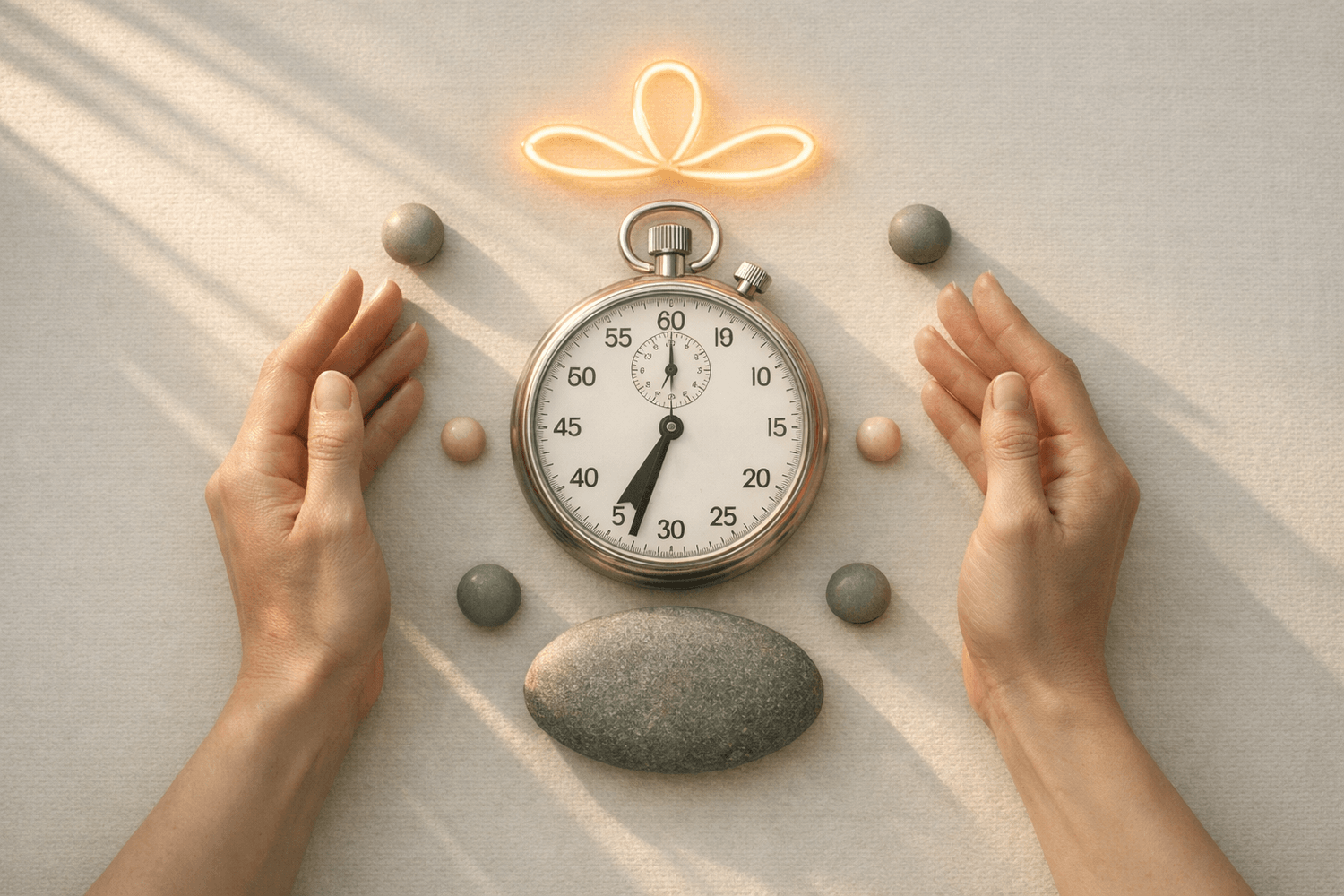
The 7-Minute Self Mastery Routine for Anxiety: Complete Step-by-Step Protocol
You can do this sitting on the edge of your bed. In your car before you walk into the office. In a bathroom stall at a wedding. It’s built to be portable—because anxiety rarely waits for a perfect setting.
Minute 1–2: Vagus Nerve Breathing Exercises (Bilateral Stimulation)
Step‑by‑Step Breathwork Instructions
Set up (10 seconds): Feet on the floor. Jaw soft. Tongue resting. Shoulders not trying to win an award for tension.
Then:
Inhale 4 seconds through the nose.
Exhale 6 seconds through the nose or softly through pursed lips.
Add alternating taps while you breathe:
Right hand taps left shoulder (or left thigh), then
Left hand taps right shoulder (or right thigh)
Keep the rhythm steady, roughly one tap per second. Stay here for 2 minutes. If 4–6 feels too intense, use 3–5 and smooth it out.
A simple phrase that helps (optional): "Longer out-breath. Not an emergency."
Why This Works: Parasympathetic Nervous System Engagement
The longer exhale is the lever. It nudges the system toward a calmer mode — less "fight-or-flight," more "I can deal with this." A 2023 Stanford study published in Cell Reports Medicine by Balban et al. found that just five minutes a day of slow, exhale-emphasized breathing produced greater improvements in mood and lower physiological arousal than mindfulness meditation over a one-month period.
The bilateral rhythm does something quieter: it gives your attention a metronome. When anxiety tries to pull you into catastrophic prediction, rhythm offers a steady alternative — one your body can follow even when your mind is loud.
Common mistake: big, forceful breathing. Make it smaller than you think you need. Calm is rarely created by effort.
Minute 3–4: Grounding Techniques for Anxiety (Progressive Muscle Release)
Anxiety isn't only in your head. It lives in your hands clenching without permission. In your shoulders living by your ears. In your stomach bracing like it's about to be hit.
So we interrupt it there.
The 5‑4‑3‑2‑1 Sensory Anchoring Technique
Before or after muscle release (choose what feels better today), do this:
5 things you can see (name them)
4 things you can feel (contact points: feet, fabric, chair)
3 things you can hear
2 things you can smell
1 thing you can taste (or one slow breath if taste isn't available)
Do it like you mean it. Not like a checklist. Let your eyes land on objects. Let your hands feel texture. Give your brain present-time evidence.
Progressive Muscle Release (Fast Version)
One quick cycle:
Hands/forearms: squeeze 3 seconds → release 7 seconds
Shoulders: shrug 3 seconds → drop 7 seconds
Stomach: tighten 3 seconds → soften 7 seconds
Legs/feet: press toes 3 seconds → release 7 seconds
You're not chasing bliss. You're teaching contrast: this is tension… and this is letting go.
Evidence: How Grounding Techniques Interrupt Rumination Cycles
Rumination is sticky because it's abstract and repetitive. Grounding is effective because it's concrete and immediate.
When you pull attention into sensory detail, you disrupt the mental movie. You stop feeding the loop with new frames. The brain can't fully run a catastrophe simulation while it's busy noticing: cool air on skin, chair under legs, distant traffic, a light humming.
That's not "woo." That's attention mechanics.
Minute 5–6: Cognitive Reframing Using the "Observer Self" Method
Now that the body is less inflamed, your mind becomes more workable.
Not silent. Workable.

Metacognitive Awareness Script
Use this exactly, or adapt it, but keep the sequence:
Name it: "I'm noticing anxiety."
Locate it: "It's in my chest / throat / stomach."
Measure it: "It's about a 6 out of 10."
Allow it (briefly): "I can make room for this sensation for 30 seconds."
Widen the frame: "Also present: the room, the chair, the next breath."
Then ask one question that turns panic into direction: "What is the next smallest helpful action I can take?"
That last line matters. Anxiety loves big questions. You answer with a small move.
Neural Mechanism: Prefrontal Cortex Activation (What This Is Doing Under the Hood)
When you label and observe, you're shifting from being fused with the alarm to noticing the alarm. UCLA research on "affect labeling" by Lieberman and colleagues shows that simply putting feelings into words measurably reduces amygdala activity and engages the prefrontal cortex.
That shift recruits higher-order control networks involved in regulation and attention. It doesn't erase sensation. It changes how much authority sensation has. In practice, that often prevents escalation: the feeling stops being a command and becomes information.
A phrase that cuts through the drama: "This is a body alarm, not a prophecy."
Before You Move to Minute 7: Discover Your Mental Imposter Type
If you notice a pattern where anxiety shows up alongside thoughts like "I don't belong here," "They're going to find out I'm not good enough," or "Everyone else has it figured out except me"—that's not random. That's a specific mental imposter pattern.
Most high-functioning people don't realize they're running executive-level self-talk scripts that amplify anxiety instead of regulating it. The voice sounds rational. Protective, even. But underneath, it's keeping your threat system armed.
I created the Executive Self-Talk for High-Achievers course that shows you how to rewrite the script your brain defaults to under pressure.
👉 Executive Self-Talk for High-Achievers
This pairs directly with the Observer Self method you just learned—because once you see the pattern, you can interrupt it.
Minute 7: Identity Statement Reinforcement (Neuroplastic Conditioning)
Anxiety becomes unbearable when it convinces you it's permanent, personal, and powerful.
Identity work flips the script. It teaches your system: I'm someone who responds skillfully.
Crafting Your Personal Mastery Affirmation
Skip grand declarations. Make it believable.
Make it behavioral. Use one of these templates:
"When anxiety rises, I return to my breath and take the next right step."
"I practice regulation before reaction."
"I can feel discomfort and still choose skill."
Say it once, slowly. Then attach an if‑then plan (this is the part your brain remembers in the moment): If I notice the first spike (tight chest / racing mind), then I do 2 minutes of 4–6 breathing + taps.
Repetition Science: How 66 Days Creates Automaticity
You'll hear "66 days" quoted as an average for habit automaticity — a figure that traces back to Lally et al.'s 2009 study at University College London. Treat it as a compass, not a contract; in that study, the range ran from 18 to 254 days.
The real point is this: your brain believes what you repeat. Not what you intend. Not what you read once. What you rehearse — especially when it's slightly uncomfortable — becomes easier to access later.
Advanced Self Mastery Protocols for High‑Anxiety States
Some days, 7 minutes feels like a luxury. Some spikes feel too sharp for finesse. That’s why you keep shorter tools within reach.
The Emergency 90‑Second Anxiety Reset (Polyvagal Theory Application)
When anxiety hits hard, do this — no negotiation, no analysis:
Physiological sigh x 2: inhale → top-up inhale → long exhale
Cold cue (optional): cool water on your face for 15–30 seconds
Orienting: slowly turn your head and name 3 neutral objects ("lamp, door, book")
Contact: press feet into the floor and lengthen the exhale
It's not magic. It's leverage: breath, temperature, orientation, and pressure — signals your nervous system understands faster than words.
Evening Anxiety Regulation: Sleep‑Optimized Routine Modifications
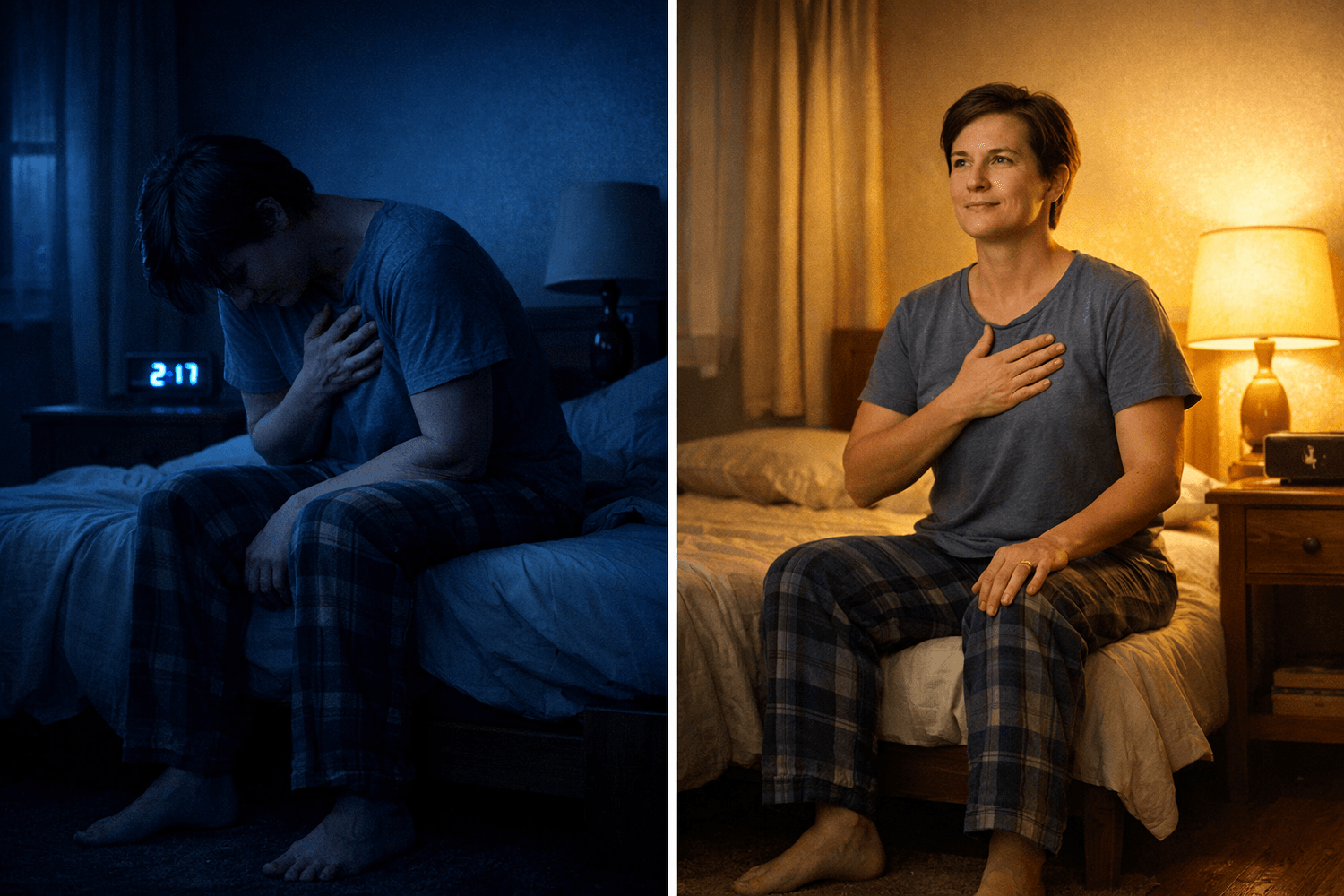
Night anxiety is its own species. The goal isn’t productivity. The goal is downshifting.
Try:
Replace tapping with one hand on chest, one on belly
Use a slower pattern: 4 in / 8 out if comfortable (don’t force it)
Add a two-minute “brain download”: write the worries, then write one next action for tomorrow
A boundary that changes everything: No problem-solving in bed. Train the bed to mean sleep, not rehearsal.
Social Anxiety Adaptation: Pre‑Event Mastery Protocols
Before the event:
Do the 7 minutes.
Add a values cue: “I’m here to be curious, not impressive.”
Add a behavior target: “Ask 2 questions. Reflect back 1 detail.”
After the event: Give yourself a strict debrief limit: 3 minutes. Then stop replaying. Rumination disguises itself as “learning,” but it’s often just self-punishment wearing glasses.
What Separates People Who Stay Anxious from People Who Master It
You now have a full protocol—breath, grounding, reframe, identity. But here's what most articles won't tell you: technique is only half the picture.
The other half is mindset architecture—the beliefs you hold about stress, discomfort, control, and progress. High performers who manage anxiety well don't just use better tools. They think differently about what anxiety means and what they're allowed to do when it shows up.
After working with hundreds of high performers, I've identified 5 specific mindset shifts that separate people who white-knuckle through anxiety from people who use it as signal and fuel.
Watch the free training: The 5 Mindset Shifts High Performers Use to Get Unstuck
👉 Watch the Free Video Training Here
You'll learn:
Why "managing" anxiety keeps you stuck (and what to do instead)
The identity shift that makes regulation feel automatic, not effortful
How to turn discomfort into traction without burning out
This pairs with everything you've learned so far—but it upgrades how you think about the process.
How to Track Anxiety Progress: Metrics and Milestones That Matter
Progress with anxiety is rarely a straight line. It’s more like the ocean: waves still come, but you stop thinking every wave is the end of you.
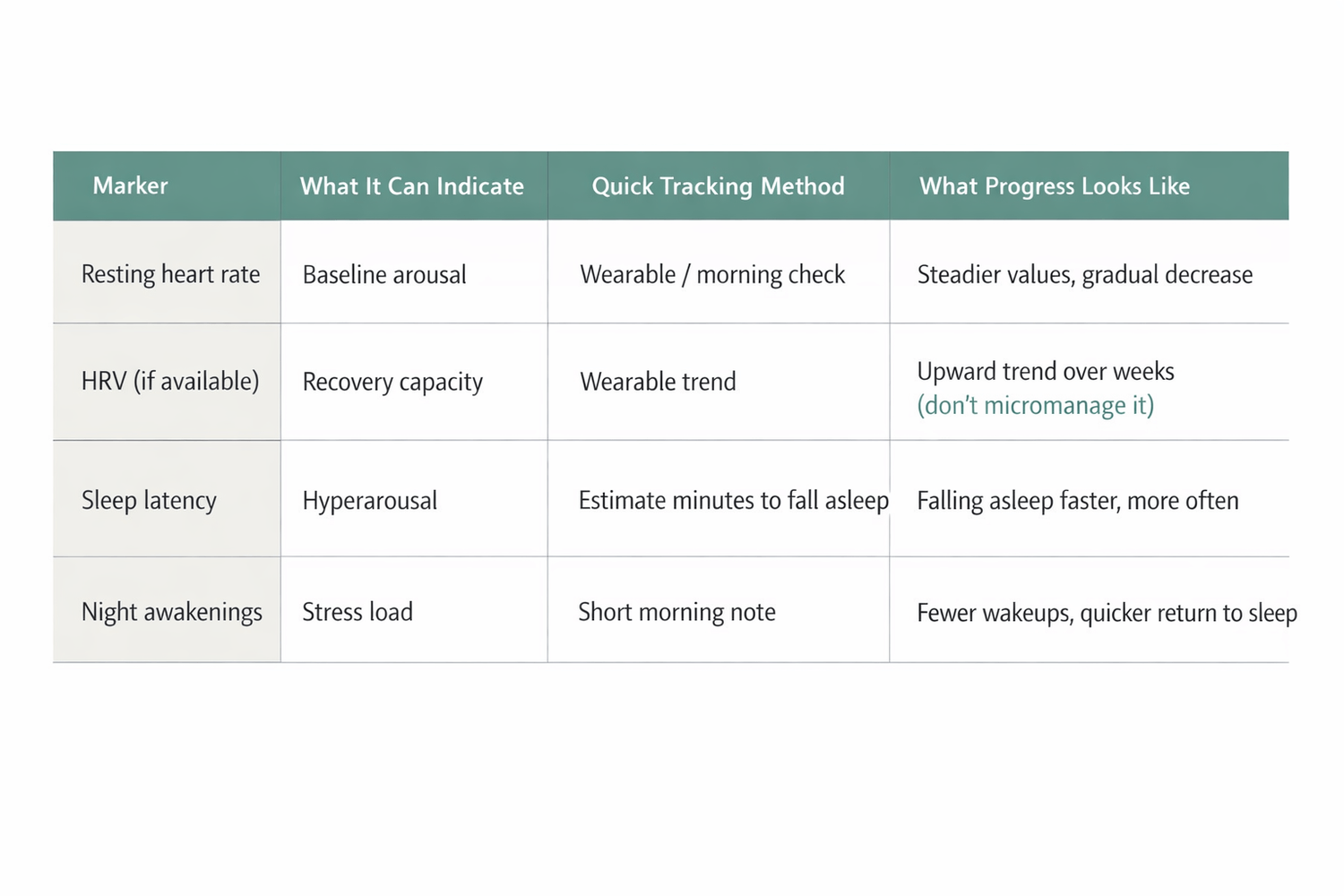
Tracking Physiological Markers (HRV, Resting Heart Rate, Sleep Quality)
Use simple signals. Trends weekly beat obsessing daily. Track four markers: resting heart rate, HRV, sleep latency, and night awakenings.
Psychological Indicators: Self‑Efficacy Scale and Distress Tolerance
Once a week, rate 0–10:
“When anxiety rises, I can help myself.”
“I can feel discomfort without spiraling.”
“I recover faster after triggers.”
The goal is not a life without anxiety. It’s a life where anxiety doesn’t run the meeting.
Week‑by‑Week Anxiety Transformation Timeline (What to Expect)
Week 1: you start catching the early signs (breath changes, scanning, tension).
Week 2: spikes still happen, but they don’t last as long.
Weeks 3–4: fewer full spirals; more moments of “I know what to do.”
Weeks 5–8: the routine feels less like effort and more like reflex.
Beyond: triggers exist, but your identity shifts: you’re not a victim of anxiety—you’re trained.
The Self Mastery Stack: Tools, Apps, and Habit Architecture
Tools don’t save you. Practice does. But the right tools can remove friction—so practice actually happens.
Evidence‑Based Apps for Anxiety Routine Tracking (No Affiliate Fluff)
Pick one lane. Too many apps becomes another form of avoidance.
Breathing timers: Breathwrk, Insight Timer (timers), Oak (simple)
Meditation/mindfulness: Waking Up, Headspace, Calm
CBT/ACT journaling: CBT Thought Diary, Daylio (mood + notes)
Habit tracking: Streaks, Loop Habit Tracker (Android), Apple Reminders
Creating Trigger‑Routine‑Reward Loops (Habit Science Integration)
Make the routine stupidly easy to start.
Trigger: after brushing teeth / first coffee / when you sit at your desk
Routine: the 7 minutes (no editing, no “today I’ll do a different version”)
Reward: immediate and concrete (checkmark, tea, 2 minutes of a favorite song)
A sentence that helps on low-motivation days:
“Seven minutes, then I’m free.”
How to Stop Anxiety Fast: Common Pitfalls and Troubleshooting
"Breathing makes me more anxious." Make breaths smaller. Shorten the inhale. Keep the exhale gentle and longer. If needed, breathe normally and just use tapping + grounding first.
"I don't have time." Do Minute 1–2 only (breathing + taps). Consistency beats completeness.
"It worked… then anxiety came back." That's normal. The metric is not "never anxious." It's "I recover faster, and I trust myself."
"My mind won't stop." Stop trying to win a debate with thoughts. Go back to sensation: feet, chair, sound, exhale.
What the Research Says: The Evidence Behind This Anxiety Routine
This routine is a bundle of components that are individually supported across clinical and experimental research: paced breathing and autonomic regulation, progressive muscle relaxation, grounding/present-focused attention, and metacognitive strategies used in CBT/ACT-style approaches. To put the scale in plain terms: anxiety disorders affect an estimated 19.1% of U.S. adults in any given year — roughly 1 in 5 — according to the National Institute of Mental Health, which is exactly why low-risk, repeatable skills like these matter so much.
The honest promise isn't "this cures anxiety." The honest promise is: these are low-risk, well-studied skills that can reduce symptoms and strengthen coping when practiced consistently.
Meta‑Analysis of Breathwork and Anxiety Reduction
A 2023 systematic review and meta-analysis by Fincham et al., published in Scientific Reports, pooled data from 12 randomized controlled trials and found that breathwork was associated with significantly lower self-reported stress and anxiety compared to control conditions. The slow-exhale breathing at the core of this routine draws on the same vagal mechanisms Stanford neuroscientist Dr. Andrew Huberman has highlighted in his research on the "physiological sigh."
Somatic Therapy Outcomes: What Body-Based Research Shows
Somatic approaches vary widely — grounding, interoception training, trauma-informed body-based modalities. A consistent thread: when you change the body's threat state, emotional intensity often changes with it. For higher-severity anxiety or trauma-linked patterns, outcomes are frequently strongest when somatic skills are integrated with evidence-based psychotherapy.
Neuroplasticity and Routine Formation: Why Repetition Rewires Anxiety
The “rewiring” isn’t a dramatic lightning strike. It’s repetition.
Your brain strengthens the pathway you practice—especially when you practice it in the presence of the very sensations you used to fear. Over time, regulation becomes less of a project and more of a default.
Pair this routine with a real reset of your inputs — here's a recovery plan for digital overwhelm that protects your calm long-term.
If anxiety keeps turning into self‑pressure, read why shame kills motivation so you stop using threat as fuel.
FAQ (The Questions People Ask Themselves at 2 a.m.)
What if I do the routine but still feel stuck in the same patterns?
That usually means one of two things: either the technique needs time to build automaticity (remember: 66 days), or there's a deeper mindset pattern running underneath—often tied to beliefs about control, perfectionism, or identity. If you keep hitting the same wall, take the Pattern Recognition Test to see if you're running a mental imposter script that's sabotaging your progress. Or watch The 5 Mindset Shifts training to identify which mental framework is keeping you looped.
Is this going to help if I'm already mid‑panic?
It can. Especially the breathing + grounding pieces. But if panic attacks are recurring, structured treatment (CBT for panic, interoceptive exposure) is one of the most reliable paths—this routine works beautifully as support, not as a substitute.
Do I really have to do it every day?
You don’t have to. But daily practice is what turns this from a technique you remember into a reflex you reach for. Think of it like brushing your teeth for your nervous system.
What if my anxiety is mostly thoughts, not body stuff?
Thoughts almost always ride on subtle physiology: breath shifts, muscle tension, restlessness. Start with the body anyway. It often quiets the mind indirectly, like lowering the volume at the source.
What if I try it and I feel nothing?
Then you’re not broken—you’re early. Some nervous systems respond immediately; others need repetition to trust the signal. Track recovery time over weeks. That’s where the change shows up first.
Can I replace therapy with this?
For mild anxiety, sometimes yes. For moderate-to-severe anxiety, OCD, trauma symptoms, or significant impairment, it’s smarter to use this as a daily stabilizer while working with a professional.
Anxiety doesn't get the final word here — your training does. The whole point of a self mastery routine for anxiety is that you stop waiting to feel better and start practicing your way there, seven minutes at a time, until calm becomes the thing your nervous system reaches for on its own. So pick your trigger, set your timer tonight, and run the protocol once before you talk yourself out of it. Take the Pattern Recognition Test, then do your first 7 minutes today.
About the Author
By Milan | Founder of Milan'Z Coaching | NLP & Hypnotherapy Master Practitioner | Neural Reprogramming Coach | Creator of MSIP | Helping entrepreneurs and high-achieving professionals overcome imposter syndrome, self-doubt, and limiting beliefs since 2014. [About Milan]




UNLOCK FREE MINDSET TRAININGS & EXCLUSIVE DISCOUNTS YOU WON'T FIND ANYWHERE ELSE!
Subscribe to the newsletter and join driven entrepreneurs, solopreneurs, executives, business owners, and high-achieving professionals on a mission to become unstoppable forces for good.
GET MINDSET STRATEGIES DELIVERED TO YOUR INBOX
Unlock free mindset trainings, neural reprogramming techniques, and
exclusive discounts. Join entrepreneurs, executives, and high-achievers
breaking through their mental blocks.
CONNECT WITH MILAN
Got questions about Breakthrough Coaching or Neural Reprogramming?
Send me a message—I read every email.
FREE RESOURCES
© 2026 Milan'Z Coaching