Imposter Syndrome for Entrepreneurs: A 7-Step Playbook to Overcome Self-Doubt
What Imposter Syndrome Looks Like for Entrepreneurs
Imposter syndrome for entrepreneurs is the persistent sense that your success doesn't quite belong to you—that you're surviving on timing, charm, or borrowed credibility, and eventually the room will notice. In the original research that named the phenomenon, psychologists Pauline Clance and Suzanne Imes found it concentrated among high achievers who externalize their wins, and later studies estimate that up to 72% of people experience it at some point.
I once coached a SaaS founder who had just closed a 2 million USD seed round and still couldn't say his pricing out loud without flinching. On paper, unstoppable. In the room, bracing. That gap is the whole problem.
What an Imposter Syndrome Coach Does for Founders
An imposter syndrome coach helps founders spot their triggers, audit the thinking that hijacks confidence, regulate performance stress, and build repeatable behavior changes—so you move faster, price cleaner, delegate earlier, and show up with leadership presence even when the stakes spike. The outcome isn't "never doubt again." It's that doubt stops driving the company.
Learn more about the mental blocks that create these triggers and how neural reprogramming rewires them at the source.
If you want a practical ‘do this today’ version first, read how to overcome imposter syndrome as an entrepreneur and then come back for the deeper system.
How to Overcome Imposter Syndrome as an Entrepreneur (Fastest Proven Path)
To overcome imposter syndrome as an entrepreneur, run a three-step sequence every time doubt spikes:
Identify the trigger — name the moment (pitch, board email, hiring, posting, negotiation).
Reframe with proof — replace mind-reading and catastrophizing with data, outcomes, and probabilities.
Do behavioral reps — take micro-actions (ask, ship, publish, delegate) that retrain confidence through experience.
You don't need a new personality. You need a repeatable loop: catch the moment, correct the story, then train the response until your body believes it.
Founder Imposter Syndrome Symptoms: Is This You?
There's a version of imposter syndrome that doesn't look like insecurity at all.
It looks like competence… turned tight. Like someone gripping the steering wheel hard enough to leave fingerprints. You're calm on the outside, productive on paper, and quietly bracing for the moment someone asks a question you can't answer instantly.
This is the paradox: research suggests roughly 72% of people feel like frauds at some point, yet it's often the most successful founders who weaponize this awareness.
If that lands in your chest, you're not alone—and you're not broken. You're likely running a very common founder pattern where perfectionism, shaky self-efficacy, and a few predictable cognitive distortions team up right when it matters most.
High-Achiever Anxiety vs. Imposter Syndrome
Sometimes it's plain stress. Sometimes it's the deeper fear of being seen. Here's the cleanest way to tell which one is steering.
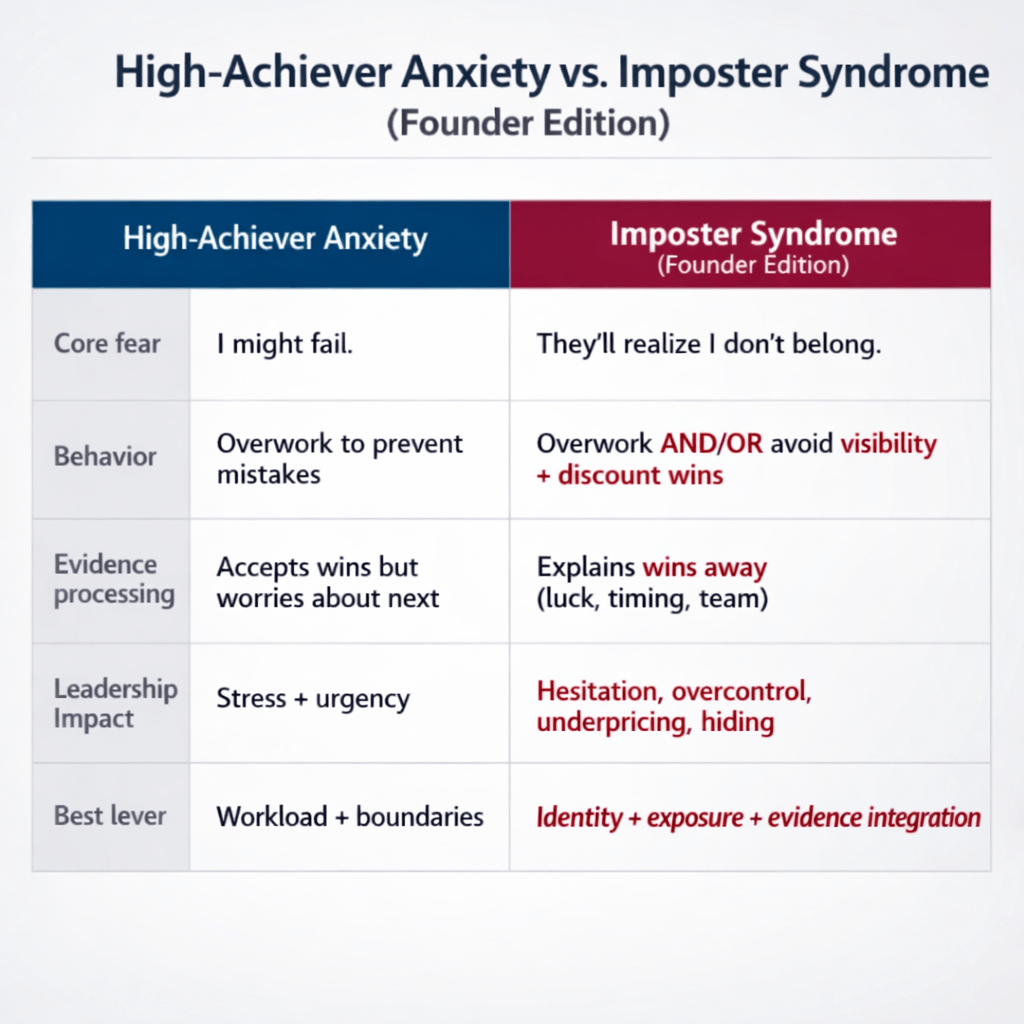
A quick gut-check: if you can list your wins on paper but can't feel them under pressure, you're dealing with a confidence-integration issue, not a capability issue. That's why advice like "just own your success" bounces right off.
Building authentic self-mastery requires more than affirmations—it demands identity-level integration.
The 9 Founder Imposter Syndrome Patterns
Founders rarely say, "I have imposter syndrome." They say things like: "I'll post when it's clearer," or "I'll reach out after I tighten the deck," or "I'll delegate after this sprint."
Listen for these nine patterns:
Fundraising fear: you draft, redraft, and rehearse—then delay outreach because you're convinced "real founders" sound more certain.
Visibility avoidance: you duck podcasts, talks, and even simple LinkedIn posts until the message is bulletproof.
Perfection loops: shipping becomes a moving target; polish replaces progress because progress can be judged.
Delegation guilt: you keep work because "it's faster," while resentment quietly piles up like dirty dishes.
Churn catastrophizing: every cancellation feels like an exposure event, not a business signal.
Underpricing/overdelivering: you charge what feels "safe," then try to earn worth with effort.
If this pattern feels familiar, read Confidence That Pays: how to set rates that match your value.
Decision paralysis: you ask for more data when what you really want is immunity from blame.
Chronic delay often reveals a deeper pattern. Discover what's driving the hesitation in our procrastination-type guide.
Role camouflage: you talk like an operator when it's time to lead like a CEO—or pretend to be the CEO when the work needs an operator's focus.
Praise deflection: you swat compliments away ("anyone could've done it") and then wonder why confidence never sticks.
Founder translation: imposter syndrome is often a visibility problem disguised as a competence problem—and it will keep disguising itself until you name it.
The Hidden Cost of Imposter Syndrome for Founders
Imposter syndrome isn't just painful. It's expensive. Quietly. Compounding.
Decision latency: you wait for "certainty," but leadership is decision-making under uncertainty. Delays become strategy by default.
Underpricing: you anchor on being "fair" instead of being sustainable, and your runway pays the price. This isn't just a confidence issue—it's a revenue and boundaries issue that compounds over time.
Burnout: perfectionism plus performance anxiety becomes physiology—sleep gets thin, recovery gets shorter, the body starts negotiating against you. Founder burnout doesn't always look like collapse; sometimes it looks like constant competence with no joy.
Team trust erosion: when you overcontrol, reverse decisions, or keep changing the target, your team stops trusting the floor beneath them.
Leadership presence: even when your words are correct, your nervous system tells on you—speed, tone, posture, urgency. People feel it.
Why Entrepreneurs Get Imposter Syndrome (Not Because They're "Insecure")
Let's retire the lazy explanation. Entrepreneurs aren't uniquely insecure. They're uniquely exposed.
The imposter syndrome paradox explains why building in public creates both vulnerability and competitive advantage.
You build in public. You make calls with partial information. You sell belief before the evidence is complete. And you do it while your identity is changing faster than your brain can update its story. Imposter syndrome is often what happens when growth outpaces self-concept.
Identity Mismatch in Entrepreneurs: "I'm Not the Type of Person Who…"
This is the sentence that quietly runs founders: "I'm not the type of person who raises, leads, sells, fires, or speaks."
Notice how it doesn't mention skill. It mentions type of person. That's identity. And identity doesn't like sudden upgrades.
When identity lags behind behavior, your nervous system treats expansion like threat. This is where self-mastery strategies become essential—aligning your internal narrative with your external expansion. You can have traction, testimonials, even revenue—and still feel a tightening in the chest before a pitch. That's not moral failure. It's a mismatch.
Social Comparison and Founder Self-Doubt
Founders compare raw footage to a trailer.
You see the chaotic Slack threads, the half-formed strategy, the "we'll figure it out" moments that never make it onto social media. Everyone else shows highlight reels: a crisp narrative, a confident smile, a perfectly framed "we 3x'd in 90 days."
That's asymmetric information. And it fuels distorted conclusions: "They're real. I'm faking."
Understanding how neural reprogramming works helps you interrupt these automatic comparisons before they derail your decisions.
The goal isn't "stop comparing." The goal is to compare with accurate context—baselines, timelines, probability, and what it actually looks like to build anything worth building.
A big part of ‘imposter syndrome’ is actually an inner critic script—use how to stop negative self‑talk when you’re alone to change the voice, not just the strategy.
Why Imposter Syndrome Spikes at Power Transitions
Imposter syndrome spikes at thresholds—because thresholds are where power changes hands.
First hire → "Now someone's livelihood is tied to me."
First manager → "If I'm not the smartest in the room, I'll be exposed."
First board → "Adults are here. I'm going to be found out."
First acquisition talk → "They're going to see how improvised this all is."
Power transitions amplify performance anxiety and demand leadership presence. They also reveal where your confidence system is thin.
Before any tactic works, it helps to understand the difference between self-worth, self-esteem, and confidence — because most people are trying to fix the wrong layer.
The Coach's 7-Layer Anti-Imposter Framework for Entrepreneurs
A good framework doesn't flatter you. It frees you.
This one is designed for founders who want something sturdier than pep talks: a system that turns self-doubt into data, then into action. Each layer is a lever. Together they build self-efficacy—the lived belief: I can handle what's next.

Layer 1 — Trigger Forensics: Mapping Your Imposter Syndrome Triggers
Self-doubt rarely arrives “randomly.” It arrives on schedule.
So we start like investigators, not philosophers.
Situations: pitches, pricing calls, launching, hiring, firing, conflict
People: investors, high-status peers, an ex-boss, a spouse, the “smart friend”
Stakes: money, reputation, belonging, team safety, identity
Narratives: “I’m behind,” “I must be certain,” “I got lucky,” “I’m not ready”
Output: a trigger map you can predict. When you can predict it, you stop being ambushed. Many of these triggers connect directly to the mental blocks you've been carrying since before you became a founder. You intervene early—before the spiral writes your calendar.
Layer 2 — Thought Audit: Naming Cognitive Distortions
Founders don’t just think. They spin. Fast. Convincingly. Under pressure, the brain becomes a storyteller with a bias toward danger.
Give the distortions names—clean ones—so you can catch them mid-sentence.
Mind reading: “They think I’m clueless.”
Catastrophizing: “If this launch flops, it’s over.”
Discounting the positive: “That win doesn’t count.”
All-or-nothing: “If I’m not the best, I’m a fraud.”
Fortune telling: “This investor will say no.”
Then run the counter-evidence protocol. Three bullets. No essays.
Facts: what happened, measurable outcomes, traction signals
Alternative explanations: timing, strategy, team execution and your leadership
Most likely outcome: not best/worst—probable
This isn’t optimism. It’s cognitive accuracy—the kind leaders need when decision-making under uncertainty is the job description.

Layer 3 — Reputation Reality Check: External Proof vs. Internal Story
Here’s the dirty trick of imposter syndrome: it makes proof feel irrelevant.
So we build a system that doesn’t rely on vibes. It relies on receipts.
Customer outcomes (before/after, retention, testimonials)
Team feedback (themes, not flattery)
Investor signals (meetings, follow-ups, intros)
Metrics (pipeline, conversion, usage, revenue, churn)
Goal: align internal story with external reality. Not to inflate your ego—just to stop your brain from running a fictional narrative over real evidence.
This is how the imposter syndrome paradox works—your brain dismisses the very evidence that would quiet the doubt.
Layer 4 — Competence Calibration: Skills Gap vs. Confidence Gap
Some doubt is information. The question is: what kind?
Founders suffer when they treat every doubt like a personality flaw instead of a diagnostic signal. You calibrate:
If you had to teach this skill tomorrow, could you outline it?
Do you fail because execution is missing—or because you keep avoiding the start?
Are you afraid of not knowing… or afraid of being seen not knowing?
If it’s a skills gap: build a learning sprint (practice + feedback).
If it’s a confidence gap: build exposure reps (see Layer 5).
This is where coaching becomes practical. You stop “working on confidence” and start closing the correct gap.
Layer 5 — Exposure Protocols: Micro-Visibility Reps That Build Confidence
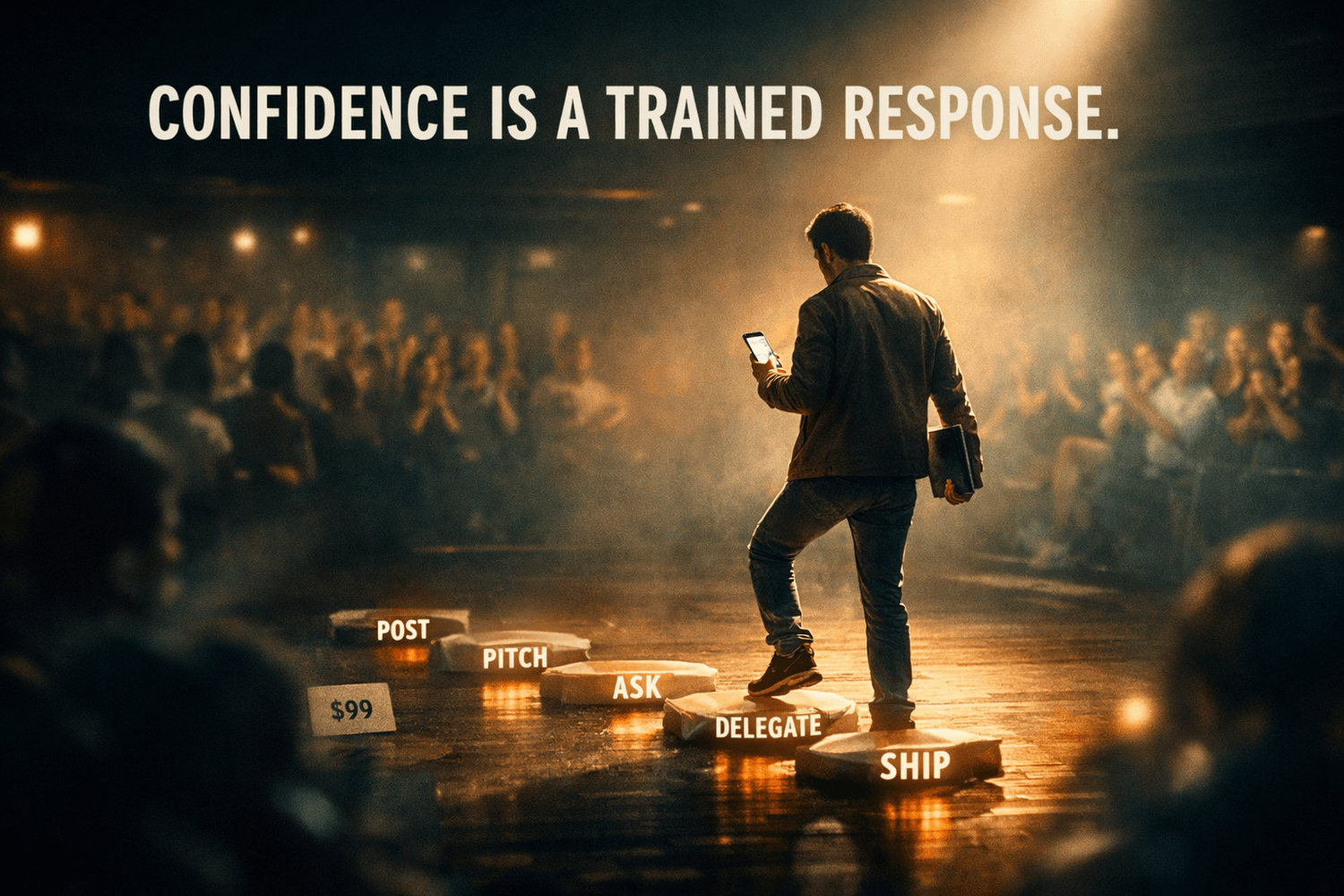
Confidence isn’t a personality trait. It’s a conditioned response.
If your nervous system associates visibility with danger, you don’t talk it out—you train it out. Gently. Repeatedly. On purpose.
Micro-exposures that work because they’re small enough to repeat:
Post one rough insight (not a manifesto) 2x/week
Make 3 direct asks/week (intro, referral, partnership, hire)
Pitch weekly (even informally) to reduce performance anxiety
State a price without justifying it, then let silence do its job
For a complete pricing confidence system, see how to raise your prices with boundaries and visibility.
Track reps like training sets. Your brain changes through repetition under tolerable stress, not reassurance.

Layer 6 — Somatic Downshift: Nervous System Regulation for Founders
Founders love to think. Under stress, thinking gets narrower.
When your nervous system is activated, you can have the right strategy and still perform like you’re cornered. So we add a performance layer: regulation. Fast, simple, repeatable.
Pick one and practice daily so it’s available under fire:
Physiological sigh: two inhales, long exhale, repeat 2–3 times
Box breathing: 4 in, hold 4, out 4, hold 4 for 2 minutes
Name 5–4–3–2–1: sensory grounding before high-stakes calls
Posture + pace reset: slow speech by 10 percent, relax jaw/shoulders
This protects leadership presence. People don’t just buy your logic—they feel your state.
Building self-mastery means integrating mental, emotional, and somatic regulation—not just mindset work.
Layer 7 — Identity Rewrite: Building a Values-Based Leadership Persona
The endgame isn’t “I never feel doubt.” The endgame is:
“I act from values even when doubt is loud.”
So you build a values-based leadership persona. Not a costume. A compass.
Values: what you refuse to trade away (truth, speed, craft, care)
Standards: what good leadership looks like when pressure rises
Story: “I’m the kind of leader who…” (behavioral, not aspirational)
When identity becomes behavior-anchored, it holds during volatility. This is the foundation of how neural reprogramming creates lasting change—rewiring identity at the behavioral level. It doesn’t require perfect mood. It requires practice.
Imposter Syndrome Tools You Can Use Today
These are meant to be saved, screenshotted, pasted into Notion, and used on a Tuesday when you’re tired and your brain is trying to write disaster fiction. They’re simple by design—because simple is what you’ll actually do.
The 5-Minute "Proof File" Ritual
Create one document titled:
PROOF FILE — [Your Name]
Then, every day for five minutes, add:
1 win: shipped, sold, hired, repaired, simplified, clarified
1 proof point: metric, testimonial, retention signal, milestone
1 earned insight: what you learned that will compound
Rules that make it work:
Use dates. Proof without time turns into fog.
Write outcomes in plain numbers when you can.
Include hard moments you handled. Resilience is evidence, too.
One founder I worked with built this file for 30 days and walked into her Series A pitch reading her own receipts beforehand. She closed the round and later told me the file did more than the deck. This is how you train your mind to stop discarding your own history.
The "CEO Decision Script" to Reduce Rumination
Use this when you feel the mental loop starting—when you keep “thinking” but nothing moves.
1) The decision I’m avoiding is: __________.
2) The real fear is: __________.
3) If I decide and I’m wrong, the cost is: __________.
4) If I delay, the cost is: __________.
5) The reversible vs irreversible parts are: __________.
6) The smallest next step that creates data is: __________.
7) I will decide by (date/time): __________.
Founder-level move: turn line 6 into a team directive. Rumination shrinks when action creates new information.
If chronic delay is your pattern, identify your specific procrastination type to understand what's really driving the avoidance.
Delegation Without Guilt: The "Owner vs Operator" Checklist
Before you keep the task, run this checklist:
Is this the highest-leverage use of founder time?
Does it require founder-only authority (vision, culture, capital allocation)?
Am I keeping it to avoid discomfort (training, feedback, letting go)?
If I delegate, what does “done” look like in one sentence?
What’s the smallest delegation version (20 percent) I can do this week?
If you can define “done,” you can delegate. If you can’t, the issue isn’t your team—it’s clarity.
Many founders confuse delegation with losing control. This is often a mental block around trust and self-worth, not a team capability issue.
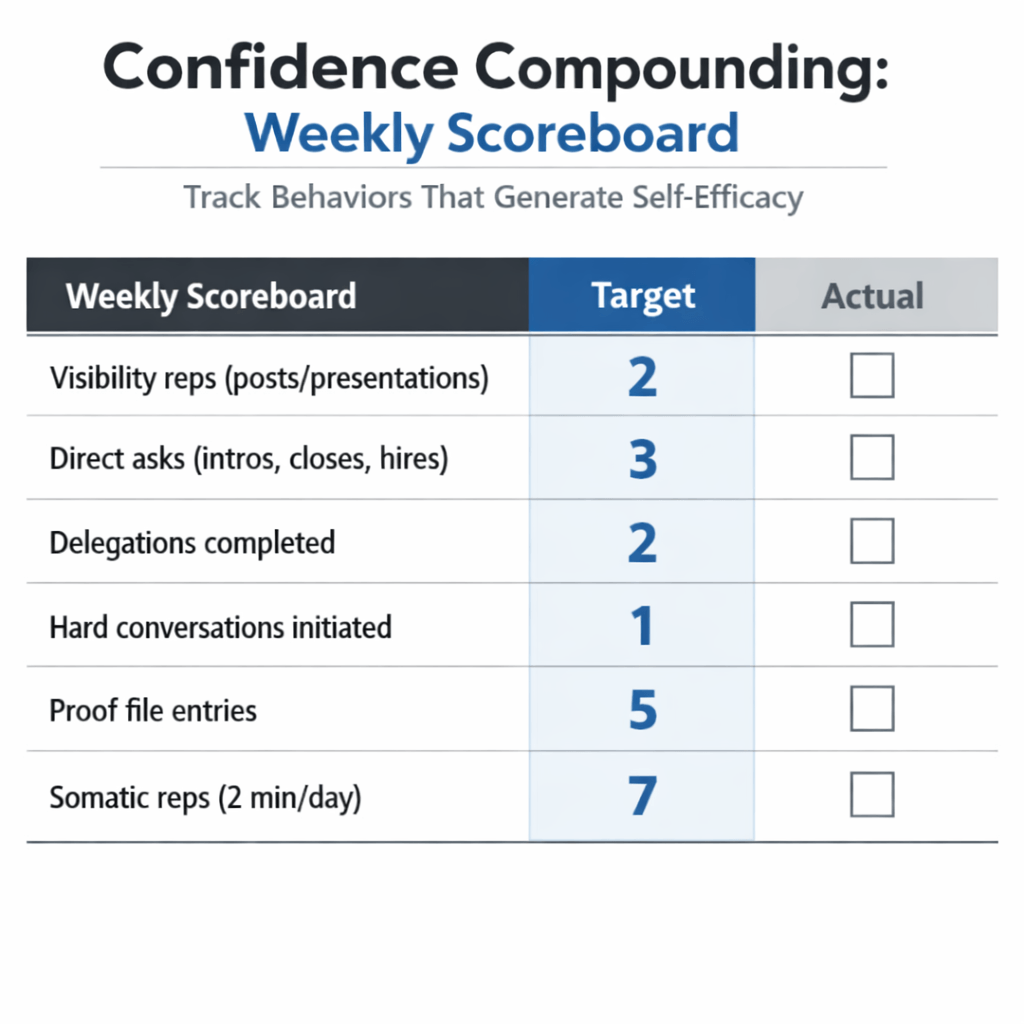
Confidence Compounding: The Weekly Behavior Scoreboard
If you wait to "feel confident" to act, you'll keep paying interest. Track the behaviors that generate self-efficacy—visibility reps, direct asks, prices stated cleanly, decisions made on time. This is confidence built like capital: small deposits, consistently.
Coaching vs. Therapy for Imposter Syndrome: Which Support Fits?
One of the most underrated leadership skills is choosing the right support. Not because you “need help,” but because you respect time, leverage, and outcomes.
When an Imposter Syndrome Coach Is the Best Fit
Coaching tends to be the best fit when the problem is performance + identity + behavior, especially in real-time founder contexts like fundraising and leadership.
It’s a strong match if you want:
Performance under pressure (sales calls, fundraising, leadership presence)
Behavior change (visibility, pricing, delegation, decision speed)
Identity integration (becoming “the CEO” without going numb)
Accountability + systems (reps, feedback loops, measurement)
A good coach won’t just empathize. They’ll build a plan you can run.
Want to understand my specific approach? Learn about the MSIP method and how I developed it.
When Therapy Is the Best Fit
Therapy is the best fit when what’s happening is clinically significant or rooted in deeper patterns that need licensed care.
It’s often the right call for:
Trauma history or complex trauma symptoms
Depression, panic attacks, severe anxiety, self-harm thoughts
Grief, addiction, or impairment that’s affecting daily functioning
Relational patterns that dominate your life beyond work
Important: coaching isn’t a substitute for mental health care. If you suspect a clinical issue, start with a licensed clinician. You can still use coaching later for performance and leadership.
Where Mentors and Accelerators Help (and Where They Don't)
Mentors and accelerators are powerful for:
Strategy, positioning, investor intros
Pattern recognition (“here’s what worked for us”)
Tactical feedback and network leverage
Where they often fall short:
Your internal narrative and performance anxiety
Nervous system regulation
Sustained behavior change when fear keeps hijacking execution
A simple distinction: mentors give you maps. Coaches help you walk through the terrain you keep avoiding.
How to Choose an Imposter Syndrome Coach for Entrepreneurs
Buying coaching shouldn’t feel like buying fog. You’re allowed to be picky. In fact, you should be.
Imposter Syndrome Coaching Cost: What to Expect
Pricing for imposter syndrome coaching for entrepreneurs varies widely—from group programs in the low hundreds per month to 1:1 founder intensives running several thousand for a multi-week engagement. What you're paying for isn't time; it's a method, accountability, and measurable behavior change. Ask any coach to tie their fee to outcomes you can track in 30 days. If they can't, the price is arbitrary no matter the number.
Online Imposter Syndrome Coach vs. In-Person: Does It Matter?
For most founders, an online imposter syndrome coach is not a compromise—it's the better fit. Real-time performance work (a pre-pitch regulation call, a same-day debrief after a hard board meeting) depends on access, not geography. Look for someone who offers between-session support for the moments that actually spike, because that's where the reps happen.
Coaching Credentials That Matter
Look for markers that correlate with real outcomes: coaching education (ICF-aligned training or equivalent rigor); literacy in leadership psychology (self-efficacy, performance anxiety, cognitive distortions); understanding of founder realities (uncertainty, fundraising dynamics, team systems); and a clear method—assessment → plan → reps → review.
A credible coach can explain what they do without mystique—and won't pretend your business is a vision board. If you want to see how this plays out in practice, explore my work with entrepreneurs and the 6-week MSIP intensive.
Red Flags to Avoid in a Coach
Walk away from: "just believe in yourself" as the entire model; vague promises with no behavioral plan; shame disguised as spirituality ("if you were aligned, you wouldn't feel this"); "manifestation-only" claims without skills, systems, and reps; and any dynamic where you need the coach's approval to feel steady.
You want grounded support that makes you more autonomous—not more dependent.
Questions to Ask on a Consult Call
Use these to test depth fast:
“How do you differentiate a skills gap from a confidence gap?”
“What would we measure in 30 days to know this is working?”
“What do you do when my nervous system is activated mid-performance?”
“How do you work with perfectionism and procrastination loops?”
“What’s your framework—step by step—and what homework should I expect?”
Notice how they respond. Clear, specific answers signal competence. Evasion signals branding.
What Results Should Look Like
Results should show up where founders actually live: calendar, conversations, and choices.
Practical KPIs include:
Pricing stated cleanly (less justification), improved deal quality
More visibility reps (posts, talks, outreach) with less avoidance
Faster decisions (shorter rumination cycles)
Delegation increases and team ownership rises
Sales/fundraising calls feel structured, not like auditions
Faster recovery after setbacks—less shame, less spiraling, more action
If nothing changes in behavior, “insight” is just entertainment.
Still exploring your options?
- [Understanding why imposter syndrome is so common] among first-time founders
- [Building pricing confidence] without the mental gymnastics
- [Diagnosing your procrastination pattern] when decision-making feels frozen
- [Exploring mental blocks] that show up as "strategy questions"
- [Learning how neural reprogramming works] at the identity level.
Founder Imposter Syndrome FAQ
Does imposter syndrome ever go away, or is it just who I am?
For most founders, it doesn’t vanish like a cold. It changes shape—and it gets quieter. With the right trigger map, evidence system, exposure reps, and nervous-system tools, it becomes shorter, less convincing, and less in control. The win is that you stop negotiating with it for permission.
How long does it take to overcome imposter syndrome if I do the work?
If you run consistent reps, many founders feel a real shift in 4–8 weeks—especially around visibility, pricing, and decision speed. Deeper identity and leadership presence work often takes 3–6 months, particularly through fundraising, hiring growth, or major product transitions.
Why did my imposter syndrome spike after I raised funding?
Because funding raises visibility, expectations, and perceived surveillance—board meetings, runway math, new hires, louder consequences. The answer isn’t to “relax.” It’s to upgrade your system: decision scripts, exposure protocols, competence calibration, and regulation tools that hold up under pressure.
How do I stop feeling like I just got lucky?
Luck can be real—and still not be the whole story. The shift happens when you start integrating proof in a causal way:
Track outcomes you influenced (not just outcomes that occurred)
Name the decisions you made (not just the results you enjoyed)
Build a repeatable process you trust
When you can explain your wins with clarity—inputs, choices, tradeoffs—“luck” stops being the only explanation your brain reaches for.
This process of building self-mastery through evidence is what separates reactive founders from strategic leaders.
Beyond This Framework: Continue Your Journey
This 7-layer system is comprehensive—but it's just one piece of the transformation puzzle. To go deeper:
- Start with [free neural shift training] to experience the method firsthand
- Explore [self-mastery strategies] that compound over time
- Read about [real founder transformations] and client results
- Or [work with me directly] in the 6-week MSIP intensive
Discover Your Specific Neural Echo Pattern
Most articles end with "contact me if you're interested." This one gives you something you can use in the next three minutes—because the best conversion is clarity, not pressure.
Not all self-doubt runs the same loop. Some founders stack credentials endlessly. Others sabotage right when momentum builds. A few can't claim pricing authority no matter what results prove.
Take the Pattern Recognition Test™ (3 minutes, free)
You'll receive:
Your personalized Mental Impostor Profile (your specific pattern type + how it shows up in decisions)
FREE access to The Inner Critic Contract Audit Workbook
This isn't a personality quiz. It's a diagnostic that shows you exactly which invisible ceiling is blocking your next level.
Book Your Free Breakthrough Strategy Call
If the test confirmed what you suspected, let's map it.
On the call:
We'll identify the exact neural patterns blocking your momentum, revenue, or leadership presence
You'll leave with a clear action plan (whether we work together or not)
BONUS: Book today and receive "Mindset Alchemy for Business Leaders" — a neural reprogramming audio tool for high-stakes moments
Who this is for: Founders willing to do behavioral reps, not just collect insights.
Who this isn't for: Anyone expecting transformation without practice.
Here's the truth: the doubt isn't going to interview itself. You've read this far because something in here was uncomfortably accurate, and the version of you that keeps waiting for certainty is the same one that's been quietly taxing your pricing, your visibility, and your runway for years. The imposter syndrome won't hand you permission—you take it by running the reps.
Take the Pattern Recognition Test™
Worst case, you walk away with clarity.
Best case, you stop letting a loop you can name keep running the company you built.
About the Author
By Milan | Founder of Milan'Z Coaching | NLP & Hypnotherapy Master Practitioner | Neural Reprogramming Coach | Creator of MSIP | Helping entrepreneurs and high-achieving professionals overcome imposter syndrome, self-doubt, and limiting beliefs since 2014. [About Milan]





UNLOCK FREE MINDSET TRAININGS & EXCLUSIVE DISCOUNTS YOU WON'T FIND ANYWHERE ELSE!
Subscribe to the newsletter and join driven entrepreneurs, solopreneurs, executives, business owners, and high-achieving professionals on a mission to become unstoppable forces for good.
GET MINDSET STRATEGIES DELIVERED TO YOUR INBOX
Unlock free mindset trainings, neural reprogramming techniques, and
exclusive discounts. Join entrepreneurs, executives, and high-achievers
breaking through their mental blocks.
CONNECT WITH MILAN
Got questions about Breakthrough Coaching or Neural Reprogramming?
Send me a message—I read every email.
FREE RESOURCES
© 2026 Milan'Z Coaching