Procrastination Quiz: Find Your Procrastination Type and Why You Delay
If you've ever wondered what type of procrastinator you are, this procrastination type quiz gives you a real answer in 3 minutes—not another "just work harder" lecture. You can call it procrastination if you want. Most people do. But if you've ever watched yourself delay something you genuinely care about—while a quieter part of you panics, bargains, and promises "tomorrow"—you already know the truth: this isn't about laziness. It's about protection.
Protection from judgment. From uncertainty. From the moment the work becomes real and you can't hide behind potential anymore. This is where procrastination intersects with imposter syndrome—both are protection mechanisms that cost you momentum. Sometimes it's protection from your own exhaustion—because your mind is running on fumes and you're still trying to drive.
This isn't a "just work harder" article. It's a short procrastination type quiz that pinpoints why you delay, then gives you a fix that matches your psychology. Answer the 8 questions, total your score, and you'll get one primary procrastination type plus the exact first step to break the cycle.
How it works: 8 questions → score → your procrastination type → a targeted prescription.
And yes—this can take 3 minutes.
Research backs this matched approach. Studies estimate that roughly 20% of adults are chronic procrastinators, and psychologist Dr. Joseph Ferrari, one of the field's leading researchers, has shown that procrastination is an emotion-regulation problem, not a time-management flaw. That's exactly why a one-size-fits-all fix fails most people.
Before we diagnose your type, understand this: procrastination is rarely the actual problem. It's usually a symptom of deeper mental blocks around perfectionism, worth, uncertainty, or capacity. Once you identify which one is running your delays, you can address the root—not just force yourself through surface symptoms.
How the Procrastination Type Quiz Works (8 Questions)
Before we do anything else, we’re going to stop guessing.
Because “I procrastinate” is a foggy sentence. It explains nothing. The fix depends on why you delay—what your brain is trying to avoid, regulate, or reclaim.
How to Score Your Procrastination Quiz (60 Seconds)
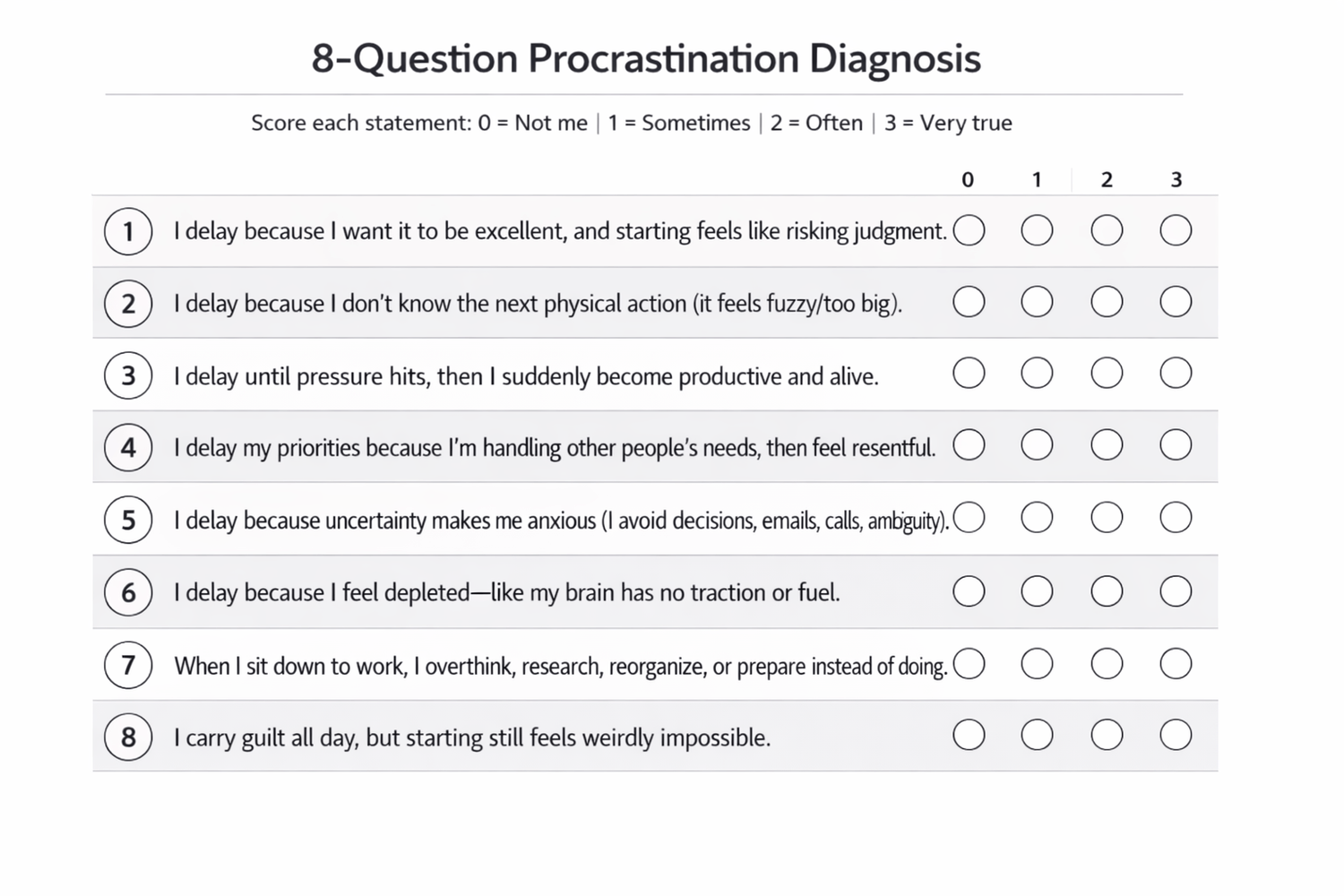
How to score: For each statement, choose 0–3.
0 = Not me
1 = Sometimes
2 = Often
3 = Very true
If you’re tempted to overthink the scoring, notice that—then choose quickly anyway. This is pattern-finding, not a personality exam.
Your Results: The 6 Procrastination Types (Read This First)
Now we translate your answers into something usable—something you can build a plan around.
Step 1 — Add your scores into these buckets:
Perfectionist: Q1 + Q7
Overwhelmed: Q2 + (half of Q8)
Thrill‑Seeker: Q3
People‑Pleaser: Q4
Anxious Avoider: Q5 + (half of Q8)
Burned‑Out Achiever: Q6 + (half of Q8)
Step 2 — Choose your procrastination type:
Your highest score = your primary procrastination archetype.
Your second-highest score = your secondary driver (the sneaky one that hijacks progress when you think you’ve “fixed it”).
If Q8 is high, treat it like an amplifier. Guilt makes everything heavier. It also disguises what’s really happening—threat response, uncertainty intolerance, or executive function depletion—under the label “I’m failing.”
Quick definitions (read like a mirror):
The Perfectionist: delays to avoid judgment, imperfection, or identity threat.
The Overwhelmed: delays because the task is undefined; decision fatigue blocks initiation.
The Thrill‑Seeker: delays to access urgency-driven dopamine and novelty.
The People‑Pleaser: delays self-priorities due to porous boundaries and social pressure.
The Anxious Avoider: delays to avoid uncertainty; anxiety “protects” via withdrawal.
The Burned‑Out Achiever: delays because executive control is depleted; recovery is the bottleneck.
Hold your type lightly. You’re not a box. You’re a pattern—one you can change.
Changing these patterns requires more than awareness—it demands neural reprogramming at the identity and behavioral level.
Whatever your type, the underlying issue is the same — the brain-based knowing-doing gap, and there are six fixes for it.
What Are the Types of Procrastination? The Full Breakdown
You just identified your procrastination archetype. That's leverage.
But here's what most people miss: procrastination is surface behavior. Underneath it, there's usually a mental imposter pattern—a specific way your inner narrator interprets threat, mistakes, progress, and identity.
The Perfectionist might be running "If it's not excellent, I'm exposed." The Overwhelmed might be stuck in "I can't trust my decisions." The Anxious Avoider might believe "Uncertainty = danger."
These patterns are invisible until you name them. Once you do, they lose half their power. This is the foundation of self-mastery—developing the awareness and tools to interrupt automatic patterns before they write your schedule.
Take the Pattern Recognition Test (3 Minutes)
You'll get your mental imposter type + a free Inner Critic Contract Audit Workbook that shows you how to rewrite the internal script that's been quietly sabotaging your momentum.
➡️Take the Pattern Recognition Test (Free)
This pairs with what you just learned—because changing what you do is faster when you also change what you believe while you're doing it.
The 6 Procrastination Archetypes Explained
If this page feels uncomfortably accurate, good. Accuracy is leverage.
Each archetype below is written as a hub: definition, mechanism, payoff. Not to label you—so you can stop fighting shadows.

The Perfectionist Procrastinator (Fear of Judgment, All‑or‑Nothing Thinking)
Perfectionist procrastination rarely starts with vanity. It starts with stakes.
Somewhere in your nervous system, “doing the work” got fused with “being evaluated.” Not just your output—you. So the mind reaches for a solution that feels safe: delay the moment where the work becomes real.
You might call it standards. Underneath, it’s often fear of judgment wrapped in all‑or‑nothing thinking.
Common tells
You “get ready” forever: outlines, tools, research, systems—anything except the messy first attempt.
You wait for the right mood like it’s a doorway you have to walk through.
You oscillate: overwork, freeze, disappear.
Root cause (entity map)
Evaluation threat → anxiety → avoidance
Cognitive distortions (catastrophizing, mind reading)
Self-worth fusion (“my work = me”)
This evaluation threat is deeply connected to imposter syndrome in entrepreneurs—the fear that doing the work will expose you as inadequate. Learn more about the 7-layer system to address this, especially Layer 1 (Trigger Forensics) and Layer 2 (Thought Audit).
Hidden payoff You keep your identity clean. No evidence. No verdict. And as long as the thing isn’t finished, you can still believe it would’ve been amazing.
That’s the trap.
Breaking this trap requires addressing the mental block that fuses your self-worth with your output quality.
If your result is the perfectionist type, dig deeper with the perfectionism limiting-beliefs workbook.
The Overwhelmed Procrastinator (Decision Fatigue, Unclear Next Actions)
Overwhelm has a particular flavor: a thousand tabs open, and none of them are the one you need.
The Overwhelmed type isn’t weak. You’re flooded. The task is too big, too vague, too many steps—so your brain does what brains do when they can’t see a clear path: it backs away.
Often the real problem is painfully specific: unclear next actions plus decision fatigue.
Common tells
You tell yourself “I should…” and feel the weight of it, but can’t find the first move.
You spend energy organizing instead of advancing.
You’re always busy, rarely finished.
Decision fatigue often shows up in pricing conversations, boundary setting, and visibility decisions—anywhere clarity and confidence intersect.
Root cause (entity map)
Decision fatigue + working memory overload
Ambiguous outcomes (“work on project”) vs. concrete actions (“write 120 words”)
Lack of a capture/clarify system (GTD-style)
Hidden payoff Overwhelm protects you from choosing—because choosing is committing. And committing means you can’t keep all options alive.
The Thrill‑Seeker Procrastinator (Deadline Dopamine, Novelty Bias)
There’s a moment—usually too close to the deadline—when your brain lights up. You lock in. You move fast. You feel sharp, even powerful.
That’s not magic. That’s chemistry.
The Thrill‑Seeker type runs on deadline dopamine and novelty bias. Urgency gives you focus. Newness gives you energy. Routine gives you… nothing.
So you delay until the pressure becomes its own engine.
Common tells
You produce miracles at the last minute, then swear you’ll “never do that again.”
You get addicted to fresh starts: new systems, new apps, new notebooks.
You confuse intensity with productivity because intensity is easier to feel.
Root cause (entity map)
Novelty bias + reward prediction (now vs. later)
Urgency-induced norepinephrine and focus
Under-designed rewards and feedback loops for “boring” progress
Hidden payoff You don’t have to build sustainable motivation—you outsource it to panic. It works… until it doesn’t.
Building sustainable systems is core self-mastery work—creating structure that doesn't rely on crisis to activate your focus.

The People‑Pleaser Procrastinator (Resentment, Porous Boundaries)
People‑pleaser procrastination is brutal because it masquerades as virtue.
You look responsible. Helpful. Available. You’re the one who replies quickly, jumps in, handles it.
And then—quietly—you don’t do your own work. Not because it doesn’t matter. Because somebody else’s need walked in and took the chair where your priorities were supposed to sit.
Over time, the emotional residue shows up as resentment, and the system starts to crack.
Common tells
You say yes fast, then pay for it later.
You keep promises to others while breaking promises to yourself.
You feel guilty choosing your own goals, as if that’s selfish.
Root cause (entity map)
Attachment needs + conflict avoidance
Boundary deficits (no scripts, no default rules)
Identity: “good person = available person”
Boundary deficits show up everywhere in business: pricing, scope creep, and client communication. Without clear boundaries, your calendar becomes everyone else's priority list.
Hidden payoff Approval and harmony. Short-term safety. The relief of not disappointing anyone—except you.
This pattern is a mental block around self-permission—the belief that your needs are less legitimate than others'.
The Anxious Avoider Procrastinator (Uncertainty Intolerance, Threat Response)
Anxious Avoider procrastination is your threat system doing exactly what it evolved to do: reduce risk.
The problem is that your brain can’t always tell the difference between “tiger in the grass” and “email with an unclear reply.”
So uncertainty becomes danger. Your body reacts. You avoid the task. Anxiety drops. Relief hits. And the loop tightens.
This is the core mechanism: negative reinforcement. Avoidance works—briefly—so the brain repeats it.
Common tells
You avoid tasks with unknown outcomes: calls, messages, applications, submissions.
You over-research to calm down, then still can’t act.
You stall because you want guarantees that don’t exist.
Root cause (entity map)
Intolerance of uncertainty
Negative reinforcement (avoidance → anxiety drops → avoidance strengthened)
Safety behaviors (checking, rehearsing, perfecting)
Intolerance of uncertainty is at the heart of many founder struggles—fundraising fear, visibility avoidance, and decision paralysis. Layer 6 (Somatic Downshift) in the 7-layer system addresses nervous system regulation for exactly this pattern.
Hidden payoff Immediate relief. It’s so quick it feels like proof you “needed” to avoid—when really, it’s the nervous system exhaling because the threat cue disappeared.
The Burned‑Out Achiever Procrastinator (Low Recovery, Depleted Executive Control)
Burned‑Out Achiever procrastination feels different. It’s not drama. It’s heaviness.
You sit down to do something simple and your brain refuses to grip. You can stare at the screen and feel your thoughts slide off it. The guilt is loud, but the fuel isn’t there.
This isn’t a discipline issue. It’s a capacity issue: low recovery and depleted executive control.
Common tells
Brain fog, irritability, dread you can’t explain.
“Easy” tasks feel like wading through wet cement.
When you do work, it costs too much.
Root cause (entity map)
Allostatic load (chronic stress burden)
Poor recovery: sleep, nutrition, movement, downtime
Unsustainable workload + depleted self-regulation
Chronic stress and poor recovery compound every other challenge—pricing confidence, imposter syndrome, and leadership presence all degrade when your nervous system is maxed out.
Hidden payoff Your system forces a stop you wouldn’t schedule on your own.
"Note: If burnout is severe, or you have persistent low mood/anhedonia, consider professional support. This article is educational, not medical advice."
No matter your type, the long‑term solution is replacing willpower with structure—start with why willpower fails and what works instead.
Your Self‑Mastery Prescription (Pick Your Path)
Here's the shift: stop trying to "fix procrastination." Fix the mechanism underneath it.
Choose the section that matches your highest score. If you have a strong second type, treat that as the reason you relapse.
In my coaching practice, the clearest example of this is a founder I worked with who'd tried every productivity app on the market and still couldn't ship her product page. She wasn't lazy—she scored highest as a Perfectionist with a People‑Pleaser secondary. The moment we stopped optimizing her calendar and started running Ugly First Draft reps, she shipped in four days. The tool wasn't the problem. The mechanism was.

If You're The Perfectionist → "Ugly First Draft" Protocol + Exposure Reps
The Perfectionist doesn’t need more pressure. You need safer starting—and more reps at being seen imperfectly.
Ugly First Draft (UFD) Protocol (15 minutes)
Define “done-for-now” in one sentence (not perfect—shippable).
Set a timer for 15 minutes.
Make the first version intentionally rough. Messy on purpose.
Stop when the timer ends. Save it as: UFD_v1.
That file name matters. It tells your brain: this is version one, not a verdict.
Exposure reps (the real cure)
Share small imperfect outputs on a predictable schedule (low stakes).
Measure reps, not praise: 10 imperfect submissions beat one masterpiece you never finish.
Language shift (behavioral linguistics)
Replace “Is it good?” with: “Is it real?” and “Is it moving?”
Replace “I need to feel ready” with: “Readiness is a byproduct of reps.”
This exposure protocol is the foundation of Layer 5 in the 7-layer anti-imposter system—building confidence through behavioral reps, not reassurance.
If You're The Overwhelmed → Capture → Clarify → Next Action Map (GTD Method)
Overwhelm doesn’t respond to pep talks. It responds to definition.
Your job is to turn fog into a doorway your feet can find: a next physical action.
The 3C Map (Capture → Clarify → Commit)
Capture: Dump every open loop onto paper (2 minutes).
Clarify: For each item, write:
Desired outcome: “What does ‘done’ look like?”
Next action: “What’s the next visible step?”
Commit: Choose one next action and timebox it.
Next-action examples
Vague: “Work on taxes” → Concrete: “Open last year’s return PDF.”
Vague: “Start business website” → Concrete: “Write 5 homepage bullet points.”
Anti-overwhelm constraint If a task has more than 2 verbs, it’s a project. Split it until it becomes a single move you can do without negotiating with yourself.
If You're The Thrill‑Seeker → Novelty Scheduling + Reward Substitution
You don’t need to become a monk. You need a smarter loop.
Thrill‑Seeker procrastination is solved by giving your brain what it’s hunting—novelty, feedback, reward—without needing a crisis.
Novelty scheduling (structured variety)
Rotate contexts, not goals: café day, playlist day, sprint day, analog day.
Use “theme days” (e.g., Monday = creation, Tuesday = outreach).
Reward substitution Future rewards don’t register emotionally when the present is boring. Pay your brain now:
After 25 minutes, take a rewarding micro-break.
Track points, streaks, and visible progress bars.
Deadline design (ethical urgency) Create micro-deadlines with consequences you control:
“Send draft to friend at 4 PM.”
“Post progress publicly every Friday.”
If You're The People‑Pleaser → Boundary Scripts + Priority Alignment
If you wait until you “feel strong enough” to set boundaries, you’ll be waiting a long time.
What you need is a script—something that makes boundaries automatic, not emotional.
Boundary scripts (copy/paste)
“I can’t take that on, but I can do X by Friday.”
“I’m at capacity this week—can we revisit next month?”
“I need to check my priorities and get back to you by tomorrow.”
Notice what these scripts do: they keep you kind and clear. You’re not begging. You’re not apologizing for existing. You’re setting terms.
Priority alignment rule
If it’s not a Hell Yes, it becomes a Not Now by default.
Your calendar is your values. If your goals aren’t scheduled, they don’t stand a chance.
Resentment diagnostic Resentment is data. It usually points to:
An unspoken “contract” you expected others to follow.
A yes you gave to avoid discomfort.
If You're The Anxious Avoider → Uncertainty Training + Tiny Commitments (ACT)
Anxiety doesn’t disappear because you argue with it. It shrinks when you prove—repeatedly—that you can move with it present.
This is where ACT (Acceptance and Commitment Therapy) shines: values first, feelings allowed, action anyway.
ACT-based micro-move Ask: “What would I do if anxiety could come with me?”
Then do the smallest value-aligned step you can tolerate today.
Uncertainty training (2-minute exposure)
Choose one avoided task.
Do 2 minutes of it without reassurance (no over-checking, no re-reading 10 times).
Stop and log the rep.
The rep matters. Your nervous system learns by experience, not by explanation.
Tiny commitment contracts
“I will open the email and write one sentence.”
“I will submit a rough version.”
Your win condition is participation, not calm.
If You're The Burned‑Out Achiever → Recovery First + Workload Constraints
Burnout doesn’t negotiate. It collects.
If you’re depleted, the move is not “try harder.” The move is recover, then constrain. Put guardrails around your workload so your executive function can come back online.
Recovery-first triage (72 hours)
Protect a sleep window.
Hydration, protein, daylight.
Short walk (even 10 minutes).
Reduce optional cognitive load: unsubscribe, pause new commitments, simplify meals.
Workload constraints (non-negotiable)
Cap deep work to what you can recover from (start with 1–2 focused blocks/day).
Use a shutdown ritual so your brain stops carrying tomorrow all night.
Minimum viable productivity Pick one keystone deliverable daily. One. Finish it. Then stop pretending you’re a machine.
How to Stop Procrastinating: Self‑Mastery Rules That Work for Everyone
Types matter. Mechanisms matter more.
These rules are the backbone—the stuff that holds regardless of whether you’re driven by perfectionism, overwhelm, anxiety, novelty, boundaries, or burnout.
These universal rules form the foundation of self-mastery—the ability to direct your behavior independent of mood, motivation, or external pressure. This is what separates reactive people from self-directed leaders.
Start Rule: The 120‑Second Launch (Beats Motivation)
Motivation is a mood. Starting is a protocol.
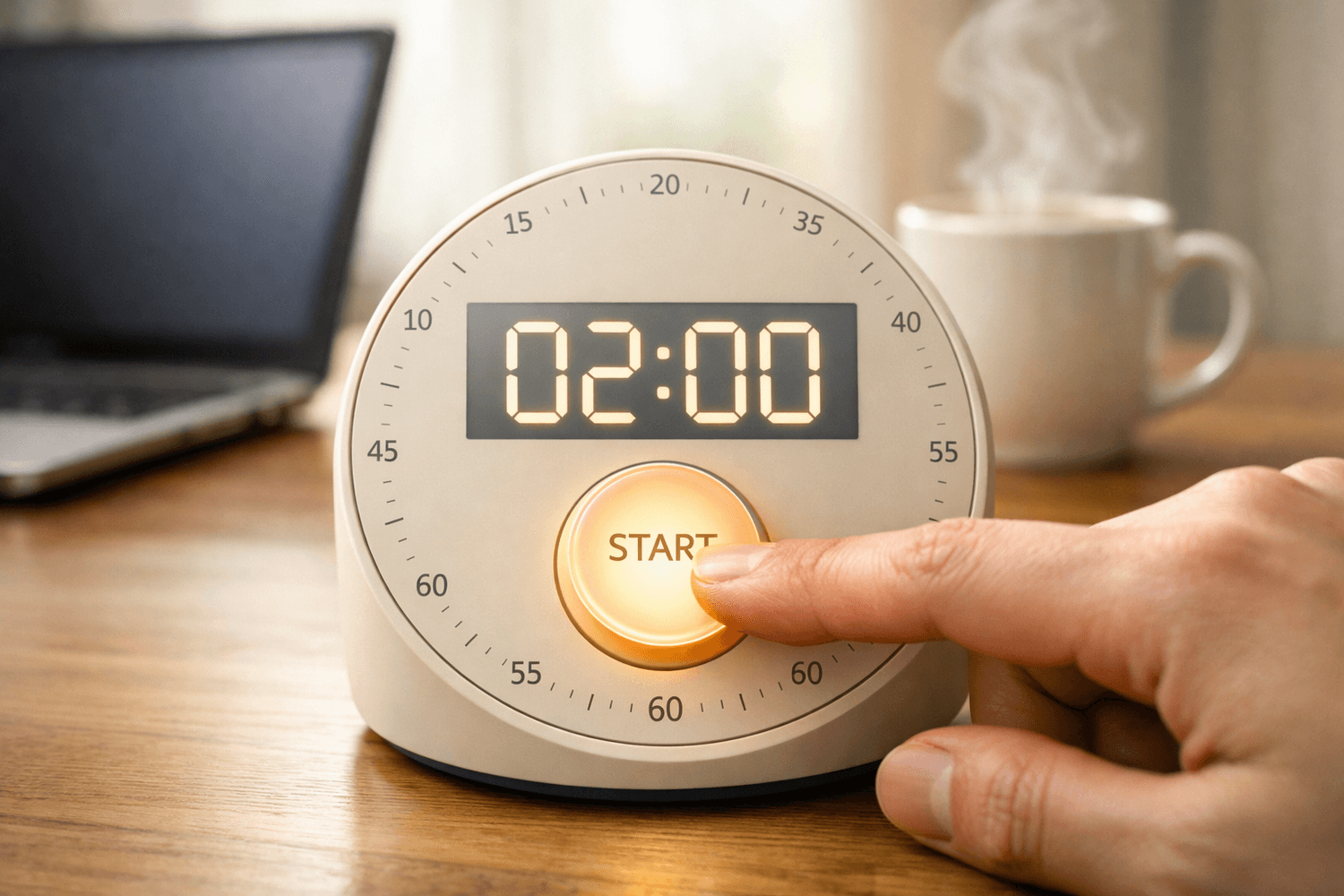
120-second launch
Set a timer for 120 seconds.
Do the smallest physical start: open the doc, write the title, create three bullets.
At 120 seconds, you may stop.
Most people don’t. Because the real enemy was the threshold, not the work.
Environment Rule: Make the Right Action the Default
Your environment is always coaching you—quietly, constantly.
Design it so “good behavior” is the easiest behavior:
Pin the work doc. Leave it open.
Put your phone in another room. Log out of social apps.
Create a start pad: notebook, pen, checklist visible where you sit.
Don’t rely on heroic self-control in a room built for distraction.
Time Rule: Timeboxing Beats To‑Do Lists
To-do lists are infinite. They make everything feel equally urgent and equally heavy.
Timeboxing is finite. It turns intention into a container.
Simple timebox format
“At 10:00, I will do X for 25 minutes.”
When you stop, leave yourself a breadcrumb: write the next action you’ll do next time.
Emotion Rule: "Name It to Tame It" + Micro‑Reframe
Procrastination is often emotion regulation disguised as time management.
When you name the feeling, you reduce its grip:
“I’m feeling anxious / bored / ashamed / overwhelmed.”
Micro‑reframe: “This feeling is a signal, not a command.”
Next: “What is the smallest safe step I can take right now?”
This emotional intelligence is central to neural reprogramming—learning to observe your patterns without being controlled by them.
How High Performers Think When They're Stuck
You now have the architecture: your type, your prescription, and the universal rules that apply to everyone.
But there's a gap most people don't talk about—the mindset layer.
Because high performers don't just use better systems. They think differently when progress stalls. They reframe faster. They don't wait for certainty. They treat friction like data, not failure.
I recorded a free video training that breaks down the 5 mindset shifts that separate people who stay stuck from people who move through it:
How to stop "waiting for clarity" and start building it in motion
Why motivation is overrated (and what replaces it)
The reframe that turns resistance into useful information
How to make decisions without needing guarantees
The single shift that collapses procrastination loops faster than any productivity hack
Watch: The 5 Mindset Shifts High Performers Use To Get Unstuck (Free Training)
This isn't theory. It's the cognitive operating system that makes everything else you just read stick.
"If This, Then That" Procrastination Troubleshooting
If you keep postponing even easy tasks…
Easy tasks can still carry emotional weight—especially if your inner narrator turns everything into a verdict.
Sometimes it’s shame. Sometimes it’s fatigue. Sometimes “easy” tasks are easy technically, but loaded socially (replying, asking, admitting, following up).
Try this
Use the 120-second launch to break the inertia.
Set a “good enough” finish line before you start.
If you feel depleted, choose one keystone task and call it a win.
If you plan perfectly but don’t start…
Planning can be a clever form of avoidance. It feels productive, looks responsible, and keeps you out of the arena where things can go wrong.
Try this
Set a hard ratio: 5 minutes planning → 15 minutes doing.
Use the Ugly First Draft protocol to force contact with reality.
If you only work under pressure…
That’s a learned loop: urgency gives you focus, and your brain has become dependent on the chemical upgrade.
Try this
Build micro-deadlines you can’t “reason” your way out of.
Add immediate rewards so progress pays you now, not someday.
If you feel guilty all day and still do nothing…
Guilt is a terrible fuel. It burns hot and leaves you emptier.
It also keeps the day emotionally noisy—which makes starting harder—so the loop feeds itself.
Try this
Replace guilt with specificity: “What is my next action, and when is my timebox?”
Use compassionate firmness: “Small counts. I’m going to start anyway.”
Tools to Stop Procrastinating Faster
Some people love building systems from scratch. Others want traction now.
If you’re in the second group, this section is for you—because reducing friction is a legitimate strategy, not a weakness.
Template Pack (Planner, Scripts, Scoreboards)
If you want speed, use assets that remove decision-making:
Diagnosis worksheet (printable scoring + archetype map)
Timebox planner (daily keystone + 2 deep-work blocks)
Boundary scripts sheet (People‑Pleaser)
UFD tracker (Perfectionist exposure reps)
Uncertainty reps log (Anxious Avoider)
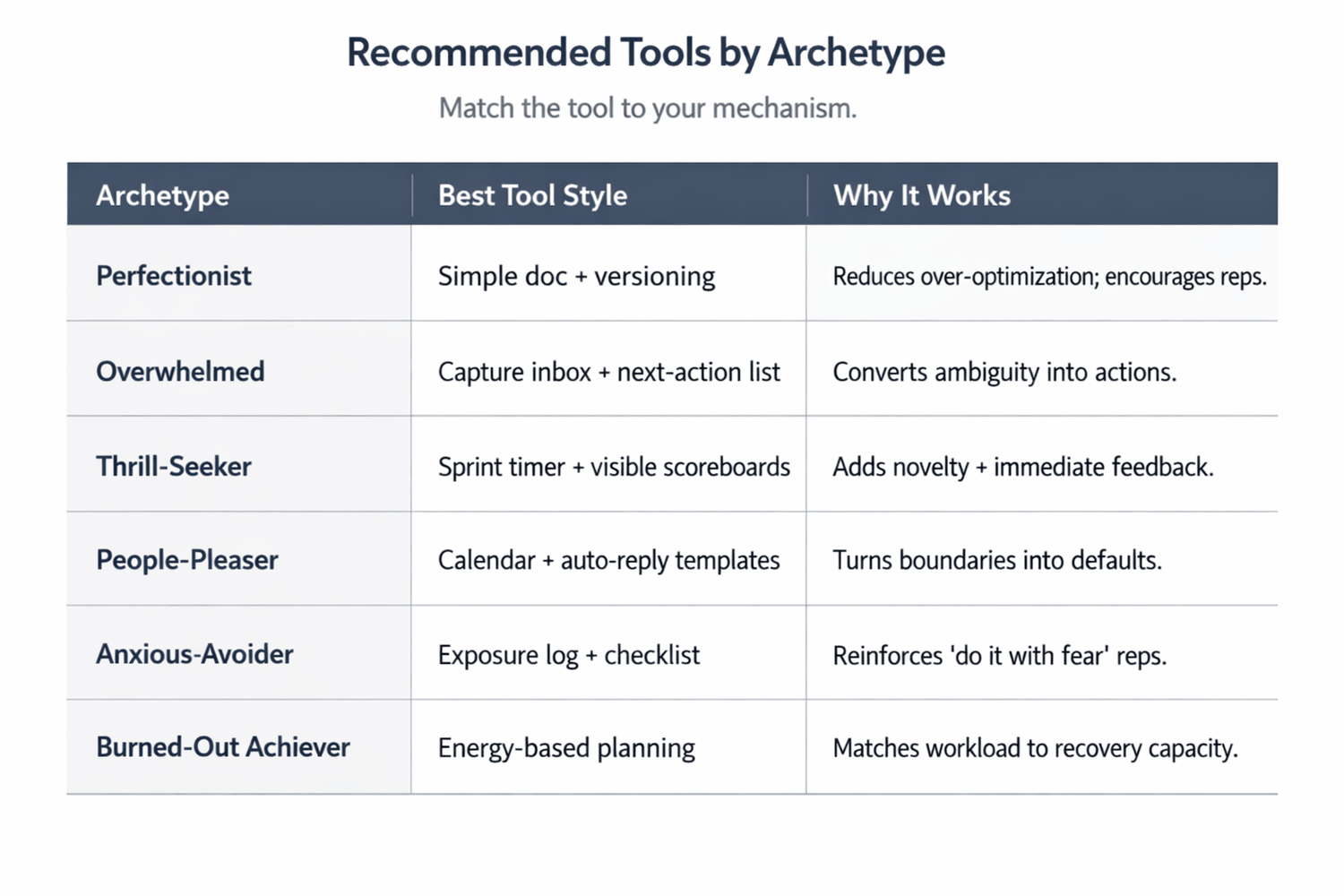
Best Tools by Procrastination Type (Apps + Analog)
Different brains stick to different supports. Match the tool to the mechanism.
Coaching vs. Course vs. Self-Serve (Decision Tree)
Be honest about what you need—because buying the wrong “solution” becomes another form of procrastination.
Choose self-serve if:
You can follow a plan once it’s clear.
Your main issue is structure, not emotional avoidance.
Choose a course if:
You want a step-by-step system with examples and a defined path.
You do well with frameworks and process.
Choose coaching if:
You know what to do but don’t do it (recurring relapse).
Boundaries, perfectionism exposure, or anxiety loops keep winning.
You want accountability plus personalization and constraints.
If you're ready for personalized, intensive support, learn about my 6-week MSIP coaching program and how it addresses procrastination at the identity and behavioral level.
Procrastination vs. ADHD vs. Anxiety (Quick Note)
This quiz is a coaching-oriented diagnostic, not a medical assessment. ADHD, anxiety disorders, depression, and burnout can all increase procrastination—sometimes dramatically. If you’ve had long-term struggles across multiple life areas (school, work, home) since childhood, consider talking to a clinician for a proper evaluation.
Procrastination Type Quiz FAQ
Okay, but what if this is ADHD and not a "type"?
It can be. And it’s worth taking seriously.
ADHD often affects executive function—task initiation, sustained attention, working memory, reward timing—so procrastination can show up as a daily pattern, not an occasional bad habit. At the same time, people without ADHD also procrastinate for reasons like anxiety, perfectionism, burnout, or unclear next actions.
If this has been persistent for years, shows up across settings (work, home, relationships), and causes real impairment, a professional evaluation can give you clarity—and options.
Is my procrastination basically anxiety?
Sometimes it’s so close it’s hard to tell where one ends and the other begins.
When anxiety spikes around uncertainty—emails, decisions, submissions, conversations—avoidance can become the fastest way to feel better. That immediate relief is exactly what reinforces the procrastination loop. That’s why approaches like ACT (Acceptance and Commitment Therapy) and exposure-based practice can be effective: they train you to move forward without waiting for certainty or calm.
Why do I procrastinate the things I care about most?
Because caring raises the stakes.
Meaningful work threatens the ego in a special way: if you try and it goes badly, it feels like you went badly. So your brain protects your identity by keeping the work hypothetical. Potential stays intact. Reality stays postponed.
The way out is not more pressure—it’s smaller starts, lower stakes, and repetition: Ugly First Draft, tiny commitments, timeboxing, and reps that teach your system, slowly and convincingly, that progress is survivable.
What are the types of procrastination?
Most frameworks cluster procrastination into patterns like perfectionism, overwhelm/ambiguity, anxiety-based avoidance, people-pleasing, thrill-seeking, and burnout. The names vary, but the mechanism is the same: avoiding discomfort.
Is procrastination a mental health issue?
It can be a habit, but it can also be linked to anxiety, depression, ADHD, or chronic stress. If procrastination is impairing your life, professional support can help.
What's the best way to stop procrastinating?
The best method depends on the “why.” If it’s overwhelm you need clarity and the smallest next step; if it’s perfectionism you need minimum-viable standards; if it’s anxiety you need exposure and self-soothing skills.
Can a procrastination quiz really help?
A good quiz helps you stop using generic advice. The value is matching the intervention to the root cause.
What if I match multiple types?
That’s normal. Use the highest score as your primary type and the second highest as your secondary; start by fixing the primary.
Products / Tools / Resources
Start here (free foundational resources)
Before you buy anything or add another app to your collection, grab these two—they're built to give you traction fast, and they're free.
1. Pattern Recognition Test (3 minutes)
Procrastination has a surface pattern (your archetype) and a deeper one (your mental imposter type). This test identifies the internal script running underneath the delay—plus you get the Inner Critic Contract Audit Workbook that shows you how to rewrite it.
➡️Take the Pattern Recognition Test (Free)
2. The 5 Mindset Shifts High Performers Use To Get Unstuck (Free Video Training)
The cognitive operating system that separates people who stay stuck from people who move through it. This is the thinking layer that makes all the tactics actually stick.
➡️Watch the Free Training
Printable + analog (low-friction, high follow-through)
Diagnosis Worksheet (Printable): The 8-question checklist + scoring buckets you can keep on your desk.
Timebox Planner Sheet: One daily keystone, two focused blocks, and a shutdown line (so work doesn’t leak into everything).
UFD Tracker (Perfectionist): A simple “exposure reps” log—date, what you shipped, how imperfect it was, what happened (spoiler: you survive).
Uncertainty Reps Log (Anxious Avoider): 2-minute exposures, tracked like strength training.
Boundary Scripts Card (People‑Pleaser): A single page you can glance at before replying to requests.
Apps (pick one—don’t collect them)
Sprint timer (Thrill‑Seeker): Any timer that supports 25-minute sprints + visible streaks/scoreboards.
Capture + clarify system (Overwhelmed / GTD entity): A notes app or task manager with an inbox you actually use, plus a “Next Actions” list.
Website blocker / focus mode (Universal): Something that adds just enough friction to stop autopilot scrolling mid-task.
Books / frameworks (for deeper pattern change)
ACT-based resources (Anxious Avoider): Look for ACT workbooks focused on anxiety, uncertainty tolerance, and values-based action.
GTD-style workflow guides (Overwhelmed): Anything that teaches capture → clarify → next action mapping without turning into perfectionism fuel.
Burnout and recovery resources (Burned‑Out Achiever): Evidence-informed material on stress load, sleep, and sustainable workload design.
When to consider professional support
Coaching: If you want accountability, boundary work, or perfectionism exposure support with customized constraints.
Therapy (especially ACT/CBT-informed): If anxiety, avoidance loops, or self-worth fusion are driving the procrastination.
Medical evaluation: If ADHD symptoms, persistent depression/anhedonia, or severe burnout are present and impairing daily function.
About the Author
By Milan | Founder of Milan'Z Coaching | NLP & Hypnotherapy Master Practitioner | Neural Reprogramming Coach | Creator of MSIP | Helping entrepreneurs and high-achieving professionals overcome imposter syndrome, self-doubt, and limiting beliefs since 2014. [About Milan]





UNLOCK FREE MINDSET TRAININGS & EXCLUSIVE DISCOUNTS YOU WON'T FIND ANYWHERE ELSE!
Subscribe to the newsletter and join driven entrepreneurs, solopreneurs, executives, business owners, and high-achieving professionals on a mission to become unstoppable forces for good.
GET MINDSET STRATEGIES DELIVERED TO YOUR INBOX
Unlock free mindset trainings, neural reprogramming techniques, and
exclusive discounts. Join entrepreneurs, executives, and high-achievers
breaking through their mental blocks.
CONNECT WITH MILAN
Got questions about Breakthrough Coaching or Neural Reprogramming?
Send me a message—I read every email.
FREE RESOURCES
© 2026 Milan'Z Coaching