Entrepreneur Mindset Shift: 5 Identity Changes That Make Self-Discipline Effortless
If you searched for an entrepreneur mindset shift that finally makes self-discipline effortless, here's the truth most advice skips: you don't have a willpower problem—you have an identity problem. Most entrepreneurs don't fail because they lack discipline. They fail because they're fighting their own identity every single day, and identity always wins.
You've felt it. The 5 a.m. alarm you negotiate with. The cold outreach you postpone until it's "the right time." The deep-work block that dissolves into seventeen browser tabs. You blame willpower, download another productivity app, and start again Monday. But here's the uncomfortable truth that high-performers eventually discover: self-discipline isn't a muscle you strain—it's a byproduct of who you believe you are. When your identity changes, the behavior stops requiring force. It becomes the path of least resistance.
This article maps the five specific identity shifts that turn grinding self-control into effortless default behavior. Not hacks. Not morning routines. Architectural changes to the self-concept that drives every decision you make before you're even conscious of making it.
A note on where this comes from: over the past twelve years I've coached more than 400 founders and senior operators through performance plateaus. The five shifts below aren't theory I read once — they're the patterns that showed up again and again in the clients who broke through, contrasted against the ones who stayed stuck.
If you’re stuck in the ‘I know what to do but I can’t do it’ loop, start with the knowing-doing gap in entrepreneurs (6 brain-based fixes).
What Is an Entrepreneur Mindset Shift? (The Short Answer)
An entrepreneur mindset shift is the transition from behavior-based effort (forcing yourself to act through willpower) to identity-based action (acting automatically because the behavior aligns with who you believe you are). Self-discipline becomes effortless when the disciplined action stops competing with your identity and starts expressing it.
In one sentence: You don't rise to the level of your goals; you fall to the level of your identity. Change the identity, and the discipline follows without negotiation.
That's the snippet-ready version. Now let's go deep—because the mechanism behind that sentence is where the real transformation lives.
Why Willpower-Based Self-Discipline Always Collapses
Before the five shifts, you need to understand why the conventional model is broken.
Willpower runs out. It works like a battery that drains under pressure. Early research by psychologist Roy Baumeister popularized this "ego depletion" effect, and while the science has been actively debated since, the lived experience is undeniable: every time you force yourself to act, you create a gap between what you're doing and how you see yourself. Psychologists call this cognitive dissonance, and your brain treats it as a threat to shut down fast. The easy fix is to quit the behavior. The hard fix is to keep grinding. Most people, most days, pick the easy one. Not because they're weak, but because the human nervous system is built to save energy and avoid internal conflict.
This is why behavior-first approaches—habit stackers, accountability apps, reward systems—work for a few weeks and then quietly die. They treat the symptom (inconsistent action) instead of the source (a misaligned identity). You're trying to out-discipline your own self-concept, and your self-concept has home-field advantage. In my years coaching founders through performance plateaus, I've watched this pattern repeat in nearly every client who arrived convinced they were "lazy"—they weren't lazy at all; they were misaligned.
The entrepreneurs who appear superhuman—the ones who train at dawn, ship relentlessly, and say no without anguish—aren't burning more willpower than you. They've engineered identities where the disciplined behavior is the default. There's no internal war because both sides of the table are on the same team.
So the question isn't "How do I get more discipline?" It's "Who would I have to become for this discipline to feel automatic?" That reframe is the doorway. Let's walk through the five rooms.
If your identity cracks into ‘I’m a fraud’ at the next level, use how to overcome imposter syndrome as an entrepreneur as your practical reset.
The 5 Identity Changes That Make Self-Discipline Effortless
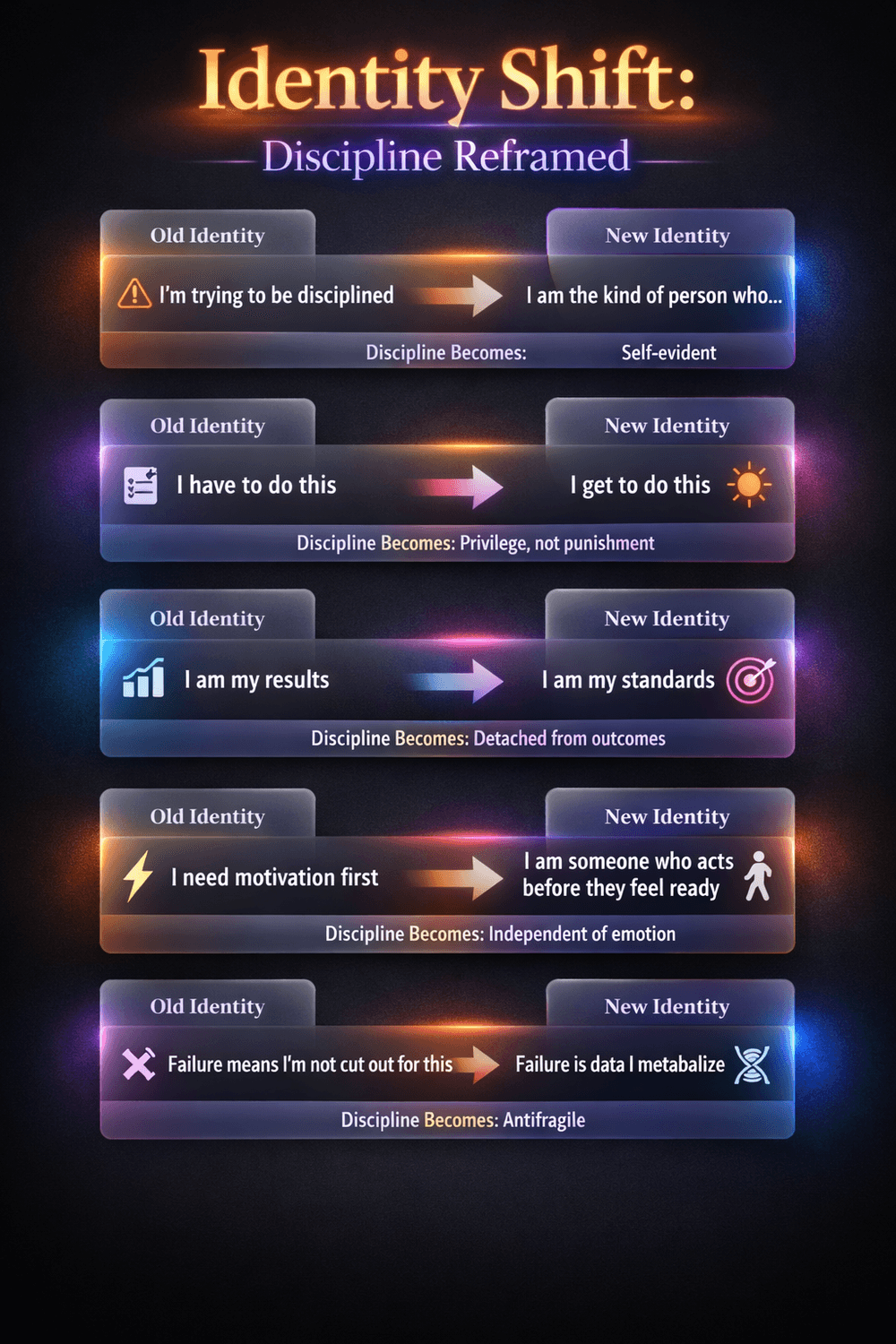
This identity-based approach echoes the core argument James Clear makes in Atomic Habits: that lasting change is identity change, not outcome change. Read that table twice. Then let's build each one into something you can actually live inside.

Identity Shift #1: How to Use Identity-Based Habits to Build Self-Discipline
The single most powerful word in the disciplined entrepreneur's vocabulary is "am."
Watch the linguistic tell. Strugglers say, "I'm trying to wake up early." Builders say, "I'm an early riser." The first frames the behavior as an external task you're attempting against your nature. The second frames it as an expression of your nature. One requires willpower every morning. The other requires nothing—because going against it would feel unlike you, and humans are exquisitely motivated to act consistently with their self-image.
This is identity-based habit formation, and it works because of a principle behavioral scientists call self-signaling: every action you take is a small vote for the kind of person you believe yourself to be. Skip the workout and you cast a vote for "someone who skips." Do the cold calls and you reinforce "someone who shows up." Over time, the accumulated votes don't just change your behavior—they rewrite the story you tell yourself about yourself.
The practical move: Stop setting outcome goals and start declaring identity statements. Don't say "I want to write a book." Say "I am a writer"—then ask what a writer does today. The behavior flows downhill from the identity instead of being dragged uphill toward a goal.
Here's the curiosity loop I want you to hold: if a single word can change your behavior, what happens when you change the entire emotional frame around the work itself? That's Shift #2.
Identity Shift #2: Reframe "I Have To" Into "I Get To" for Lasting Motivation
There's a quiet phrase that sabotages more entrepreneurs than any market downturn: "I have to."
"I have to make sales calls." "I have to post content." "I have to grind." Every one of those statements positions the work as a burden imposed from outside—a tax on your freedom. And the brain treats burdens the way it treats threats: with avoidance, procrastination, and resentment. You can't be effortlessly disciplined about something you secretly resent.
Now run the swap. "I get to." "I get to build something that didn't exist yesterday." "I get to talk to people who might transform their lives with what I've made." "I get to do work most people are too afraid to attempt." This isn't toxic positivity or affirmation theater. It's a structural reframe of agency. Obligation lives outside you; privilege lives inside your choices. The instant the work becomes something you chose rather than something you're enduring, the friction collapses.
This shift maps directly onto the autonomy dimension of intrinsic motivation described in Self-Determination Theory, the research framework developed by psychologists Edward Deci and Richard Ryan. Behavior driven by external pressure (introjected regulation) is fragile and exhausting. Behavior driven by personal value and ownership (integrated regulation) is durable and energizing. The disciplined entrepreneur isn't tolerating the grind—they've claimed it as an expression of who they are and what they value.
The practical move: For one week, catch every "I have to" and physically rewrite it as "I get to." Notice which tasks resist the reframe—those are the ones either misaligned with your real values (cut them) or buried under a story you've outgrown (rewrite them).
But reframing the work only holds if you're not emotionally hostage to its results. Which brings us to the deepest shift of all.

Identity Shift #3: How to Stop Tying Self-Worth to Business Results
This is the one that breaks people, and the one that, once integrated, makes you nearly unstoppable.
Most entrepreneurs fuse their identity to their outcomes. A good launch means "I'm brilliant." A flat month means "I'm a fraud." This emotional leverage feels like motivation early on, but it's a trap. Outcomes are governed by variables outside your control—market timing, algorithm changes, luck, macroeconomics. When your self-worth rides on uncontrollables, your discipline becomes a hostage to circumstances you can't influence. One bad quarter and the identity cracks, and the discipline crumbles with it.
The shift is to anchor identity to standards rather than outcomes—to the quality of action you control rather than the results you don't. "I am someone who ships excellent work consistently" is a standard. "I am someone who built a seven-figure company" is an outcome. The first is available to you every single day regardless of the market. The second can be taken away by forces you'll never meet.
This is the entrepreneurial expression of what high-performers across every domain—elite athletes, surgeons, special forces operators—converge on: process over outcome. They've decoupled their sense of self from the scoreboard and welded it to the standard of their execution. The paradox is that this detachment produces better outcomes, because the energy formerly spent on anxiety and self-protection gets reinvested into the work itself.
The practical move: Define your non-negotiable standards—the inputs you control daily. Did I do the deep work? Did I show up with full effort? Did I uphold my quality bar? Grade yourself on those, not on revenue. The revenue is a lagging indicator of standards held over time.
Hold that thread, because it leads directly to the question that stops most people cold: what do you do when you don't feel like it?
If discipline collapses every time results dip, it usually means your identity is tied to the wrong layer—this breakdown of self-worth vs self-esteem vs confidence will help you anchor to something stable.
Here's the catch: the specific way your identity cracks isn't random. It follows a pattern — and most founders have no idea which one is running them. Some collapse into "I'm a fraud" (the Imposter). Some swing into frantic overwork (the Proving Machine). Some quietly avoid the work that might expose them (the Hider). Until you can name your pattern, you'll keep treating the symptom instead of the source.
→ Take the free 3-minute Pattern Recognition Test and discover your personal Mental Imposter Type — plus get instant access to The Inner Critic Contract Audit Workbook that rewires it.
Then come back, because the rest of this shift only works once you know which pattern you're up against.
Identity Shift #4: How to Build Self-Discipline Without Motivation
Here is the lie that keeps an entire industry of motivational content in business: the belief that you need to feel motivated before you act.
Can you build self-discipline without motivation? Yes—and it's the skill that separates pros from amateurs. Amateurs wait for the feeling. Professionals have cut the wire between emotion and action completely. The disciplined entrepreneur's defining trait isn't that they feel motivated more often. It's that they've stopped asking how they feel before they start. They act first. The motivation shows up later, pulled along by momentum.
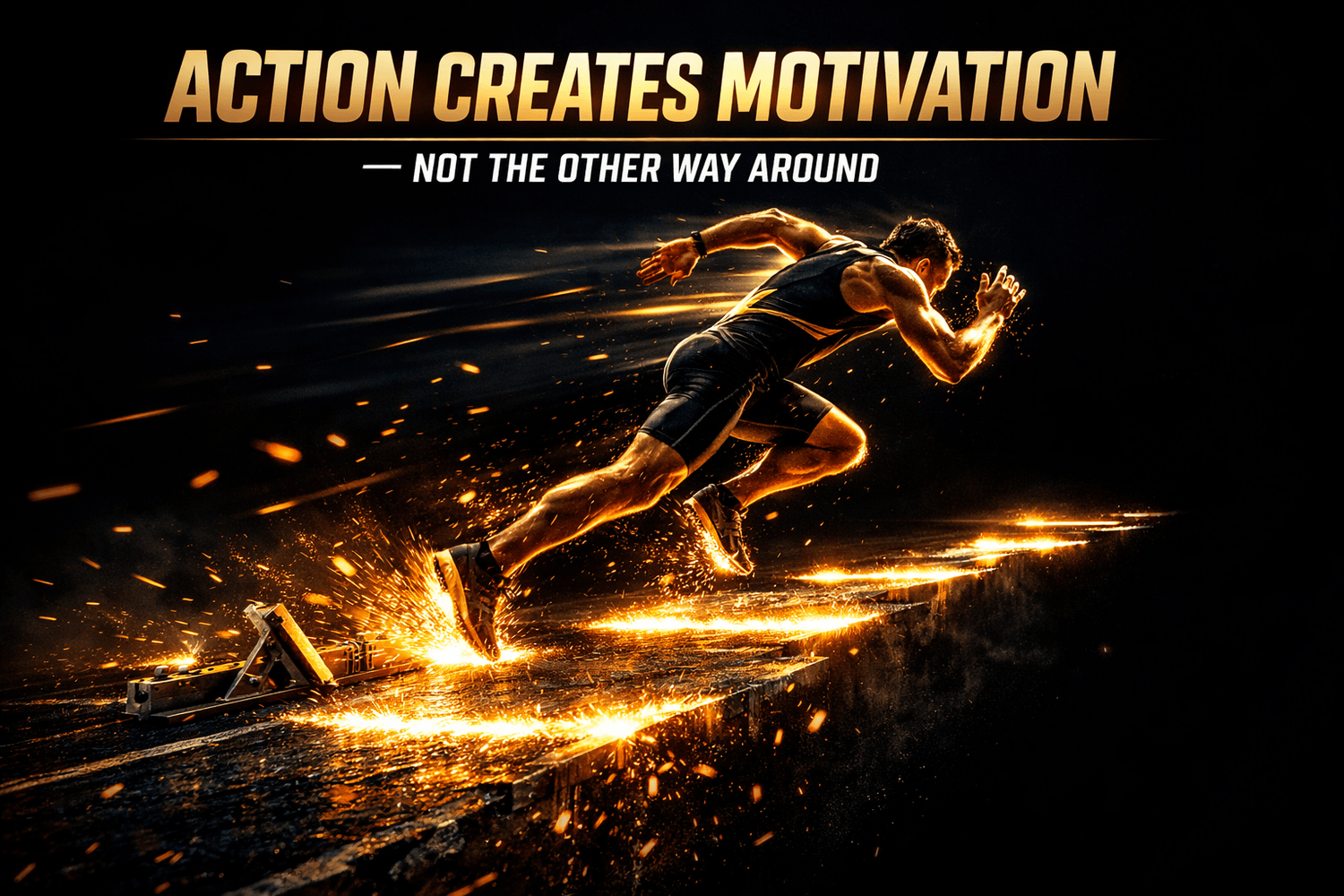
This inverts the cultural script. We're taught: motivation → action. The reality high-performers live by is: action → momentum → motivation. You don't think your way into right action; you act your way into right thinking. The hardest part is always the first repetition—the moment before the feeling has caught up. Build an identity around being someone who initiates in the absence of readiness, and you become immune to the single most common cause of entrepreneurial stagnation: waiting.
This is why "discipline equals freedom" is more than a slogan. When your action no longer depends on your emotional weather, you become reliable to yourself. And self-trust—the earned confidence that you'll do what you said regardless of how you feel—is the bedrock of effortless discipline. Every kept promise to yourself compounds into an identity that simply does the thing, no debate required.
The practical move: Adopt a starting ritual so small it's impossible to refuse—open the doc, put on the shoes, dial the first number. Make your identity about beginning, not about feeling ready. The feeling is not your responsibility. The first move is.
And yet, even the most disciplined operator will face the thing they fear most: failure. The final shift determines whether failure ends you or fuels you.
Identity Shift #5: How to Turn Failure Into Fuel With an Antifragile Mindset
The last identity change is the one that lets all the others survive contact with reality.
For the fragile entrepreneur, failure is a verdict—proof that they don't belong, a wound to the identity that triggers retreat. For the antifragile entrepreneur, failure is information. It's raw material the system digests to grow stronger. Same event. Two different identities, so two different responses. One person sees a closed door and goes home. The other sees a closed door and updates the map.
This is the difference between a fixed self-concept and a growth-oriented one—the distinction Stanford psychologist Carol Dweck spent decades documenting in her research on mindset. When your identity is fixed ("I either have what it takes or I don't"), every setback is existential, and discipline collapses under the weight of self-protection—because the safest way to never fail is to never fully try. When your identity is built around growth and adaptation ("I am someone who gets better through iteration"), failure loses its power to stop you. It can't threaten an identity that feeds on it.
The most resilient founders narrate their failures as chapters, not endings. "That launch flopped" becomes "that launch taught me my positioning was off." The reframe isn't denial—it's metabolism. They extract the lesson, discard the shame, and re-engage. This is what makes their discipline durable: it doesn't require a perfect track record to keep functioning. It's been engineered to operate in a world where loss is guaranteed and persistence is the only real edge.
The practical move: After every setback, run three questions—What actually happened (facts, not story)? What's the lesson? What's the next action? Refuse to let your brain answer the fourth question it desperately wants to ask: "What does this say about me?" That question is a trap. You are not your failures. You are what you do next.

How These 5 Identity Shifts Compound Into Effortless Discipline
Notice the architecture. These aren't five separate tactics—they're a single integrated identity, each shift reinforcing the others.
You declare who you are (Shift 1), so the behavior expresses identity rather than fighting it. You frame the work as a privilege (Shift 2), so it energizes instead of depletes. You anchor your worth to standards, not outcomes (Shift 3), so external chaos can't shake your consistency. You act before you feel ready (Shift 4), so motivation never becomes a bottleneck. And you metabolize failure (Shift 5), so the whole system survives the inevitable setbacks. Together, they produce a person for whom discipline isn't an act of will—it's simply the shape of their character in motion.
The discipline becomes effortless not because the work gets easier, but because you've stopped being someone who has to be forced to do it.
Reading about these shifts and installing them are two different things. If you want to watch exactly how high performers run this in real time — the words they use, the moment they make the switch, and how they get unstuck when they stall — I put it on video.
→ Watch the free training: The 5 Mindset Shifts High Performers Use to Get Unstuck. It's the over-the-shoulder version of everything you just read, in under 20 minutes.
Frequently Asked Questions About the Entrepreneur Mindset Shift
How long does an entrepreneur mindset shift actually take?
Identity change isn't a single event but an accumulation of consistent self-signaling actions. Most people notice the internal frame shifting within two to four weeks of deliberate practice, but durable rewiring—where the new identity becomes automatic—typically takes two to three months of repeated votes for the new self-concept. In my coaching practice, the founders who commit to one shift daily tend to report it feeling "automatic" somewhere around the 8–12 week mark. The speed depends less on time and more on the consistency and emotional weight of each reinforcing action.
Can you build self-discipline without motivation?
Yes—and learning to act independent of motivation is precisely the skill that defines disciplined entrepreneurs (see Identity Shift #4). Motivation is an unreliable emotional weather pattern. Discipline rooted in identity and triggered by small starting rituals functions regardless of how you feel, with motivation arriving as a byproduct of momentum rather than a prerequisite for action.
What's the difference between motivation and discipline?
Motivation is a feeling that fluctuates and depends on external or emotional triggers. Discipline is a structure—and when built on identity rather than willpower, it's a default behavior that doesn't require feeling motivated. Motivation gets you started occasionally; identity-based discipline keeps you consistent permanently.
Why does willpower fail for most entrepreneurs?
Willpower depletes under cognitive load and creates friction whenever a forced behavior conflicts with your self-image. That internal conflict (cognitive dissonance) usually resolves by abandoning the behavior. Identity-based discipline eliminates the conflict by aligning the behavior with who you believe you are, removing the need for willpower in the first place.
What is identity-based self-discipline?
It's the practice of changing your underlying self-concept so that disciplined behaviors become automatic expressions of who you are rather than tasks you force yourself to complete. Instead of "I'm trying to exercise," it becomes "I'm an athlete." The behavior follows the identity downhill instead of being dragged uphill toward a goal.
How do I stop tying my self-worth to my business results?
Anchor your identity to standards you control (effort, quality, consistency) rather than outcomes you don't (revenue, market response, luck). Grade yourself daily on inputs, not results. This detachment—paradoxically—tends to improve outcomes because energy shifts from anxiety and self-protection into the work itself.
The Bottom Line
So stop hunting for more discipline. You won't find it, because it was never the thing you were missing. The entrepreneur mindset shift that actually works isn't about forcing harder—it's about becoming someone the disciplined action belongs to. The founders who make it look effortless aren't tougher than you. They just stopped fighting themselves. Pick the one shift on that list that made you flinch as you read it—the one your current identity is most afraid to let go of—and live inside it for the next seven days. Not all five. One. That's where this starts.
About the Author
By Milan | Founder of Milan'Z Coaching | NLP & Hypnotherapy Master Practitioner | Neural Reprogramming Coach | Creator of MSIP | Helping entrepreneurs and high-achieving professionals overcome imposter syndrome, self-doubt, and limiting beliefs since 2014. [About Milan]





UNLOCK FREE MINDSET TRAININGS & EXCLUSIVE DISCOUNTS YOU WON'T FIND ANYWHERE ELSE!
Subscribe to the newsletter and join driven entrepreneurs, solopreneurs, executives, business owners, and high-achieving professionals on a mission to become unstoppable forces for good.
GET MINDSET STRATEGIES DELIVERED TO YOUR INBOX
Unlock free mindset trainings, neural reprogramming techniques, and
exclusive discounts. Join entrepreneurs, executives, and high-achievers
breaking through their mental blocks.
CONNECT WITH MILAN
Got questions about Breakthrough Coaching or Neural Reprogramming?
Send me a message—I read every email.
FREE RESOURCES
© 2026 Milan'Z Coaching