
Self-Worth vs Self-Esteem vs Confidence: How to Tell the Difference and Improve the Right One
Most people try to fix confidence when the real leak is self-worth or self-esteem. This article explains the 3‑layer model (self‑worth = identity; self‑esteem = internal evaluation; confidence = task ability), gives a 3‑question diagnostic to find your weakest layer, and step‑by‑step exercises to rebuild each one.
Self-Worth vs Self-Esteem vs Confidence — The 30-Second Answer
Self-worth, self-esteem, and confidence are three separate layers of self-concept. Self-worth is your inherent value as a person, independent of performance. Self-esteem is your fluctuating self-evaluation, shaped by comparison and results. Confidence is your belief you can do a specific task, built through skills and reps. Fix the wrong layer and nothing sticks.
Confidence is the "I can do this" layer—specific, trainable, and attached to a domain. This maps directly to what psychologist Albert Bandura named self-efficacy: your belief in your capacity to execute a specific task. Self-esteem is your running self-review, the internal rating system that spikes and dips with standards and comparison—the construct Nathaniel Branden spent his career mapping. Self-worth sits underneath both: the quiet, non-negotiable truth that you matter even when you're not impressive, productive, or liked.
If you build these in the wrong order, you can stack wins all day and still feel strangely hungry at night. The fast relief comes from one move: identify which layer is missing and repair that—not the one that feels most convenient to work on.
As a coach who has run this 3-layer model with hundreds of high performers, I can tell you the pattern is almost always the same: the person grinding hardest on confidence is usually nursing a self-worth wound they've never named. Research backs this up—a long-running Dunedin study of more than 1,000 New Zealanders found that low self-esteem in adolescence predicts worse mental and physical health, fewer economic prospects, and more criminal behavior in adulthood. The layers are not a self-help abstraction. They shape real outcomes.
Self-Worth, Self-Esteem and Confidence Defined in One Line Each
Self-worth = your inherent value as a person (non-performance-based)
Self-esteem = your evaluation of yourself (often comparison/performance-influenced)
Confidence = your belief you can do a specific thing (domain-based, skill-linked)
Self-Worth vs Self-Esteem vs Confidence Comparison Table
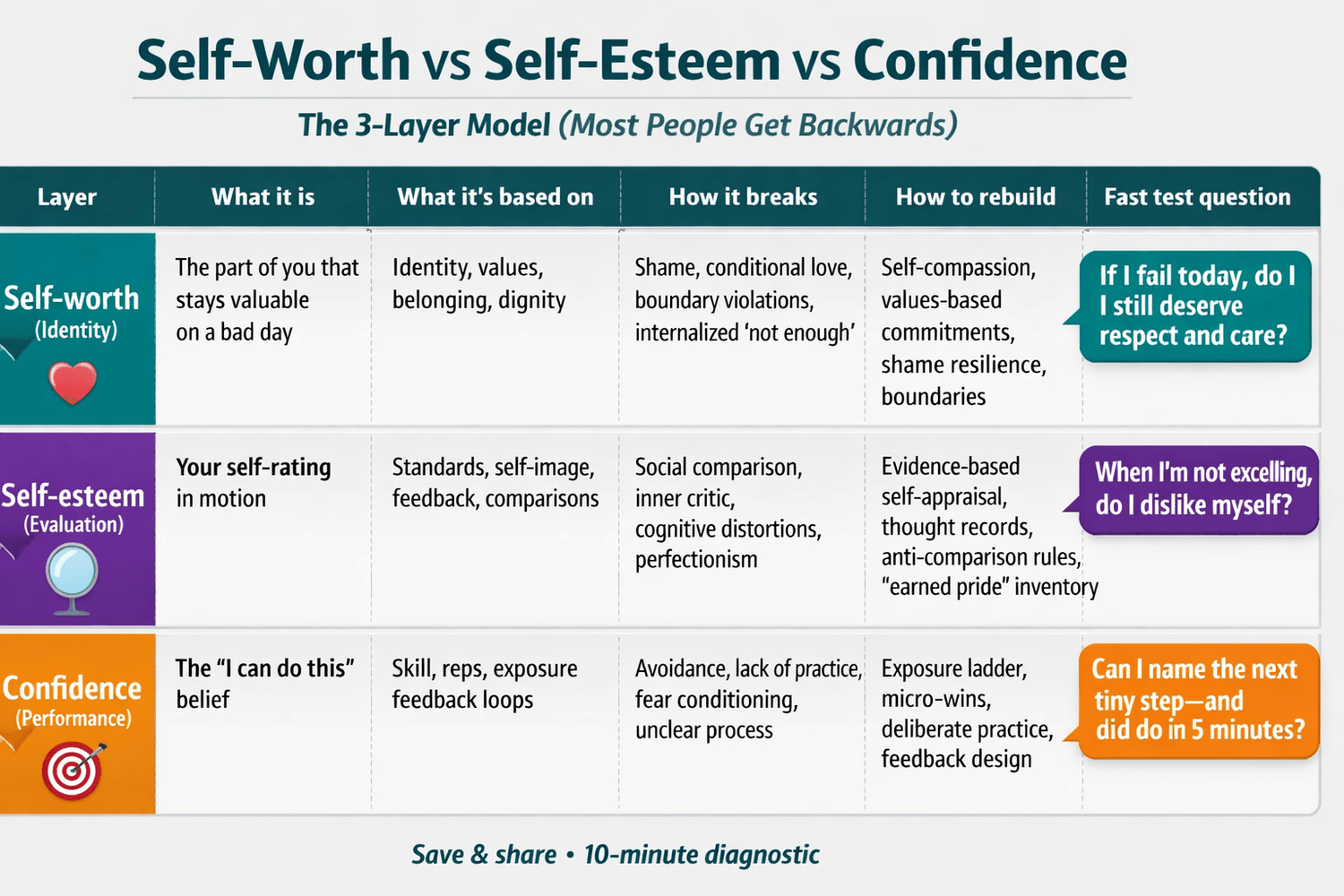
Ask yourself these 3 questions — the layer you answer “yes” to most often is likely your weakest link:
Do I feel unworthy even when I’m successful? → Self‑Worth
Do I constantly compare and feel better or worse based on achievements? → Self‑Esteem
Do I know what to do but avoid trying because I fear failure? → Confidence
How to Tell Which Layer Is Your Weakest (3-Question Diagnostic)
Don't journal. Don't litigate your childhood. Just answer.
After a mistake, do you feel "I did something bad" or "I am bad"? If it's I am bad, that's a self-worth leak—the shame kind, the identity kind.
When someone else wins, do you shrink—even if your life is objectively fine? That's usually self-esteem volatility, driven by comparison and status signals.
Do you believe you have value, but your body locks up in specific moments (socially, speaking up, dating, interviews, conflict)? That's a confidence gap—domain-based, skill-linked, exposure-dependent.
A quick rule that almost always holds: global pain = worth. ranked pain = esteem. situational fear = confidence.
Find Your Mental Imposter Type (2-Minute Next Step)
If those 3 questions hit a little too accurately, don't guess which layer you're fighting. Take the Pattern Recognition Test—it tells you your mental imposter type and exactly how it shows up under pressure. When you opt in, you'll also get The Inner Critic Contract Audit Workbook so you can start rewriting the loop immediately.
→ Take the Pattern Recognition Test (free short quiz)
The Self-Worth vs Self-Esteem vs Confidence 3-Layer Model Explained
Picture your self-concept like a three-story structure.
Self-worth is the foundation. It’s identity. It’s dignity. It’s what remains when the day didn’t go your way.
Self-esteem is the mirror. It’s your evaluation layer—how you interpret your performance, your appearance, your social standing, your “shoulds.”
Confidence is the muscle. It’s self-efficacy in motion: Can I do this specific thing, in this specific context, with my current skills?
Here’s where most people get it backwards: they try to build the top floor first. They chase confidence—skills, achievements, optics—hoping it will drip downward into esteem and worth. Sometimes it does. Briefly. Then life gets quiet and the old question returns, sharper than before: Okay, but am I still okay if I’m not winning?
This three-layer gap is exactly why so many capable founders still feel fake — it's the foundation beneath imposter syndrome in entrepreneurs.
Signs of Low Self-Worth, Low Self-Esteem, and Low Confidence
Before you rebuild a layer, you have to spot which one is failing. Here's what each looks like in real life. Low self-worth shows up as feeling "not enough" even after success, minimizing your own needs, and tolerating poor treatment. Low self-esteem shows up as mood that swings with results and comparison. Low confidence shows up as avoidance—knowing you could do something but freezing before you start.
If your self-esteem drops in silence, start here: how to stop negative self‑talk when you’re alone.
How to Build Self-Worth (Identity Layer)
Self-Worth (identity layer) is the belief that you are inherently valuable as a human being, independent of performance, titles, or approval. It's the quiet baseline that determines whether you give yourself care, set boundaries, or tolerate shame.
Signs of low self-worth:
You chronically minimize your needs, accept poor treatment, feel "not enough" even after success, or silence yourself to avoid rejection.
Why it breaks:
Low self-worth is usually shaped by early relational experiences (shame, neglect, conditional love) and reinforced by social comparisons. Shame researcher Brené Brown calls the antidote shame resilience—the skill of staying grounded in your worth even when you feel exposed.
How to rebuild:
Values clarification: write your top 5 values and list 3 small actions this week that honor each value.
Shame resilience: when you notice shame, name the trigger, label the feeling, and practice a compassionate self-response.
Boundaries practice: identify one relationship where you'll set a small boundary this week and follow through.
How to Build Self-Esteem (Evaluation Layer)
Self-Esteem is your internal evaluation of yourself across areas (appearance, competence, social value). It fluctuates with comparisons and wins/losses and often creates the rollercoaster mood tied to achievement.
Signs: You feel proud or worthless depending on results, you measure yourself by comparison, and social feedback strongly shifts your self-view.
How to rebuild:
Earned-pride inventory: weekly list of 3 things you did well and why they matter.
Comparison rules: limit social media time, and when you compare, ask "what's different about their situation vs mine?"
Cognitive audit: note automatic negative judgments and challenge them with evidence.
How to Build Self-Confidence (Skill Layer)
Confidence is the belief in your ability to perform specific tasks. It's domain-specific, built by practice and corrective feedback, and tends to be the most changeable layer in the shortest time. This is exactly why people ask how to build self-confidence and get stuck—they look for a feeling when what actually works is collecting evidence through reps.
Signs: You avoid tasks despite knowing you could learn them, you feel nervous before action, or you rely on perfection to start.
How to rebuild:
Exposure ladder: break a feared task into 8 micro-steps from tiny to challenging and practice step 1 for a week.
Practice with feedback: schedule short deliberate practice sessions and seek one specific piece of feedback each time.
Micro-wins log: track tiny successes to create evidence of ability.
Why You Feel Bad Even When You Succeed (Achievement Trap + Comparison Spiral)
If you’ve ever thought, My life looks good—why do I feel like this? you’re not broken. You’re misaligned.
One layer can be thriving while another is starving. That mismatch creates a special kind of confusion: the kind that makes you doubt your own reality.
The Achievement Trap Loop: Confidence Rises, Self-Worth Stays Hungry

You get competent. Your confidence climbs. You can do hard things.
People notice. Feedback comes in. Your self-esteem gets a hit—clean and bright, like a shot of oxygen.
Then the moment passes. The room is quiet. The praise is over. And self-worth, the foundation, asks the question confidence can't answer: Am I still safe if I stop performing?
If the honest answer feels like no, you don't rest. You reach. You chase. You set a new goal, not because it excites you, but because it soothes you.
The Comparison Spiral Loop: Self-Esteem Drops Even When Life Is Fine

Nothing terrible has happened. Your day is fine.
Then you see someone else—better body, bigger launch, happier relationship, cleaner morning routine, shinier success. Your brain doesn't merely notice difference. It converts difference into deficiency.
Self-esteem drops. Motivation turns brittle. You either overwork with a quiet panic or disengage with a numb shrug. Both paths reinforce the same story: I'm behind.
The Avoidance Tax Loop: Low Confidence Means Less Evidence

Anxiety shows up before the task.
You avoid it. Relief arrives instantly. Your nervous system logs the lesson: Avoidance equals safety.
But then you pay interest. Because you didn't get the rep, you didn't get evidence. Because you didn't get evidence, you can't trust yourself next time. Confidence stays low, not because you're incapable, but because you never got a clean chance to prove capability to your own brain.
Real-World Self-Worth and Confidence Patterns People Search For
"I Feel Worthless But I'm Good at My Job" (Worth Deficit, Confidence Intact)
This one is brutal precisely because it’s confusing.
You can function. You can perform. You can even excel. In meetings, you’re competent. In deadlines, you deliver. Your confidence in the domain is real.
And yet, internally, you feel disposable—like if you stopped being useful, you’d stop being lovable.
That’s typically a self-worth deficit wearing a successful outfit. The fix is not more achievement. The fix is identity stabilization: dignity, values, shame resilience, boundaries.
"I'm Confident Sometimes, Then Crash" (Self-Esteem Volatility + Comparison Triggers)
You can feel solid… until you’re watched, judged, ranked, or compared.
Sometimes it’s obvious—social media, performance reviews, dating apps, competitive friends. Sometimes it’s subtle—tone shifts, delayed texts, a tiny facial expression you interpret as disappointment.
That pattern often points to self-esteem volatility. Your evaluation layer is reactive. Your internal critic has an easy job because the environment keeps feeding it.
"I Know I'm Valuable, But I Freeze Socially" (Confidence Deficit, Worth Intact)
This is more common than people admit.
You may genuinely believe you matter. You may even have stable self-esteem in many areas. But social moments require skills—timing, conversation flow, risk tolerance, exposure to awkwardness—and if you haven’t trained those, your body may still hit the brakes.
That’s not a character flaw. It’s a confidence deficit in a specific domain.
What Causes Each Layer to Break (Root Causes Without Over-Medicalizing)
Conditional Love and Performance-Only Praise → Conditional Worth
If affection showed up mostly when you were impressive—high-achieving, helpful, easy, low-maintenance—your nervous system learned the rule: I earn care by performing.
It’s not a moral failing. It’s conditioning. And conditioning can be updated, but it usually can’t be argued with.
Social Media and Status Metrics → Self-Esteem Dependence
If your self-esteem is built on public scoring, it becomes fragile by design.
Even when you know, logically, that people post highlight reels, your brain still absorbs the hierarchy. It still measures. It still asks, Where do I rank? That question is exhausting because it never ends.
Lack of Reps and Fear Conditioning → Confidence Gaps
Confidence requires evidence. Evidence requires reps. Reps require discomfort.
So when fear conditions avoidance early—one embarrassing moment, one harsh critique, one panic spike—the brain tries to prevent a repeat. It steers you away from the very exposures that would heal the loop.
Perfectionism and Imposter Feelings
Perfectionism raises the standard until it becomes a cliff. Imposter feelings erase evidence even when you have it.
Together, they create a terrible deal: you work harder, but you feel less rewarded. You’re always “almost there,” and somehow never allowed to arrive.
How to Rebuild Each Layer (Step-by-Step Protocols)
Rebuild Self-Worth: Identity Stabilization Protocol

The goal here isn't to feel amazing. The goal is to become unshakable in your basic humanity.
Values-based commitments work because they give your identity a spine. Pick 1–2 values (courage, honesty, kindness, discipline) and commit to one small behavior that proves you live them this week. Not a grand reinvention. A proof-of-life.
Self-compassion practice works because it interrupts shame without pretending you're perfect. Try this, exactly:
"This is hard. I'm not alone. I can take one step."
Shame-resilience naming creates space between you and the story:
"I'm having the thought that I'm not enough."
Boundaries language protects worth in real time. Worth isn't just believed; it's defended.
10-minute worth reset (do it now):
Sit quietly and say aloud three statements of inherent value: "I am human and worthy of care," "I deserve rest," "My worth is not earned." Repeat slowly.
Rebuild Self-Esteem: Evidence and Cognition Protocol

Self-esteem stabilizes when you become a fair judge.
Not an indulgent one. Not a cruel one. A precise one.
A thought record helps because it forces your brain to show its work:
Situation → Thought → Emotion → Evidence for → Evidence against → Balanced thought
This is where you catch cognitive distortions in the act: all-or-nothing thinking, mind-reading, catastrophizing, discounting positives.
A realistic self-appraisal is even simpler: list 3 strengths, 3 growth edges, 1 constraint (sleep, time, bandwidth). The point is to stop demanding a fantasy self and start respecting the real one.
Anti-comparison rules reduce volatility. A few that actually hold up:
"No scoring myself while scrolling."
"Compare to learn skills, not to rank worth."
"If I'm triggered, I exit—immediately."
An earned pride inventory rewires what you reward. Track specific efforts, not outcomes:
"Had the hard conversation."
"Practiced for 20 minutes."
"Asked for feedback."
"Kept the boundary."
10-minute esteem stabilizer:
Write 3 specific things you did well this week and why they matter (one sentence each). Read them aloud.
Rebuild Confidence: Skill Acquisition Protocol

Confidence wants a training plan, not a pep talk.
Start with an exposure ladder: list situations from 1–10 by discomfort. Then pick a 2 or 3—something mildly uncomfortable, not terrifying. Your goal is to practice "I can tolerate this," not to prove invincibility.
Stack micro-wins: tasks that take 2–10 minutes and end with a clear result. Confidence is an evidence ledger. Keep it honest and it will grow.
Use deliberate practice: narrow target, repetition, immediate feedback. Vague practice feels productive and builds very little.
Design feedback loops: a recording, a rubric, a trusted person, a measurable outcome. Avoid "How was I?" feedback. Ask, "What's one thing to keep and one thing to change next time?"
10-minute confidence builder:
Pick a small task you've avoided. Break it into the tiniest next step and commit to doing that single step in the next 24 hours.
The One-Week Stack to Rebuild All Three Layers
If you want momentum without spiraling into an overhaul, run this.
Day 1 (Worth): ☐ Write your “old rule” and your “new rule.”
Day 2 (Confidence): ☐ Build a 5-step exposure ladder for one domain.
Day 3 (Esteem): ☐ Do one thought record on a recurring self-attack.
Day 4 (Confidence): ☐ Complete one exposure rep (2–10 minutes).
Day 5 (Worth): ☐ Set one micro-boundary (small no / small ask / small limit).
Day 6 (Esteem): ☐ Add 10 items to your earned pride inventory (efforts only).
Day 7 (Integration): ☐ Write: “When I feel triggered, I will repair Layer X by doing Y.”
Stuck in "I Know What to Do But I'm Not Doing It"? Watch This
High performers don't usually need more motivation—they need a fast mental shift that unlocks motion again. I made a short training: The 5 Mindset Shifts High Performers Use To Get Unstuck. It's designed to click things back into place quickly (especially if you're oscillating between overthinking and avoidance).
→ Watch the free video training now
Scripts and Examples for Worth, Esteem and Confidence
Boundaries Scripts (Worth)
Clean language. No apology tours. No essays.
Time boundary: “I can do 20 minutes today, not more.”
Respect boundary: “I’m open to feedback, but not to being spoken to like that.”
Availability boundary: “I’m not available for that this week.”
Clarifying boundary: “Before I commit, what does ‘urgent’ mean here?”
Family/friend boundary: “I love you, and I’m not discussing my body/relationship/work like that.”
If your hands shake when you say it, that doesn’t mean it’s wrong. It often means it’s new.
Self-Talk Rewrites (Esteem)
These are not affirmations. They’re translations—from global attack to accurate evaluation.
“I’m a failure” → “I failed at this attempt. I can adjust the process.”
“They think I’m dumb” → “I’m mind-reading. I don’t have evidence.”
“I should be further ahead” → “I’m comparing chapters. My next step is ___.”
“If it’s not perfect, it’s worthless” → “Useful beats perfect. Version 1 counts.”
One-line template:
“A more accurate thought is: ___, and my next small action is: ___.”
Pre-Performance Routine (Confidence)
Use this before presentations, dates, interviews, tough conversations—any moment where your brain turns it into a referendum on your value.
Name the task: “I’m doing a 7-minute update, not proving my worth.”
Process goal: pick one controllable focus (pace, clarity, one story).
Physiology: 4 slow breaths, longer exhales.
Micro-exposure: rehearse the first 30 seconds out loud.
After-action evidence: write 1 thing you did well + 1 adjustment.
You’re training your brain to associate action with survivability. That’s the real win.
When to Get Professional Support for Self-Worth Issues
Some struggles are not "content problems." They're not "mindset problems." They're pain problems, and they deserve care. The exercises in this guide are educational and are not a substitute for diagnosis or treatment by a licensed mental health professional.
Red Flags That Signal You Need a Therapist
Consider professional support if you’re noticing:
Persistent hopelessness or a sustained inability to function day-to-day
Self-harm thoughts or urges, or feeling unsafe with yourself
Trauma symptoms (flashbacks, severe hypervigilance, dissociation, panic that feels unmanageable)
Escalating substance use to cope
Sleep and appetite disruption that doesn’t lift over time
If you feel at risk of harming yourself, seek immediate help: contact your local emergency number, or if you're in the US/Canada call/text 988 (Suicide & Crisis Lifeline). If you're elsewhere, the International Association for Suicide Prevention maintains a directory of crisis centers worldwide.
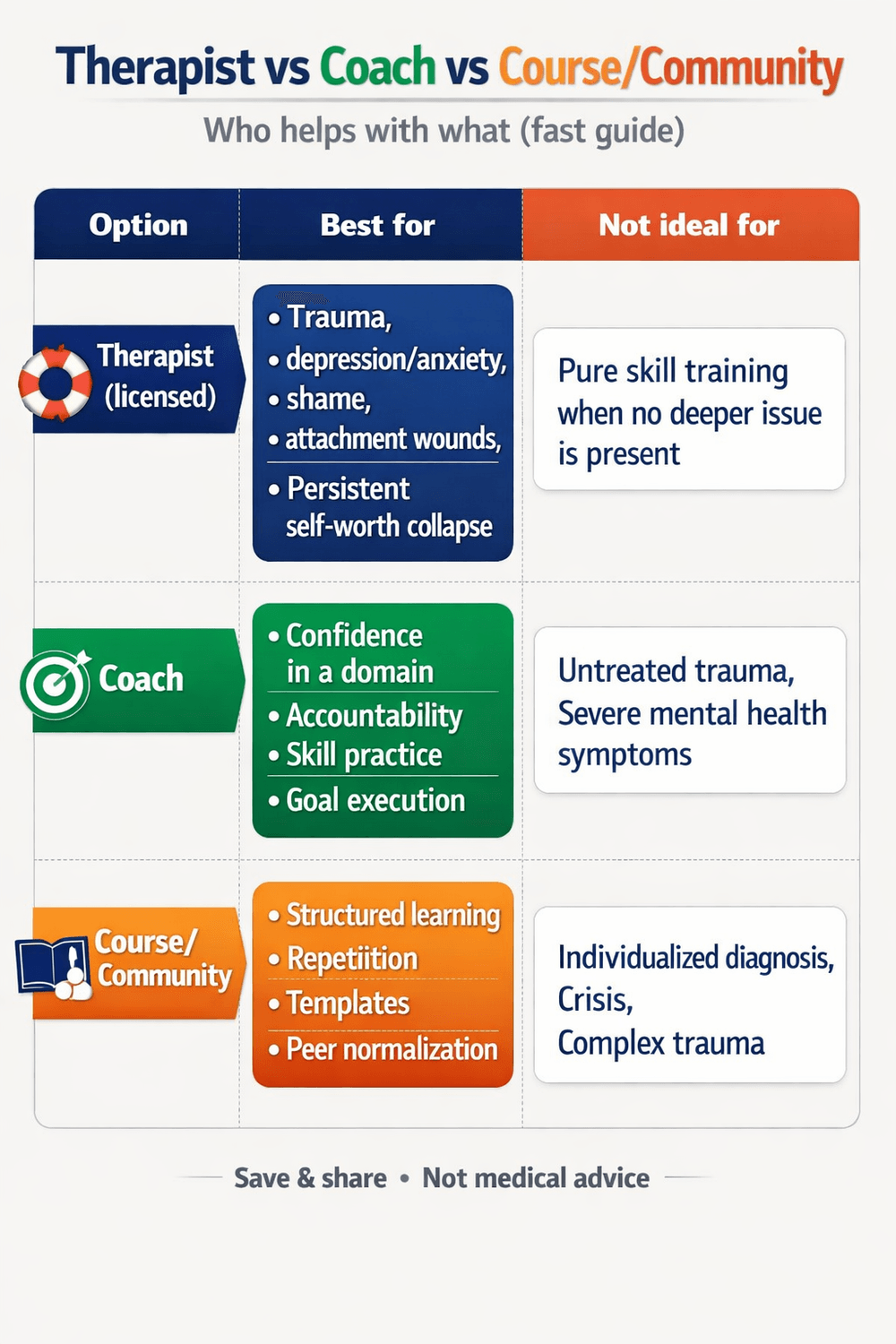
Therapist vs Coach vs Course: Who Helps With What

A therapist treats clinical pain—trauma, depression, anxiety disorders—and works at the level of healing and diagnosis. A coach helps a functioning person close a specific gap, build skills, and execute a plan. A course or community gives you the framework and accountability to do the work yourself at lower cost. If your pain is clinical, start with a therapist. If your pain is "stuck," a coach or structured course usually moves faster.
FAQ: Self-Worth vs Self-Esteem vs Confidence
What is the difference between self-worth, self-esteem, and confidence?
Self-worth is your inherent value as a person (not performance-based). Self-esteem is your evaluation of yourself, often shaped by standards and comparison. Confidence is your belief you can do a specific task, built through skills, reps, and feedback. Most people try to fix confidence first, when the deeper issue is worth or esteem.
How do I know if I'm missing self-worth, self-esteem, or confidence?
If the pain feels global and identity-based, it’s usually self-worth. If it’s tied to ranking, comparison, or approval, it’s self-esteem. If it shows up only in certain situations (presenting, dating, conflict), it’s confidence. Use three quick questions—about failure, comparison, and freezing—to identify the missing layer.
Can I be confident and still feel worthless?
Yes. And if you’ve lived it, you already know how disorienting it is.
You can be competent, even elite, in a specific domain and still carry an identity-level belief that you’re only as good as your latest performance. That’s the achievement trap: confidence rises, self-esteem gets a temporary lift, and self-worth stays conditional—still waiting for proof that you’re lovable when you’re not winning.
What's the line between self-esteem and narcissism?
Self-esteem can hold reality. Narcissism often can’t.
Healthy self-esteem says, “I’m good at some things, I’m messy at others, and I’m still a person.” Narcissism (as it’s commonly used) tends to involve fragile self-esteem protected by superiority, entitlement, or the need to win the room. One is stable enough to admit flaws. The other often treats flaws like a threat to survival.
What's the fastest way to build confidence when I'm panicking?
Fast doesn’t mean dramatic. Fast means repeatable.
The quickest reliable path is an exposure ladder plus micro-wins:
Choose the domain.
Shrink the task until it’s a 2–10 minute rep.
Do it again tomorrow.
Add feedback, even a tiny amount.
Confidence doesn’t come from convincing yourself. It comes from collecting evidence your nervous system can’t argue with.
Why do compliments not stick for me?
Because they’re landing on the wrong layer.
If self-worth is wounded, praise can feel unsafe—like someone is about to discover the “real you.” If self-esteem is comparison-driven, compliments fade the second you encounter someone “better.” If confidence is low, compliments can feel irrelevant: “Nice words, but I still can’t do the thing.”
A practical fix: ask for specificity (“What exactly worked?”), then pair it with integration (“Even imperfect, I still matter.”) That’s how praise turns into something you can actually keep.
How long does it take to rebuild self-worth?
It varies. Small consistent practices (values work, boundary setting, shame resilience) produce meaningful change over months; therapy speeds deep healing.
Can I fix these without therapy?
You can make measurable progress with the exercises here, but if childhood trauma or persistent depression is present, professional support is strongly recommended.
What should I start with?
Use the 3‑question diagnostic above. Start with the layer you identified as weakest; work on one layer at a time for clarity and momentum.
Products, Tools and Resources
Free quick-starts (best place to begin):
Pattern Recognition Test (short quiz): get your mental imposter type + The Inner Critic Contract Audit Workbook
5 Mindset Shifts High Performers Use To Get Unstuck (video training): a fast, practical reset when you’re frozen or spinning
So stop pouring effort into the floor that isn't cracked. If you're exhausted from chasing confidence and still feel hollow, the problem was never your confidence—it was the self-worth holding it up. Pick your weakest layer using the 3-question diagnostic, run the one-week stack on that layer and nothing else, and watch how fast the noise drops. Do that one thing this week. Start with the diagnostic right now, before you close this tab and let the old loop talk you out of it.
About the Author
By Milan | Founder of Milan'Z Coaching | NLP & Hypnotherapy Master Practitioner | Neural Reprogramming Coach | Creator of MSIP | Helping entrepreneurs and high-achieving professionals overcome imposter syndrome, self-doubt, and limiting beliefs since 2014. [About Milan]





UNLOCK FREE MINDSET TRAININGS & EXCLUSIVE DISCOUNTS YOU WON'T FIND ANYWHERE ELSE!
Subscribe to the newsletter and join driven entrepreneurs, solopreneurs, executives, business owners, and high-achieving professionals on a mission to become unstoppable forces for good.
GET MINDSET STRATEGIES DELIVERED TO YOUR INBOX
Unlock free mindset trainings, neural reprogramming techniques, and
exclusive discounts. Join entrepreneurs, executives, and high-achievers
breaking through their mental blocks.
CONNECT WITH MILAN
Got questions about Breakthrough Coaching or Neural Reprogramming?
Send me a message—I read every email.
FREE RESOURCES
© 2026 Milan'Z Coaching