
How to Think Strategically at Work: 7 CEO-Level Habits
There’s a specific kind of panic that sends you to search.
It’s not curiosity. It’s not “self-improvement.” It’s that hot, tight feeling in your chest when you realize the next sentence you say—or the next decision you make—might change your life in a way you can’t easily undo.
So you type things like “should I quit my job?” or “how do I ask for a raise?” or “what do I say in a hard conversation?” and you scroll like the answer is hidden in someone else’s certainty.
This is what CEO thinking for real life is for.
Not hustle culture. Not alpha posturing. Not pretending your emotions don’t exist. It’s a way of thinking clearly inside emotional weather—a system for objectives, incentives, risk, optionality, and communication that actually lands.
Quotable Takeaways for Thinking Like a CEO
Define the objective, not the activity. "Get a better job" is activity; "increase learning rate + income with downside protection" is an objective. Map stakeholders and incentives—most conflict is misaligned incentives wearing a "personality" mask. Pick a decision rule before debating; speed vs. data vs. reversibility determines the right process, not vibes. Use optionality as your safety net: when uncertain, buy options; when certain, place bets. And speak in decisions, not drama—emotion is real, but the executive move is translating it into requests, boundaries, and next steps.
A 2-Minute Check: Which Mental Imposter Type Runs Your Decisions?
If your brain gets loud right before a raise ask, a quitting decision, or a hard conversation, you don't need more motivation—you need pattern recognition. Take the Pattern Recognition Test to get your Mental Imposter Type (the specific loop your mind defaults to under pressure) and instant access to The Inner Critic Contract Audit Workbook so you can shift from spiral → strategy. Take the Pattern Recognition Test →
The CEO Decision-Making Framework for Any Problem
Executives don't have a secret source of calm. They have a repeatable lens. They walk into messy rooms—limited data, loud opinions, real consequences—and their first move isn't to work harder. It's to frame the problem correctly, so effort goes somewhere useful. Then they choose a decision rule that matches the stakes. That's the whole game: less thrash, more signal.
This framework covers four entities—goals, outcomes, constraints, and tradeoffs; stakeholders, incentives, alignment, and game theory; uncertainty, risk, reversibility, and decision rules; and narratives, communication, and accountability.
How to Define the Objective, Not the Activity
Most people don't have a decision problem. They have a language problem. They say, "I need to network more," but what they mean is, "I'm afraid my career is stalling and I want options." They say, "I should talk to them," but what they mean is, "I can feel resentment hardening and I don't know how to stop it." CEO thinking starts by stripping the fog out of the sentence.
Use this sentence frame: "I want [outcome] by [timeframe], while protecting [constraint], and I'm willing to trade [tradeoff] but not [non-negotiable]." You'll feel the difference immediately. Suddenly you're not "doing things." You're optimizing.
Examples (activity → objective):
"Network more" → "Increase inbound opportunities by building 3 strong relationships in my target function within 60 days."
"Have the talk" → "Restore trust and set a boundary so the relationship feels safe again."
"Save money" → "Increase monthly free cashflow by USD 400 without reducing sleep or health."
CEO-level questions that sharpen the objective:
What would "better" look like in observable terms (metrics, behaviors, outputs)?
What does "worse" look like (failure modes, regret triggers, reputational risk)?
Which constraint is real—time, energy, money, identity, relationships, or fear?
What is the minimum viable win if conditions aren't perfect?
If you want a fast tool, jump to the Decision Memo Template (1 page) below and write the objective in one paragraph.
Thinking like a CEO is worthless if you can't execute — which is why you also need to close the knowing-doing gap that traps most entrepreneurs.

How to Map Stakeholders and Incentives Before a Hard Conversation
Here's a hard truth that will save you years: a lot of "personality conflicts" are just incentives colliding. When executives say "stakeholders," they don't just mean org charts. In real life, your stakeholders include your manager, your partner, your kids, your cofounder, your landlord, your future self—and the part of you that gets scared and tries to buy safety through approval. If you don't map incentives, you'll keep arguing with symptoms.
A simple stakeholder map asks five questions:
Who is impacted, directly and indirectly?
What do they want (status, safety, autonomy, belonging, money, time)?
What are they afraid of (loss, embarrassment, uncertainty, workload)?
What do they control (resources, approvals, information, attention)?
What do they reward or punish (promotion, access, affection, criticism, withdrawal)?
This is where the whole thing gets oddly compassionate. You stop making people villains. You start seeing them as humans protecting something—sometimes clumsily.
Incentive truths that reduce conflict:
People don't resist your goal—they resist the cost they think they'll pay.
Misalignment shows up as "busyness," "forgetting," "tone problems," and "confusion."
Negotiation isn't manipulation; it's making incentives explicit so both sides can choose.
The high-leverage move is to name the shared goal, then name the feared cost: "I think we both want the project to ship cleanly. I also think you're worried this adds overhead. Can we design it so it's lighter?"

How to Choose the Right Decision Rule for the Stakes
A quiet killer of good judgment is using the wrong process for the stakes. Some decisions are doors you can open and close again. Others are one-way. Amazon's Jeff Bezos popularized this exact distinction in his 1997 shareholder letter, separating reversible "two-way door" calls from irreversible "one-way door" ones—and it remains one of the most useful decision tools in business. When you treat a two-way door like a life sentence, you freeze. When you treat a one-way door like a casual experiment, you end up paying for bravado. CEO thinking is choosing the rule before the debate.
Use this decision rule selector:
Two-way door (reversible): decide fast, test, iterate.
One-way door (hard to reverse): slow down, get data, run a pre-mortem, get second opinions.
High stakes + time pressure: use a bounded process with time-boxed research and a clear owner.
Low stakes + lots of opinions: standardize and automate with defaults, templates, and "good enough."
A practical rule of thumb: if it's reversible, decide with 70% confidence and learn. If it's irreversible, aim for 90% confidence and protect the downside.
And if you want your nervous system to trust you again, stop calling everything "uncertainty." Uncertainty means you don't know what will happen. Risk means you know what could happen and can estimate impact. The executive move is converting uncertainty into bounded risk with options, time horizons, and stop-losses.

CEO Moves for Real Life: Quitting, Raises, Offers, Boundaries, and Conflict
This is the library you reach for when the room feels hot and your brain starts bargaining.
Each scenario answers the obvious question—but it also answers the one underneath it: How do I make a move I can live with?
Should I Quit My Job? Protect Downside, Keep Optionality
Should I quit my job? Quit when three things are true: you have runway (enough cash to cover months of expenses), a credible next path, and quitting meaningfully reduces a cost you can't recover—your health, your ethics, or your long-term career. If your runway is thin or you're reacting to one bad week, stay and fix the role first.
There's a version of quitting that's courageous. There's also a version that's just desperation dressed up as identity. The CEO move is not "stay" or "go." It's protect downside while preserving optionality. Treat quitting like an acquisition decision: you don't buy the next chapter with hope. You finance it with runway and career capital.
Runway is your personal balance-sheet reality:
Cash reserves (months of expenses)
Probable income (freelance, partner income, severance)
Fixed obligations (rent, debt, dependents)
Health bandwidth, because burnout is a hidden liability
Career capital is your compounding asset:
Transferable skills (writing, systems, leadership, sales, technical depth)
Reputation (references, portfolio, internal advocates)
Signal strength (brand, credentials, tangible outcomes)
Network warmth—people who will actually respond
Notice what's not on the list: vibes. Righteousness. The fantasy of relief. Relief is real, by the way. It's just not a plan. And the stakes are higher than people admit: the U.S. Bureau of Labor Statistics reported a median employee tenure of just 3.9 years in 2024, which means most people will make this exact decision many times over a career. Getting a repeatable process for it pays off again and again.
Quit (or plan an exit) if:
Your role is actively eroding your confidence, health, or ethics.
You've tried reasonable fixes (boundary reset, role redesign, manager conversation).
You have at least one strong option—runway, an offer pipeline, or a high-conviction plan.
Don't quit yet if:
You're reacting to a bad week.
Your runway is thin and you're likely to panic into a worse job.
You haven't harvested learnings, wins, or references from the current role.
The non-burned-bridge exit script: "I've appreciated the growth here. I've realized my next chapter needs to focus on [direction]. I'm planning my transition with care—could we align on a timeline and what 'excellent handoff' looks like?"
Pair this with the Decision Memo Template and Risk Budget in the Money section to avoid emotional overcorrection.

How to Ask for a Raise: Build a Value Narrative and a BATNA
How do I ask for a raise? Raises get approved when you tell a credible story that links your impact to business outcomes, and you negotiate from options (a BATNA) instead of neediness. Show what changed because you were there, name a specific number, and ask what they need to see to approve it—and by when.
I learned this the hard way coaching a mid-level marketer—I'll call her Priya—who'd been turned down twice. Both times she'd walked in with an effort story. The third time, we rebuilt her ask around two revenue outcomes and a market comp range; she got an 18% bump in one meeting. Nothing about her work had changed. Her narrative had.
Most raise conversations fail before they begin—not because the person isn't valuable, but because they walk in carrying the wrong story. They bring an effort narrative: Look how hard I worked. But businesses fund outcome narratives: Here is what changed because I was here. Your manager may like you. That's not the same as having budget authority. So you make it easy. You connect dots. You reduce ambiguity.
Build your value narrative from five parts:
Scope: what you own now, and what breaks if you don't.
Impact: measurable outcomes—revenue, cost, time saved, quality, retention.
Trajectory: what you can deliver next quarter with clearer incentives.
Market reality: comp ranges, internal parity, role leveling.
The Ask: a specific number or range plus a timeline.
BATNA—Best Alternative To a Negotiated Agreement—is a concept from the classic negotiation text Getting to Yes by Fisher, Ury, and Patton. It sounds like a textbook term until you feel what it does to your spine. When you have a real BATNA, you stop pleading. You start collaborating. Your voice slows down because your future isn't trapped in the other person's mood. A BATNA might be another offer, a credible internal transfer path, freelance income, or the ability to stay without resentment (rare, but powerful).
The calm-authority raise script: "I'd like to align compensation with the scope and results of my role. Over the last [timeframe], I delivered [2–3 outcomes]. Based on my level and market, I'm targeting [range]. What would you need to see to approve that, and by when can we decide?" If they stall: "Totally understand constraints. Let's make it concrete: what are the criteria, and can we set a decision date?" If they say no: "Thanks for the clarity. If comp can't move, I'd like to discuss adjusting scope, title, or a defined path with measurable milestones."
Which Job Offer Should I Take? Compounding vs. Cash Now
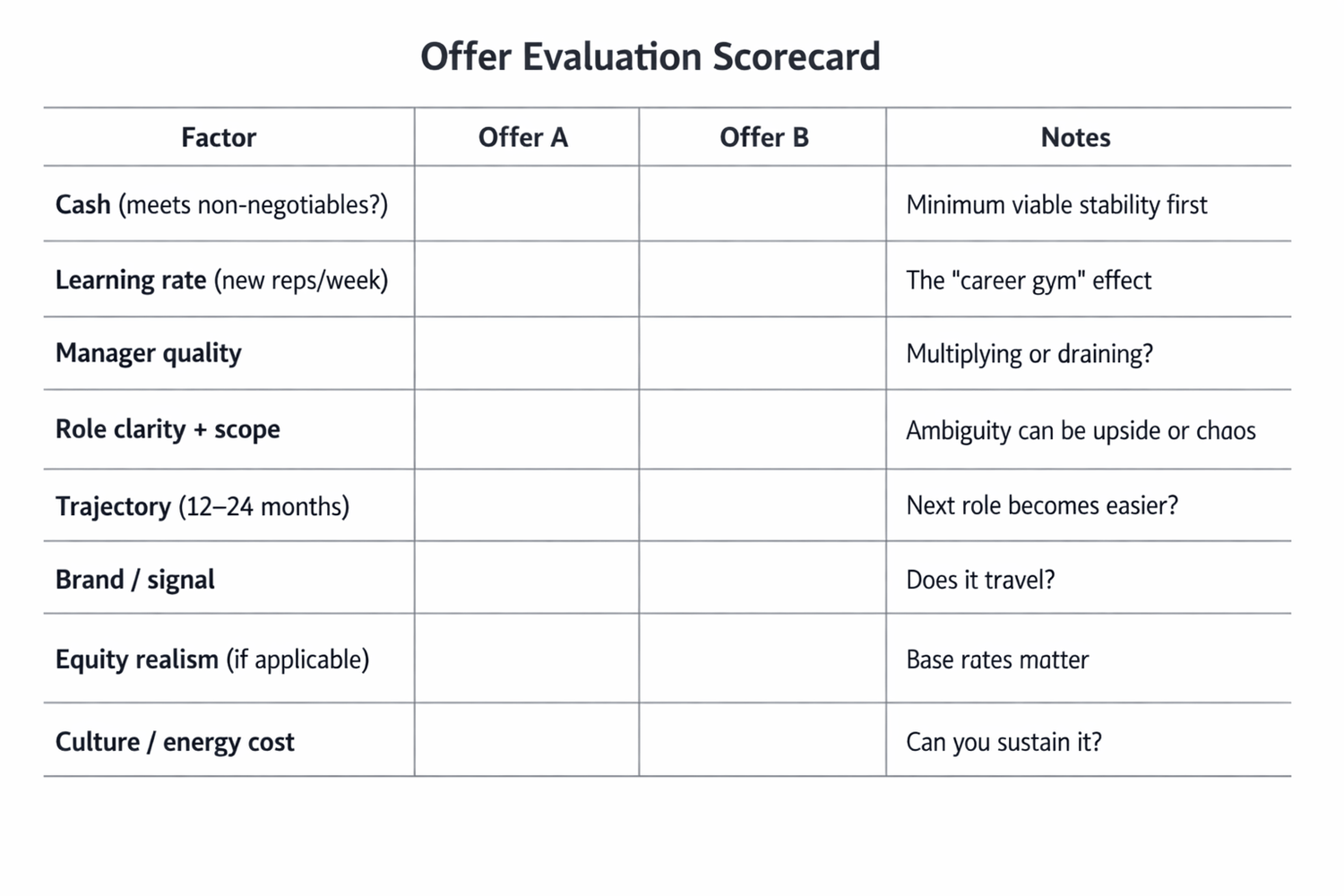
Which offer should I take? Choose the offer that maximizes learning rate × credibility × energy, as long as it meets your minimum cash needs. Cash is survival; compounding is destiny. If both offers cover your minimum, pick the one with the higher learning rate and better manager—even if the title is smaller.
Offer decisions are rarely just about salary. They're about who you become doing the job. One job tightens your thinking, expands your network, and makes you braver. Another slowly teaches your nervous system to dread Monday. That difference compounds.
Executives think in trajectories:
Skill compounding: hard skills plus decision-making reps.
Network compounding: proximity to talent and power.
Brand compounding: signals that travel across markets.
Equity compounding: if the company has a plausible path.
Score each offer 1–5 on those dimensions, then apply the rule: if both meet your minimum cash needs, pick the one with the higher learning rate and better manager. If equity is involved, also read the Risk Budget section below.
How to Stop People From Wasting Your Time: Boundary Design
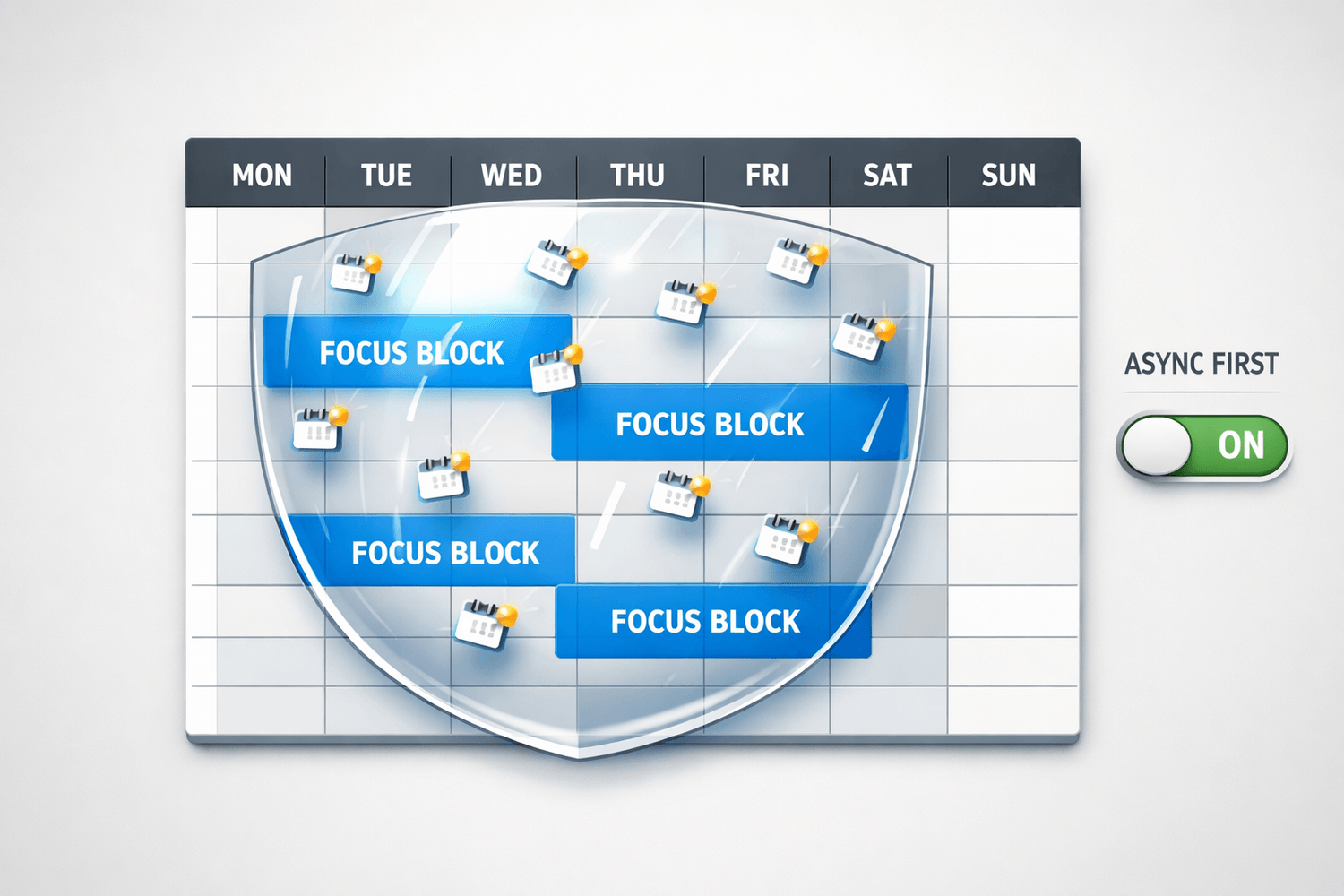
How do I stop people from wasting my time? Stop negotiating time one interruption at a time. Build systems instead: clear defaults, office hours, required agendas, async-first communication, and polite refusal language. Calendars don't create expectations—people do—so design boundaries that don't require willpower.
If you're constantly overwhelmed, it's tempting to blame your calendar. But calendars don't create expectations. People do. And if you've trained people that your attention is always available, they'll keep spending it. Executives don't "get disciplined" as much as they design boundaries that don't require heroism. Time is a budget. Attention is a budget. Energy is a budget. If you don't allocate it, someone else will.
Meeting hygiene policies, simple and enforceable:
No meeting without a purpose, agenda, decision needed, and pre-read.
Default to 25/50 minutes, not 30/60.
Invite only decision-makers and operators.
If no decision is needed, make it an async update.
Async templates:
"Can you send that in a doc with context, options, and your recommendation?"
"If you need a decision, list A/B with tradeoffs and your call."
The boundary script: "I'm protecting focus blocks this week. If you send me the decision needed plus 2 options, I'll reply by [time]. If it's a brainstorm, I can do 15 minutes on [day]."

How to Handle Conflict at Work: Be Kind and Direct
How do I handle conflict? Conflict gets easier when you separate relationship safety from performance truth. You can be kind and direct at the same time. Name your shared intent, describe the facts, state the impact, make a specific request, and agree on a next step with an owner and a date.
Most people avoid conflict because they're afraid it will become cruelty. But unspoken conflict doesn't disappear. It just leaks out as sarcasm, withdrawal, "forgetting," and a slow emotional tax you pay every time you see the person's name pop up. The executive move is making conflict clean. Culture isn't your mission statement. It's what gets addressed, what gets avoided, and what becomes normal because no one wanted it to be awkward.
A clean conflict model:
Name shared intent: "I want this to work for both of us."
Describe facts: observable behavior, specific examples.
State impact: cost, delay, trust, stress.
Make a request: what needs to change.
Agree on a next step: who does what by when.
Feedback stems that run high-signal and low-heat:
"When [behavior] happens, the impact is [impact]. Going forward, I need [request]."
"Help me understand what I'm missing."
"What would 'good' look like to you?"
Accountability isn't punishment. It's clarity—so resentment doesn't become your personality. For a deeper toolkit here, Crucial Conversations by Patterson and colleagues is the standard reference.
If you're stuck right now, watch this before you try to muscle through. The fastest way out of a mental loop isn't force—it's a clean reframing that gives you your next move back. I made a short training, The 5 Mindset Shifts High Performers Use To Get Unstuck. It's for the moment you're overthinking, second-guessing, or bracing for fallout—and you want traction without the emotional crash later.
The Executive Tools: Templates and Scripts
If you've ever wished you could borrow someone else's calm, start here. These tools are not "tips." They're infrastructure. You can reuse them for careers, money decisions, and hard conversations without reinventing yourself each time. After coaching more than 400 people through quitting decisions, raise asks, and offer choices, the same pattern shows up every time: the people who write things down decide faster and regret less. The tools below are the reason why.
The 1-Page Decision Memo Template
Use this when your mind is loud and your stakes are real. It turns emotional fog into something you can see. Then you can steer.
Title: Decision on [topic] by [date].
Objective: what outcome are we optimizing for, and why now?
Constraints: time, cash, energy, ethics, relationship limits.
Context: three bullets, only what matters.
Options (2–4): each with a summary, pros, cons, cost, and risks.
Recommendation: choose [option] because [reason].
Decision rule: reversible vs. irreversible, confidence level, time-box.
Pre-mortem: "It's 90 days later and this failed because…"
Next steps: who/what/when.
Stop-loss: what evidence would make us change course?
Use this memo before quitting, negotiating, or choosing offers to reduce regret.
The Calm-Authority Negotiation Script
There's a particular tone that changes rooms. Not aggressive. Not apologetic. Just grounded, specific, unhurried. That's calm authority—and you can borrow it even if you don't feel it yet.
The structure is three moves:
Frame: shared goal plus your intent.
Anchor: your number or range plus rationale.
Collaborate: ask what would make it possible.
General-purpose script: "I want to make this work and be fair to both sides. Based on the scope and the outcomes I'm accountable for, I'm targeting [number/range]. I'm flexible on structure, but not on the overall value. What path do you see to get there?" If they counter low: "I hear you. That's below what makes sense for me given the role. If budget is fixed, we can adjust scope, title, or add a performance-based step-up with a clear date."
Credibility boosters, without posturing:
"Here are the outcomes I drove."
"Here are 2 comparable market datapoints."
"Here's what I'm committing to deliver next."
A Relationship Operating Cadence (1:1s for Life)
Most relationships don't break in one dramatic moment. They erode in small omissions. The unasked question. The unsent message. The assumption that "we're fine" is the same thing as "we're connected." Executives schedule what they value. You can too—without making it weird.
A weekly 15-minute 1:1 with a partner, close friend, or teammate:
What felt good this week?
What felt heavy?
Any missed expectations to repair?
What do you need from me next week?
A monthly 30–45 minute alignment review:
Are we aligned on priorities?
Any resentment building?
What should we stop doing?
What would make this month feel like a win?
When things go sideways, run the repair protocol: acknowledge impact, own your part, name the pattern, propose a new agreement, and follow through fast.
A "No" Framework That Preserves Respect
Saying no is one of the fastest ways to regain a life you recognize. It's also where people get tangled—because they confuse clarity with cruelty. You can be firm without being cold. The Respectful No has four parts: Appreciation, Constraint, Alternative, Boundary.
"Thanks for thinking of me. I can't take this on because I'm committed to [priority/constraint].
If helpful, I can [offer alternative: quick review / connect you to X / share a template].
I won't be able to join the meeting, but I can respond async by [time]."
When someone pushes: "I understand it matters. My answer is still no. If priorities change, I'll re-evaluate—but I can't right now."
How to Develop Executive Presence Without Pretending
“Executive presence” has been turned into a costume.
But real executive presence isn’t a voice or a blazer. It’s the felt sense that you are clear, stable, and accountable—even when pressure rises.
People trust you because they can predict you.
Speak in Decisions, Not Drama
Drama isn’t “emotion.” Drama is emotion without structure.
Decision language is how you respect your feelings and move the world forward. It turns intensity into clarity.
Executive summary format (3 sentences)
Context in one line
Decision needed (or decision made)
Next step + owner + date
Example
“We’re seeing delays due to unclear ownership. Decision needed: should we prioritize speed or quality this sprint? If speed, I’ll cut scope and ship by Friday; if quality, we extend to Wednesday.”
The magic here is cognitive load. You’re making it easier for other brains to cooperate with yours.
Narrative Control: What to Emphasize, What to Omit
In high-stakes moments, people remember the headline, not the footnotes.
So you choose the headline on purpose.
That’s not spin. That’s leadership.
What to emphasize (executive signal):
Outcomes
Tradeoffs
Risks and mitigations
Clear asks
Timelines
What to omit (unless asked):
Excess backstory
Emotional justifications as the core argument
Every detail you learned along the way
Narrative power move
“Here’s the headline. Here are the two options. Here’s my recommendation.”
Calm Authority Under Pressure
Calm authority is not the absence of fear. It's the ability to feel fear—and still choose your next sentence. This is where emotion regulation becomes a practical skill, not a wellness slogan.
Rapid regulation in 60–90 seconds:
Label the emotion ("This is anxiety").
Name the goal ("My goal is clarity and respect").
Reappraise ("This is a hard moment, not a dangerous one").
Choose the next sentence—not the whole outcome.
Silence is not failure. A 2-second pause signals thoughtfulness and stops reactive spirals. This isn't just folklore. Cognitive reappraisal—the technique behind that "reappraise" step—is one of the most studied emotion-regulation strategies in psychology; research led by Stanford's James Gross has repeatedly shown it lowers physiological stress responses more effectively than suppressing emotion, which is why executives who use it negotiate better under pressure.
Money Like a CEO: Runway, Risk Budget, and "Buy Time" Decisions
Money decisions are rarely about math.
They’re about safety, identity, and the quiet dread of being cornered. That’s why people either obsess—spreadsheets at midnight—or avoid—“I’ll deal with it later.”
The CEO approach is gentler and more honest: visibility, risk boundaries, and spending that buys freedom instead of regret.
Build a Personal P&L to See Where Your Cash Goes
A CEO doesn't manage a business by guessing. They read a P&L. Your personal P&L doesn't have to be complicated. It just has to be real—because clarity is kindness. Track it monthly:
Income (after tax)
Fixed costs (rent, debt, insurance)
Variable costs (food, transport, fun)
Investments and savings
"Leaks" (subscriptions, convenience spending)
Free cashflow (what's left)
Two questions change everything: What category is rising without improving my life? If I had to cut 10%, what would I cut first without resentment?
Set a Risk Budget: How Much Volatility You Can Afford
A risk budget is not a vibe check. It's your capacity to absorb bad luck without letting it rewrite your entire life. The goal isn't "no risk."
The goal is survivable risk. Core components:
Emergency fund: months of expenses, varying by stability and dependents.
Insurance: health, disability, renters or home, liability as relevant.
Diversification: don't let one event—a job, an asset, or a person—destroy you.
The practical rule: if losing your income for 3 months would create panic, your first "investment" is runway, not higher-return risk. This isn't fringe advice—the U.S. Consumer Financial Protection Bureau and most mainstream financial planners recommend keeping three to six months of expenses in an accessible emergency fund before taking on meaningful investment risk.

"Buy Time" vs. "Buy Status"
This is the money question that quietly determines the shape of your life: Are you buying time—or buying status? One expands your options. The other quietly increases your fixed costs until you can't breathe.
Buying time is usually high ROI:
Tools that remove friction (automation, better setup).
Services that reduce cognitive load (cleaning, meal prep).
Health supports (sleep, training, therapy or coaching when appropriate).
Buying status often carries high opportunity cost:
Purchases meant to signal identity rather than improve life.
Upgrades that increase fixed costs and reduce runway.
"Treat yourself" spending used to numb burnout.
Before a big upgrade, ask: "Does this increase my fixed costs in a way that reduces my freedom to change jobs, leave a bad situation, or take a risk?"
Decision frameworks work best when your identity can execute them—here’s the entrepreneur mindset shift that makes discipline effortless.
Frequently Asked Questions
What is thinking like a CEO in relationships?
It’s realizing that love doesn’t survive on intention alone.
Thinking like a CEO in relationships means you stop relying on mind-reading and start using clear expectations, regular check-ins, fast repairs, and honest boundaries. You talk early, not late. You name what you need before it turns into a test. And you treat trust like something you maintain—like sleep, like health—not something you assume will just be there.
How do I develop executive presence fast?
Start with two moves that change how people experience you within two weeks.
First: speak in headlines and decisions, not backstory. Second: make your asks concrete—who owns what, by when, and what “good” looks like. Executive presence isn’t a performance; it’s the feeling that you’re clear, stable, and accountable even when things get tense.
What are CEO habits that translate to normal life?
The boring ones. The repeatable ones. The ones that work on your best day and your worst day.
Write a decision memo when emotions are loud. Map stakeholders and incentives before hard conversations. Use two-way door thinking so you stop treating reversible choices like permanent identity statements. Set a cadence for relationships and money—because what you don’t review, you don’t control.
What's the best book or course for a CEO mindset?
The best resource is the one that forces you into practice—weekly, not someday.
Look for negotiation training that teaches BATNA, framing, anchoring, and credibility. Pair it with decision-making under uncertainty (reversibility, pre-mortems, stop-losses) and a solid approach to difficult conversations (clear requests + accountability without cruelty). If you tell me your exact scenario—career move, raise, offer choice, money stress, or conflict—I can tailor recommendations to your constraints and goals.
Products, Tools, and Resources
Free resources (start here if you want the fastest win)
Pattern Recognition Test (short quiz): Get your Mental Imposter Type + The Inner Critic Contract Audit Workbook.
The 5 Mindset Shifts High Performers Use To Get Unstuck (video training): A quick reset for overthinking, hesitation, and “I know what to do but I can’t move.”
Build-it-once templates that form your personal operating system:
The Decision Memo (1 page): put it in Notion, Google Docs, or Apple Notes and keep a clean copy named "Decision Memo — Template" so you don't start from scratch when you're stressed.
The Offer Comparison Sheet: a simple spreadsheet with the scoring table from the offer section—the point isn't precision, it's forcing tradeoffs into the light.
The Monthly Personal P&L: one tab covering income, fixed, variable, leaks, and free cashflow.
Money tools for visibility without becoming a spreadsheet person:
YNAB — best for hands-on control of cashflow.
Monarch Money — a clean dashboard and household-level tracking.
Empower (Personal Capital) — net worth and investment visibility.
Communication and boundary tools, where most CEO thinking actually shows up:
Calendly or any scheduling tool to protect focus blocks.
Loom for async video that reduces meetings while keeping nuance.
A recurring "Weekly 1:1 (life)" calendar event—it sounds almost too simple, and it also quietly changes everything.
Books that match the exact ideas in this article:
For negotiation, BATNA, and framing: Getting to Yes (Fisher, Ury, Patton) and Never Split the Difference (Chris Voss).
For difficult conversations and feedback: Difficult Conversations (Stone, Patton, Heen) and Crucial Conversations (Patterson et al.).
For decision-making under uncertainty: Thinking in Bets (Annie Duke).
For money psychology: The Psychology of Money (Morgan Housel).
Here's the thing nobody tells you: the people who run their lives like a CEO aren't smarter or calmer than you. They just refuse to make the biggest decisions of their lives on vibes. They name the objective, map the incentives, pick the rule, and write it down—even when their chest is tight and their brain is screaming. You already have everything you need to think like a CEO. The only question left is whether you'll keep scrolling for someone else's certainty, or open the Decision Memo template right now and write down the one decision that's been keeping you up at night. Do that next.
About the Author
By Milan | Founder of Milan'Z Coaching | NLP & Hypnotherapy Master Practitioner | Neural Reprogramming Coach | Creator of MSIP | Helping entrepreneurs and high-achieving professionals overcome imposter syndrome, self-doubt, and limiting beliefs since 2014. [About Milan]





UNLOCK FREE MINDSET TRAININGS & EXCLUSIVE DISCOUNTS YOU WON'T FIND ANYWHERE ELSE!
Subscribe to the newsletter and join driven entrepreneurs, solopreneurs, executives, business owners, and high-achieving professionals on a mission to become unstoppable forces for good.
GET MINDSET STRATEGIES DELIVERED TO YOUR INBOX
Unlock free mindset trainings, neural reprogramming techniques, and
exclusive discounts. Join entrepreneurs, executives, and high-achievers
breaking through their mental blocks.
CONNECT WITH MILAN
Got questions about Breakthrough Coaching or Neural Reprogramming?
Send me a message—I read every email.
FREE RESOURCES
© 2026 Milan'Z Coaching