
Free Perfectionism Workbook PDF: 17 Exercises to Overcome Limiting Beliefs
Perfectionism limiting beliefs rarely announce themselves like a villain. They show up as "being responsible." As "having standards." As "not wanting to waste anyone's time." And because those things sound virtuous, the real engine stays hidden—quiet, convincing, relentless. This is that engine, and this workbook is how you finally rewrite it.
Inside: a free, PDF-ready workbook you can copy into Google Docs or Notion and export in under a minute, plus 17 structured exercises designed to surface the 9 hidden rules that run perfectionism from the background. Not pep talk. Not vibes. Actual levers.
How to get the free PDF (30 seconds): Copy the workbook section into Google Docs / Notion → File → Download → PDF.
Want this as a ready-to-use template? Grab the Google Doc here - FREE WORKBOOK
What Are Perfectionism Limiting Beliefs (and Why They Feel "True")
Perfectionism is rarely about wanting something to be good. It's about wanting to feel safe.
What are perfectionism limiting beliefs?
Perfectionism limiting beliefs are rigid, fear-driven rules you treat as non-negotiable (like "If it's not perfect, it's worthless"). They feel true because they reduce anxiety in the moment—until they create overwork, procrastination, control, shame, or burnout. Changing them means replacing threats and absolutes with flexible standards and earned self-trust.
Roughly 1 in 3 people now report clinically significant perfectionist traits, and a meta-analysis published in Psychological Bulletin (Curran & Hill, 2019) tracking more than 40,000 American, Canadian, and British college students from 1989 to 2016 found that perfectionism has risen sharply across every generation since the late 1980s. The American Psychological Association has since flagged the same upward trend. So if this feels bigger than you, it is—you're pushing against a cultural current, not just a personal habit.
Perfectionism feels like high standards, but underneath it's your brain's self-sabotage system protecting you from judgment.
Limiting Belief vs High Standards vs Excellence
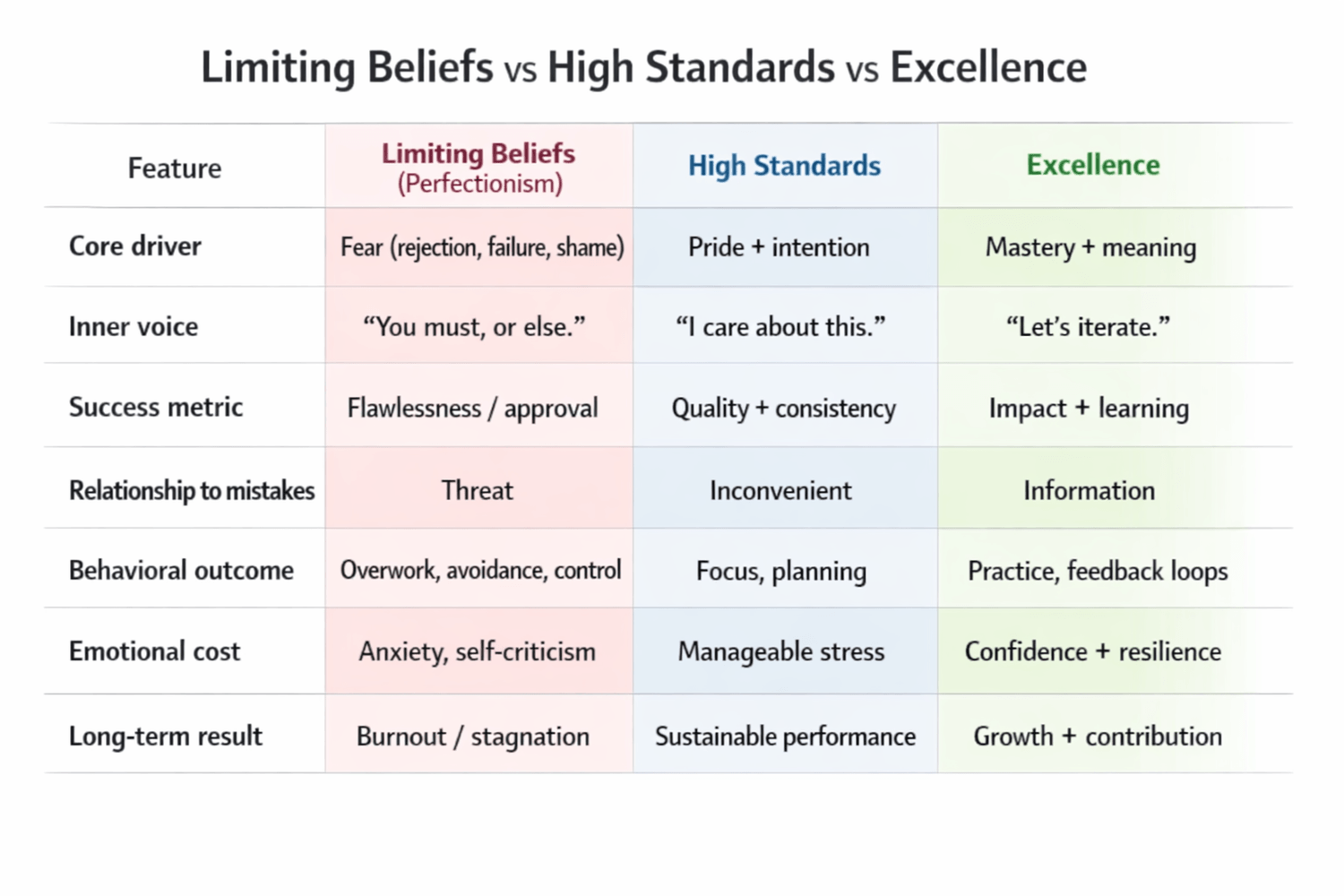
Here's the hinge: high standards are chosen. Perfectionistic rules are obeyed. High standards energize you. Limiting beliefs coerce you. Excellence is something you build; a perfectionism limiting belief is something that holds you hostage.
The Perfectionism Cycle: Trigger, Rule, Anxiety, Relief
Perfectionism is a loop, not a trait. And the loop is beautifully engineered—right up until it isn't.
Trigger: a deadline, feedback, comparison, stakes, uncertainty.
Rule: "Don't screw this up." (Translation: if I'm not exceptional, I'm at risk.)
Anxiety: the body tightens; the mind searches for certainty.
Behavior — overwork/control: rewriting, checking, micromanaging, polishing.
Behavior — avoidance: procrastination, "research," hiding drafts, waiting for confidence.
Temporary relief: you didn't get judged yet.
Long-term cost: less output, more dread, more shame, a smaller life.
That's why it feels true: it gives relief. Briefly. Like holding your breath.

Quick Self-Assessment: Which Perfectionism Pattern Is Yours?
Not all perfectionism sounds the same in your head.
Some people hear a drill sergeant. Some hear a disappointed parent. Some hear a silk-gloved whisper: Just one more tweak.
Want a more precise result than this quick quiz? Take the Pattern Recognition Test to get your Mental Imposter Type + The Inner Critic Contract Audit Workbook
2-Minute Perfectionism Quiz (Yes/No Scoring)
Answer Yes/No. Count Yes's in each section.
A. Performance & identity
I feel uneasy when I'm not achieving.
My self-worth dips when my output dips.
I raise the bar the moment I succeed.
B. Responsibility & approval
I feel responsible for other people's feelings.
I struggle to say no without over-explaining.
I over-deliver so nobody can be disappointed.
C. Control & certainty
I'd rather do it myself so it's "right."
Ambiguity makes me stall or over-plan.
I rehearse conversations/tasks repeatedly.
D. Avoidance & procrastination
I delay shipping because it's not ready.
I start strong, then get stuck perfecting.
I avoid feedback unless I'm sure it's excellent.
Scoring guide: 0–1 Yes = not dominant. 2 Yes = secondary pattern. 3 Yes = primary pattern.
Pattern results:
All-or-nothing performer. Signature thought: "If it's not an A, it's an F." Most common behavior: over-editing, harsh self-talk, sprint/crash cycles. Fastest lever: redefine "done" + minimum viable progress. Start here: Worksheet 4 (Standards reset) + Worksheet 5 (Exposure plan).
Over-responsible caretaker. Signature thought: "If someone's upset, I failed." Most common behavior: people-pleasing, over-functioning, resentment you feel guilty for having. Fastest lever: boundaries + "small disappointments on purpose" exposures. Start here: Belief #9 rewrite + Exercise 14 (Boundary bank).
"If I'm not exceptional, I'm nothing" striver. Signature thought: "Average is dangerous." Most common behavior: comparison spirals, identity fused with achievement. Fastest lever: worth decoupling + values-based excellence. Start here: Belief #3 rewrite + Exercise 16 (Non-output worth ledger).
Avoidant procrastinator ("can't fail if I don't ship"). Signature thought: "If I wait, I stay safe." Most common behavior: research loops, hidden drafts, last-minute sprints. Fastest lever: graded exposure to imperfect shipping. Start here: Worksheet 5 (Exposure plan) + Exercise 15 (Imperfect shipping checklist).
Content Upgrade: Get Your Mental Imposter Type (Free)
If this quiz hit a nerve, you’re going to want the full Pattern Recognition Test. It pinpoints your Mental Imposter Type (the exact flavor of self-doubt + overfunctioning you default to) and tells you what to do next—without generic advice.
What you’ll get when you opt in:
Your Mental Imposter Type result
The Inner Critic Contract Audit Workbook (practical, designed for high performers)

The 9 Most Common Perfectionism Limiting Beliefs (With Rewrite Scripts)
Read these slowly.
The one that makes you bristle, or feel called out, or instantly start arguing—that’s usually the active rule.
If you want the fastest “unstuck” reset before you do the rewrites, watch The 5 Mindset Shifts High Performers Use To Get Unstuck.
Belief #1: "If I Can't Do It Perfectly, It's Not Worth Doing"
Hidden rule: only perfect counts.
Rewrite script: "Progress counts. A Version 1 has value because it exists."
Implementation line: "I will do 15 minutes, then stop on purpose."
Micro-exposure: ship a "good-enough" draft with one minor imperfection left in.
Perfectionism is one of the most common procrastination styles — take the quiz to find out if you're a perfectionist procrastinator and get a targeted fix.
Belief #2: "Mistakes Mean I'm Incompetent"
Hidden rule: mistakes reveal identity.
Rewrite script: "Mistakes reveal process, not worth. Errors are feedback loops."
Implementation line: "I can be competent and still be learning."
Micro-exposure: ask for critique one step earlier than you want to.
Belief #3: "My Worth Equals My Output"
Hidden rule: no output, no value.
Rewrite script: "My worth is inherent. Output is something I do—not who I am."
Implementation line: "Today I act from values, not self-verdicts."
Micro-exposure: take real rest without "earning" it first.
Belief #4: "If I Relax, I'll Fall Behind"
Hidden rule: rest is risk.
Rewrite script: "Rest is maintenance. Recovery is part of the job."
Implementation line: "I rest on schedule, not as a reward."
Micro-exposure: stop at the planned time even if something is unfinished.

Belief #5: "People Will Reject the Real Me"
Hidden rule: authenticity is unsafe.
Rewrite script: "The right relationships survive imperfection and honesty."
Implementation line: "I can share five percent more truth."
Micro-exposure: express a preference without cushioning it.
Belief #6: "I Must Be in Control"
Hidden rule: control prevents pain.
Rewrite script: "I can handle uncertainty. I don't need certainty to act."
Implementation line: "I will choose the next best step with incomplete information."
Micro-exposure: delegate and allow someone else's method.
Belief #7: "Asking for Help Equals Weakness"
Hidden rule: needing help equals failing.
Rewrite script: "Asking is leadership. Support improves speed and outcomes."
Implementation line: "I will make one clear request with a deadline."
Micro-exposure: send a two-sentence help request today.
Belief #8: "If I'm Not the Best, I'm Failing"
Hidden rule: only number one is safe.
Rewrite script: "I'm allowed to be mid-journey. Growth is directional."
Implementation line: "I measure success by consistency and learning."
Micro-exposure: publish something you'd rate 7/10.
Belief #9: "I Can't Disappoint Anyone"
Hidden rule: disappointment equals danger.
Rewrite script: "Disappointment is survivable. Boundaries prevent resentment."
Implementation line: "I can be kind and still say no."
Micro-exposure: decline one request without over-explaining.
Root Causes That Make Perfectionism Beliefs Stick
You don’t need to “blame your childhood” to understand this part.
But it helps to see the wiring.
Inner Critic, Shame, and Conditional Approval
Perfectionism thrives where approval felt conditional—on grades, behavior, usefulness, being “easy,” being impressive, being the caretaker, being the achiever.
And a part of you learned something painfully logical: If I’m exceptional (or needed), I’m safe.
So the inner critic becomes a misguided bodyguard. Loud. Harsh. Certain. Always scanning for what could go wrong.
Common early rules sound like:
“Don’t make mistakes.”
“Don’t be a burden.”
“Be the good one.”
“Keep everyone calm.”
They were adaptations. Useful then. Expensive now.
Cognitive Distortions Behind Perfectionism
Perfectionism also runs on predictable mental habits—fast shortcuts that feel like "thinking," but behave like a trap. These map directly onto the cognitive distortions first catalogued in cognitive behavioral therapy (CBT).
All-or-nothing: "If it's not perfect, it's trash."
Catastrophizing: "If I mess up, everything collapses."
Mind-reading: "They'll think I'm incompetent."
Should statements: "I should be able to handle this."
Discounting positives: "That win doesn't count."
The workbook is designed so you don't spend your life analyzing distortions. You identify them, then move.

Is Perfectionism a Trauma Response? Impostor Syndrome and Evaluation Fear
When your identity is welded to performance, evaluation stops being “feedback” and starts feeling like a verdict.
That’s how you end up over-preparing, hiding drafts, chasing more credentials, waiting for the mythical moment you feel ready.
The counter-move is weirdly specific: practice being seen mid-process. Not once. Repeatedly. Gently. On purpose.
How Perfectionism Causes Burnout and Procrastination (Not Laziness)
If you procrastinate, it's tempting to attack yourself. But procrastination often functions like a sedative: it lowers exposure, uncertainty, and the possibility of "not being enough." It's protection. Burnout, meanwhile, is often your body staging a quiet rebellion: the boundary you didn't set, set for you. The World Health Organization now classifies burnout as an occupational phenomenon driven by chronic unmanaged stress—exactly the kind perfectionism manufactures.
Free Video Training: The 5 Mindset Shifts High Performers Use to Get Unstuck
If you’re reading this while mentally saying, “Yes, but I still feel stuck,” this is for you. It’s a short training that shows the five shifts that break perfectionism’s grip—especially the kind that looks like procrastination, overthinking, or endless revision.
You’ll learn:
The shift that turns “I’m behind” into a workable next step
The reframe that stops all‑or‑nothing spirals
How high performers ship before they feel ready—without self-betrayal
The Perfectionism Workbook (Downloadable + Interactive)
Everything below is PDF-ready. Copy/paste it into a doc. Export. Print. Use a pen. Make it real. I built these worksheets after running them with hundreds of high performers in coaching sessions—the order matters, because each one sets up the next.
Worksheet 1 — Belief audit: “When I feel X, I tell myself Y”
Goal: catch the rule while it’s running.
Fill in 3 recent moments:
Situation (what happened):
Emotion (1–2 words):
Body signal (where do you feel it?):
Automatic thought (verbatim): “…”
Hidden rule underneath: “I must…” / “I can’t…” / “If I don’t…, then…”
Done looks like: three rules you can actually rewrite—clear, blunt, specific.
Worksheet 2 — Evidence ladder (CBT thought record, simplified)
Goal: turn “it feels true” into “it’s a hypothesis.”
Pick one rule:
Claim: “If I make mistakes, I’m incompetent.”
Evidence FOR (facts only):
Evidence AGAINST (facts only):
More balanced statement:
Action experiment (small, measurable):
If you can’t find evidence against it, pause. You may be arguing with a fear, not a fact.
Worksheet 3 — Cost/benefit: what perfectionism pays vs costs
Goal: reveal the deal you’re making.
What perfectionism gives me (short-term)
e.g., relief from judgment
What it costs me (long-term)
e.g., time, health, joy, momentum
Then answer:
What am I afraid would happen without perfectionism?
What is already happening because of it?
Worksheet 4 — Standards reset: “must/should” → “prefer/choose”
Goal: keep standards, remove coercion.
Rewrite:
“I must do it flawlessly” → “I prefer to do it well, and I choose what ‘well’ means today.”
“I should be able to handle this” → “I’m learning to handle this, and support is allowed.”
Your 5 rewrites:
Worksheet 5 — Exposure Plan: Ship Imperfect on Purpose
Goal: teach your nervous system that imperfection is survivable.
Build a ladder (easy → hard). Example:
Send a rough draft to one safe person
Publish a 7/10 post
Submit something with a small typo you don’t fix
Ask for feedback publicly
Ship before you feel ready
Rule: repetition beats intensity. Quiet reps rewrite the rule.

Worksheet 6 — Self-Compassion Script (Performance-Safe)
Goal: reduce shame without turning into complacency. This script is adapted from the self-compassion research of Dr. Kristin Neff at the University of Texas at Austin.
A 60-second script:
Mindfulness: “This is hard right now.”
Common humanity: “Many people feel this.”
Kindness + next step: “May I be kind to myself—what’s one helpful action?”
Custom version:
“This is hard because…”
“Others struggle with…”
“The next kind step is…”
Worksheet 7 — "Good-Enough" Definition Builder
Goal: stop moving the goalposts mid-task.
Pick a role:
Role: parent / leader / student / creator / partner
Good-enough looks like (observable behaviors):
Not required today (optional excellence):
My ‘stop rule’ (when I end the task):
This worksheet is where relief often hits first—because “good enough” stops being vague.
Worksheet 8 — Relapse Plan: What to Do on High-Pressure Days
Goal: make a hard day smaller.
Plan for “high-stakes mode”:
Early warning signs:
My 3 non-negotiables (sleep/food/movement/connection):
What I will pause:
Who I will tell:
My smallest acceptable output:
My reset ritual (10 minutes):
Printable Pack Preview + Copy/Paste Prompts
Printable preview (text mockups you can convert into pages):
[Page 1: Cover]
Perfectionism Limiting Beliefs Workbook
9 Hidden Rules + 17 Exercises
Rewrite 1 rule in 30 minutes
[Page 2: The 9 Rules Checklist]
☐ If I can’t do it perfectly…
☐ Mistakes mean I’m incompetent…
☐ My worth = my output…
☐ If I relax, I’ll fall behind…
☐ People will reject the real me…
☐ I must be in control…
☐ Asking for help = weakness…
☐ If I’m not the best, I’m failing…
☐ I can’t disappoint anyone…
[Page 3: Belief Audit]
Situation → Emotion → Body → Thought → Rule
Copy/paste prompts (optional)
“Summarize the hidden rules in my belief audit into 3 themes and suggest one exposure step for each.”
“Turn my balanced statements into short replacement beliefs I can rehearse daily.”
“Design a 7-day micro-exposure plan based on my ladder and my schedule constraints (15 min/day).”

17 Exercises to Rewrite Perfectionism Beliefs (Quick Index)
Worksheets 1–8 are your foundation. Here are Exercises 9–17—short drills built for real life, not perfect conditions: the 30-minute rewrite sprint, the 5-minute spiral stopper, the 80 percent rule, two-line shipping, the help request script, the boundary sentence bank, the imperfect shipping checklist, the non-output worth ledger, and the weekly proof-of-progress review.
Exercise 9 — Rewrite a Limiting Belief in 30 Minutes
Set a timer. One rule only. No multitasking. No “I’ll do the rest later.” This is the rest.
Minutes 0–5: Worksheet 1 (capture the rule verbatim)
Minutes 5–12: Worksheet 2 (evidence ladder)
Minutes 12–18: Worksheet 3 (cost/benefit—what is it protecting you from?)
Minutes 18–24: write replacement belief (one sentence) + implementation line (one sentence)
Minutes 24–30: pick one exposure step and schedule it (exact time)
Replacement belief formula:
“I prefer X, but I can tolerate Y, because Z matters more.”
Exercise 10 — The 5-Minute Spiral Stopper for Anxiety
Name it: “This is perfectionism threat mode.”
Exhale longer than you inhale (6 cycles).
Write one sentence: “The story I’m telling myself is…”
Write one sentence: “A more complete story is…”
Do one micro-action (2 minutes) that proves movement is possible.
Relief comes from motion. Not from winning the argument in your head.
Exercise 11 — The 80 Percent Rule Experiment
Pick one task this week and stop at 80 percent.
What did you fear would happen?
What happened instead?
What did you gain (time, energy, output, calm)?
This is exposure training in disguise.
Exercise 12 — Two-Line Shipping: Beat Procrastination Daily (For Avoidant Procrastinators)
For 7 days, ship something that takes under 3 minutes:
a two-sentence email draft
a rough outline
a messy voice note
a quick public comment
This is not about quality. It’s about teaching your system: being seen doesn’t kill me.
Exercise 13 — Help Request Script to Stop People-Pleasing (Copy/Paste)
Template:
“I’m working on ____. Could you help by ____?”
“What I need: ____ (time/feedback/example).”
“Deadline: ____.”
“A quick yes/no is helpful.”
Short is kind. Clear is respectful. Vague is exhausting.
Exercise 14 — Boundary Sentence Bank: How to Say No Without Guilt
Pick one and send it:
“I can’t take that on this week.”
“I’m at capacity; I can do X, not Y.”
“I won’t meet that deadline. I can do A by Friday or B by Tuesday—your pick.”
“No, but thank you for thinking of me.”
If your body expects backlash, start with the lowest-stakes boundary first.
Exercise 15 — Imperfect Shipping Checklist
Before you delay, ask:
☐ Does this need to be perfect—or useful?
☐ What’s the smallest version that still helps someone?
☐ What would I ship if I had 30 minutes?
☐ What am I avoiding feeling?
Then ship the smallest version.
Exercise 16 — Non-output worth ledger (5 entries)
Write 5 proofs of worth that have nothing to do with output:
character (kept a promise)
courage (did it scared)
care (showed up for someone)
integrity (told the truth)
growth (learned, repaired, tried again)
This isn’t “self-esteem fluff.” It’s identity diversification—so one bad day doesn’t erase you.

Exercise 17 — Weekly Proof-of-Progress Review (10 Minutes)
Each week:
3 shipped things (small counts)
1 mistake that taught you something
1 boundary you held
1 rest choice that helped
Next week’s one exposure step
This is how you replace shame with evidence.
Real-Life Examples of Perfectionism Limiting Beliefs
Perfectionism gets personal fast. Here's what it looks like once it leaves the abstract and starts living in your calendar. The names below are composites drawn from real coaching clients, with details changed for privacy.
Student: Studying Becomes Endless Revision
Rule: “If I don’t know everything, I’ll fail.”
What it looks like: rereading, rewriting notes, avoiding practice questions—the one place mistakes are guaranteed.
Rewrite + exposure: “Practice mistakes are the path.” Do 15 timed questions, then review. No rereading allowed.
The point isn’t to feel confident. The point is to build competence through contact with reality.
Professional: Perfectionism → Procrastination → Last-Minute Sprint
Rule: “If it isn’t impressive, I’m exposed.”
What it looks like: delay, dread, avoidance, then a panic sprint at midnight.
Rewrite + exposure: “A clear draft beats an invisible masterpiece.” Send an outline to a stakeholder 48 hours earlier than your usual.
You’re not lowering standards. You’re shortening the distance between you and feedback.
Creator: Fear of Cringe Blocks Publishing
Rule: “Cringe means I’m not talented.”
What it looks like: hoarding drafts, waiting for the “right” idea, watching other people build momentum.
Rewrite + exposure: “Cringe is the tax of growth and visibility.” Publish one 7/10 piece weekly for four weeks.
Talent doesn’t emerge from hiding. It emerges from reps.
Parent/Partner: Over-Functioning and Resentment
Rule: “If I don’t do it, it won’t be done right.”
What it looks like: carrying everything, getting snappy, then feeling guilty for being snappy.
Rewrite + exposure: “Shared effort beats silent resentment.” Delegate one task and allow a different method.
You’re not giving up. You’re giving other people room to be competent.
Perfectionism Limiting Beliefs FAQs
Is This Just Me Being Ambitious, or Is It Actually Perfectionism?
If your standards make you feel energized, focused, and proud—even when you’re tired—you’re probably in healthy ambition.
If your standards make you feel tense, brittle, ashamed, or constantly behind… that’s perfectionism. The giveaway is the emotional tone: excellence feels chosen; perfectionism feels compulsory.
A quick test: do you feel relief when you don’t ship? That’s the loop.
What if I Have Anxiety or ADHD—Does That Change the Whole Picture?
It changes the strategy, not the truth.
Anxiety can crank up threat sensitivity so mistakes feel dangerous. ADHD can make starting and finishing harder—overwhelm, time blindness, initiation friction—so perfectionism becomes a way to avoid the discomfort of beginning or being evaluated.
The most effective combo tends to be tiny structure + gentle exposure: smaller steps, clearer definitions of “done,” and imperfect shipping that’s planned rather than forced.
Is Perfectionism Basically a Trauma Response?
Sometimes, yes.
Not always in the dramatic way people imagine. It can come from growing up around criticism, unpredictability, conditional affection, or roles you didn’t ask for (the achiever, the peacemaker, the caretaker). Perfection becomes armor.
If that’s you, move with care: prioritize safety, self-compassion, boundaries, and tolerance for discomfort—not intensity or self-attack.
How Long Does It Take to Change Limiting Beliefs for Real?
You can feel lighter quickly once you name the rule—because you stop mistaking it for objective reality.
But durable change usually takes weeks of evidence. Beliefs update when your brain collects proof: I shipped imperfectly, and I survived. Repeated, low-stakes exposures beat the one heroic leap.
When I'm Spiraling, What's the Fastest Thing That Actually Helps?
Do Exercise 10 (the 5-minute spiral stopper), then take one micro-action.
Your mind will beg for certainty. Offer it structure instead: the next step, the smallest output, the scheduled time block. Spirals hate movement.
When Should I Get Therapy, and What Actually Helps With Perfectionism?
Consider therapy if perfectionism is linked to panic, depression, burnout, relationship strain, disordered eating, or feeling unable to function. Modalities that often help: CBT (thought patterns + behavior experiments), ACT (defusion, values, willingness), schema therapy (deep patterns and roles), self-compassion / compassion-focused work, and exposure-based approaches (for evaluation fear, social anxiety, performance anxiety). This workbook is educational—not a replacement for individualized mental health care, and I'm a coach and writer, not your clinician. If you're in crisis, contact a licensed professional or a local crisis line.
Tools and Resources to Pair With the Workbook
A few genuinely helpful things to pair with this workbook—especially if you want more than insight (you want traction). A simple timer you'll actually use: the 30-minute rewrite sprint works because it's bounded, and a dedicated Pomodoro-style timer makes it feel like a container rather than a vague "I should be working." A CBT workbook if you like structure and evidence-based reframes—it reinforces Worksheet 2. ACT resources if your mind argues with every reframe. Dr. Kristin Neff's self-compassion exercises if shame is the fuel, not standards. A notes app template (Google Docs / Notion / Obsidian) so you turn Worksheets 1–8 into something reusable. And accountability that isn't punitive—a trusted friend, coach, or group who can normalize "Version 1."
Here's the thing nobody tells you: you will never feel ready enough to drop a perfectionism limiting belief. The belief is designed to make sure of that. So stop waiting for the feeling. Open Worksheet 1, set a 30-minute timer, and rewrite one rule today—messy, unfinished, good enough. Grab the free workbook now and do the first sprint before you close this tab.
About the Author
By Milan | Founder of Milan'Z Coaching | NLP & Hypnotherapy Master Practitioner | Neural Reprogramming Coach | Creator of MSIP | Helping entrepreneurs and high-achieving professionals overcome imposter syndrome, self-doubt, and limiting beliefs since 2014. [About Milan]





UNLOCK FREE MINDSET TRAININGS & EXCLUSIVE DISCOUNTS YOU WON'T FIND ANYWHERE ELSE!
Subscribe to the newsletter and join driven entrepreneurs, solopreneurs, executives, business owners, and high-achieving professionals on a mission to become unstoppable forces for good.
GET MINDSET STRATEGIES DELIVERED TO YOUR INBOX
Unlock free mindset trainings, neural reprogramming techniques, and
exclusive discounts. Join entrepreneurs, executives, and high-achievers
breaking through their mental blocks.
CONNECT WITH MILAN
Got questions about Breakthrough Coaching or Neural Reprogramming?
Send me a message—I read every email.
FREE RESOURCES
© 2026 Milan'Z Coaching