
Why Willpower Fails: The Habit System That Works
If you’re a busy professional who keeps asking why you can’t stay consistent even when you know exactly what to do, the answer is not that you lack discipline. The real reason willpower fails is that willpower is unstable. It drops with stress, poor sleep, emotional overload, and decision fatigue. The people who look the most disciplined are usually not forcing themselves harder than everyone else. They are using a habit system that makes the right action easier to start, easier to repeat, and harder to avoid.
If you keep thinking ‘I know what to do but I can’t do it,’ that’s not a moral failure—it’s the pattern behind the knowing‑doing gap in entrepreneurs.
If you keep falling off routines even when you “know better,” it’s usually not a time-management problem. It’s a pattern problem: the same invisible loop shows up under stress, and your brain runs it automatically.
Want to see yours in under 2 minutes? Take The Pattern Recognition Test — a short quiz that gives you your personal Mental Imposter Type plus instant access to the Inner Critic Contract Audit Workbook so you can change the internal script that sabotages consistency.
There is a flattering myth at the center of modern productivity culture: disciplined people simply have more self-control than everyone else. They wake up earlier, resist distraction more easily, and do the hard thing on command. It is a neat story. It is also incomplete.
What looks like extraordinary discipline from the outside is usually better design on the inside. The person who writes every morning, trains after work, eats well under pressure, and follows through on long goals is rarely having a heroic inner battle every day. More often, they have reduced the number of decisions required. Their environment, schedule, and routines are doing part of the work for them.
This article draws on behavioral psychology research and habit-formation evidence, including work by Wendy Wood, Phillippa Lally, and the American Psychological Association, to explain why self-control breaks down and what works better instead.
Why does willpower fail when you want something badly?
Willpower fails because wanting a result is not the same as having a system for repeated action. Stress, fatigue, decision overload, and emotional friction all weaken self-control. People who stay consistent rely less on motivation and more on stable cues, easier starts, supportive environments, and repeatable routines.
If you have ever thought, “I know what to do, so why can’t I just do it?” the problem is usually not character. It is architecture. Most people try to solve a systems problem with intensity. High performers solve it with design.
And if your problem isn’t starting but finishing, you’ll want this breakdown of why you can’t finish what you start as a high‑achiever—because that pattern is rarely about discipline.
Why willpower fails in real life
Willpower is real, but it is a poor operating system for everyday behavior change. It works best in short bursts, under good conditions, and for actions that do not have to be repeated constantly. The trouble starts when people try to run their whole life on effort.
Your brain is always balancing effort, reward, stress, and energy. Repeated behavior is not driven by good intentions alone. It is shaped by context, emotion, learned cues, and what feels easiest in the moment. That is why behavior change is rarely a simple matter of “wanting it more.”
Wendy Wood’s research helps explain why. Habits strengthen when rewarding behaviors are repeated in stable contexts, which is why routines tied to the same time, place, or trigger are much easier to keep. The American Psychological Association also notes that when self-control fails, a “hot” stimulus can override the cooler, more reflective system that supports restraint.
That is why someone can genuinely want to exercise, write, save money, sleep earlier, or stop procrastinating and still default to the opposite behavior when tired or stressed. Wanting the outcome is not enough. You need a path that still works when the day gets heavy.
How decision fatigue destroys consistency

Every unresolved choice drains attention. What time should I work out? What should I eat? Should I start now or later? Which task matters most? By the time many people reach the moment of action, they have already spent their best mental energy on deciding.
High performers cut down the number of decisions they have to make. The workout happens at the same time. The writing session starts with the same setup. The healthy meal is already available. The first step is obvious before the day gets noisy.
Consistency gets easier when there is less to negotiate. That is one reason decision fatigue quietly ruins good intentions.
Why stress makes bad habits feel automatic
Under stress, the brain looks for relief fast. That is not laziness. It is normal human wiring. When you are anxious, sleep-deprived, overloaded, or emotionally worn down, your brain is more likely to choose what feels easy, familiar, and immediately rewarding.
This is why people drop good routines exactly when they need them most. Stress does not make your goals less important. It makes your automatic habits more powerful.
If your default under pressure is scrolling, snacking, procrastinating, or avoiding difficult work, then willpower has to fight your stress response. That is not a fair fight.

Why motivation fades and habits last
Motivation is useful for starting. It is not strong enough to carry repetition on its own. It changes with sleep, mood, workload, self-image, and stress. When people try to build routines on motivation alone, they are building on unstable ground.
High performers do not ignore motivation. They just do not depend on it. They use moments of motivation to build systems that still function when motivation disappears.
That is one of the clearest answers to why motivation fades: motivation is emotional weather. A habit system is infrastructure.
When motivation disappears, most people assume they’re stuck and start waiting for the feeling to come back. High performers do the opposite. They change the story in their head, then they move.
If you want the fastest version of that reset, watch The 5 Mindset Shifts High Performers Use to Get Unstuck — a short video training that shows how to break the stall-out loop and regain momentum without forcing willpower. Opt in and you’ll get immediate access to the video.
Why environment matters more than self-control
People like to think behavior mainly reflects values. In practice, behavior often reflects what is visible, easy, nearby, and rewarded.
Keep your phone within arm’s reach and deep work gets harder. Keep junk food visible and healthy eating becomes a fight. Put your running shoes by the door, block focus time on your calendar, and define the first step before the day begins, and good behavior becomes far more likely.
Environment is not a side issue. It is often the first cause.
Why identity conflict makes habit change harder
Many people try to build habits that clash with the identity they quietly carry around. They say, “I want to write every day,” while still seeing themselves as inconsistent. They say, “I want to get fit,” while replaying the story that they always quit. They say, “I want to be organized,” while staying attached to the idea that they work best in chaos.
When a new behavior threatens an old self-image, resistance shows up. Sometimes it looks like procrastination. Sometimes it looks like endless planning. Sometimes it looks like “starting tomorrow.”
That is why identity-based habits matter. They change the story underneath the behavior.
The real upgrade isn’t ‘try harder’—it’s identity: here are 5 entrepreneur mindset shifts that make discipline automatic.
What is a habit system?
A habit system is a repeatable structure that makes the right behavior easier to start, easier to continue, and easier to restart after disruption. It usually includes a cue, a clear action, low friction, a stable context, a small reward, and a reset plan for missed days.
That is the difference between hoping to stay consistent and actually engineering consistency.
Willpower vs. habit system: which one actually keeps you consistent?
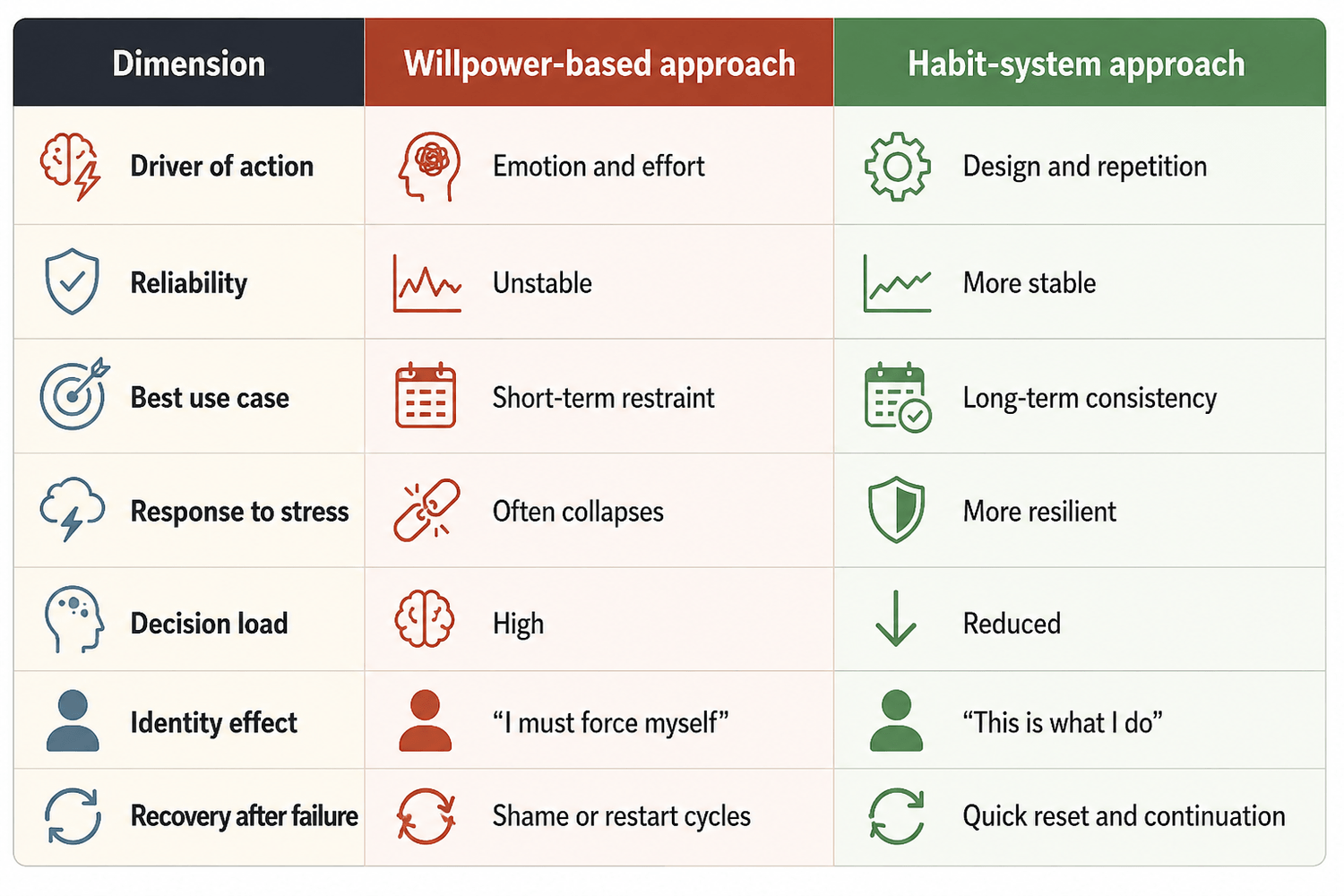
The big difference is timing. People who rely on willpower try to win at the moment of temptation. People with strong systems make the choice earlier, when they set the cue, prepare the environment, and reduce friction.
How to build habits that last
The people who stay consistent are not always stronger at the moment of resistance. Usually, they have built a better structure around the behavior.
Use a clear cue so the habit starts on autopilot
Every habit needs a trigger. The cue tells the brain when the sequence begins. Without a stable cue, behavior stays tied to mood and memory.
A cue can be a time, a place, a previous action, or a visible object. After coffee, I write for 25 minutes. When I get home, I change into workout clothes. After brushing my teeth, I set out tomorrow’s notebook.
The more stable the cue, the less mental work the habit requires.
Make the first step so small you can do it on a bad day
Starting is the hardest part. That is where most habits die. High performers know this, so they make the first step almost too easy to resist.
Instead of “work out for an hour,” the habit begins with “put on training clothes and do the first set.” Instead of “write a chapter,” it begins with “open the document and draft one rough paragraph.” Instead of “meditate for 20 minutes,” it begins with “sit down and breathe for two minutes.”
This is not lowering the standard. It is lowering the friction at the point where action usually breaks.
Reduce friction for good habits and increase friction for bad ones
High performers make the behavior they want easier and the behavior they do not want harder.
If the guitar is visible and ready, practice happens more often. If social apps are logged out, buried, or blocked during work hours, distraction becomes less automatic. If healthy food is prepped and easy to reach, eating well requires fewer negotiations.
Behavior follows the path of least resistance more often than people admit. Smart systems take advantage of that.
Use implementation intentions instead of vague promises
The brain resists ambiguity. “I’ll do it later” is not a plan. “I’ll write Tuesday at 7:00 AM at the kitchen table for 30 minutes before opening email” is a plan.
This is one reason implementation intentions work so well. They answer three questions in advance: when, where, and what.
Specificity turns intention into behavior.
Track process, not just outcomes
When people track only results, they get emotionally whiplashed. If the scale does not move, the month feels wasted. If the business metric dips, the habit feels pointless. If the chapter is rough, the writing session feels like failure.
High performers track what they can repeat: workouts completed, pages drafted, reps done, sleep schedule kept, outreach messages sent. This protects consistency from the emotional swings of delayed rewards.
Outcome matters. Process is what produces it.
Build a reset rule before you need one
Most people expect perfect streaks. Then life interrupts, the streak breaks, and the habit disappears under the weight of self-judgment.
High performers assume disruption is part of the system. Travel, deadlines, illness, family obligations, and low-energy days are not rare exceptions. They are normal life.
So the system includes a reset rule. Never miss twice. Do the minimum version on hard days. Restart at the next cue, not next Monday.
Consistency is not perfection. It is fast recovery.
How to stay consistent when life gets stressful
The short answer is not that disciplined people feel inspired all the time. It is that their systems still work on bad days.
A strong system has three traits. It is simple enough to do when energy is low. It is tied to stable cues instead of changing emotions. And it has a minimum version that keeps the behavior alive when full effort is unrealistic.
In a well-known habit-formation study, Phillippa Lally and colleagues found that habit automaticity reached its average plateau at 66 days, though the range varied widely from 18 to 254 days. That matters because it shifts the question away from “How do I feel today?” and toward “What can I repeat long enough for this to become easier?”
When life gets chaotic, most people swing from full intensity to zero. People who stay consistent usually do something smarter. They reduce the volume, keep the pattern, and protect the identity.
That is the real answer to how to stay consistent: not heroic streaks, but durable continuity.
What is a minimum viable habit?

A minimum viable habit is the smallest version of a behavior that still counts as keeping the identity intact.
For exercise, it might be ten push-ups, a ten-minute walk, or one lift session instead of a full program. For writing, it might be 150 words. For reading, five pages. For meditation, three minutes. For business development, one meaningful outreach message.
This works because the biggest risk is rarely one missed day. The real risk is the story that follows it: “I’m off track now.” “This week is blown.” “I always fall back.”
A minimum viable habit breaks that story. It gives your brain proof that the pattern is still alive.
The emotional reason self-control breaks down
People do not only fail habits because they manage time badly. They fail because habits are emotional.
Starting a creative project can trigger fear of judgment. Going to the gym can bring up shame. Budgeting can surface anxiety. Rest can feel unsafe for people whose identity is built around proving themselves. Deep work can expose uncertainty, which makes distraction feel comforting.
When behavior carries emotional weight, self-control gets weaker. You are not just fighting laziness. You may be dealing with discomfort, self-protection, or an old story about who you are.
People who stay consistent are not always fearless. Usually, they just stop letting discomfort make the decision for them.
A simple habit system for busy professionals
If you work in a demanding job, lead a team, run a business, or create for a living, you do not need a perfect routine. You need one that survives meetings, travel, stress, and low-energy days.
Use this structure:
1. Choose one habit that supports the identity you want
Pick one behavior that matters. Not five. One.
For a busy professional, the highest-return habits are usually things like:
writing before email
strength training three times a week
planning tomorrow before ending the workday
walking after lunch
shutting down screens at a fixed hour
2. Attach it to a stable cue
Examples:
After I pour my coffee, I write for 20 minutes.
When my last meeting ends, I plan tomorrow’s top three tasks.
After I get home, I change into workout clothes immediately.
3. Shrink the starting point
Make the first move small enough to do without debate.
Open the document
Put on the shoes
Write one sentence
Review one budget category
Read one page
4. Prepare the environment before the hard moment arrives
Put the notebook on the desk. Lay out the gym clothes. Hide the distracting apps. Keep healthy food visible. Put the phone in another room during deep work.
Environment design beats last-minute self-control.
5. Decide what counts on hard days
Your minimum version might be:
100 words
a 10-minute walk
one set
five pages
tomorrow’s top three priorities
This is how you keep the pattern alive.
6. Track the repetition
Use a calendar, app, notebook, or habit tracker. The point is not perfection. The point is evidence.
Visible proof of repetition reinforces identity.
7. Use a reset rule
Never miss twice is still one of the best rules in behavior change. It is simple, fast, and forgiving.

Real example: the same person, different system
Imagine someone who wants to exercise consistently.
In a willpower model, they tell themselves they should work out five days a week, ideally after work, if they still have energy. Every day becomes a new argument. Stress interferes. Meetings run late. Motivation drops. The plan collapses.
In a habit-system model, the setup changes. The cue is getting home. The clothes are ready the night before. The first step is ten minutes. The minimum viable version is a walk plus one exercise set. The phone stays away until the session ends. Completion gets tracked. Missing once triggers a next-day reset instead of shame.
Same person. Different structure. Different result.
Common mistakes that make willpower fail
Most habit breakdowns are predictable.
The first mistake is choosing a habit that is too big to survive normal life. The second is relying on vague intentions instead of clear cues. The third is ignoring environment design. The fourth is measuring only outcomes while ignoring process. The fifth is treating disruption like failure.
Another common mistake is trying to change everything at once. New diet. New workout plan. New morning routine. Less screen time. Earlier bedtime. More reading. More deep work.
That feels ambitious. Usually, it creates overload.
The smarter move is sequential compounding. Stabilize one habit. Then add the next one.
If the breakdown happens at the finish line, read why you can’t finish what you start as a high‑achiever.
Frequently asked questions about willpower, discipline, and habits
Why does willpower fail even when I really want something?
Because desire is not the same as behavioral infrastructure. You can want a result and still lack a cue, a routine, an environment, or a low-friction path that makes the action repeatable. Stress and fatigue weaken effortful control even more.
How do I become more disciplined without relying on willpower?
Stop trying to feel stronger and start making action easier. Use a stable cue, lower the starting threshold, remove friction, track repetition, and build a reset rule. Discipline gets stronger when the environment supports it.
How long does it take to build habits that last?
There is no magic number, but the best-known research found that habit automaticity plateaued at an average of 66 days, with wide variation depending on the person and the behavior. The key is not chasing a deadline. It is making the behavior easy enough and regular enough to repeat.
Is willpower useless?
No. Willpower is useful for starting, interrupting bad patterns, and handling short bursts of temptation. It is just not strong enough to be your main engine for long-term consistency.
What is the best habit for high performance?
The best habit is the one that most reliably strengthens the identity and capacity you need right now. For many professionals, the highest-return habits are sleep, exercise, planning, deep work, and distraction control because they improve more than one area at once.
Research and expert references
This article is grounded in research and expert commentary on habit formation, self-control, and behavior change, including work from Wendy Wood on habits and stable contexts, Phillippa Lally on the time course of habit formation, and the American Psychological Association on how self-control can break down under “hot” conditions.
Stop trying to win with willpower
Now you know why willpower fails: it was never meant to carry the full weight of repeated behavior. If you want to stay consistent, stop asking motivation to do a system’s job. Pick one habit, lock it to one cue, make the first step small, and repeat it until it becomes part of who you are. Then do it today, not when you feel ready.
About the Author
By Milan | Founder of Milan'Z Coaching | NLP & Hypnotherapy Master Practitioner | Neural Reprogramming Coach | Creator of MSIP | Helping entrepreneurs and high-achieving professionals overcome imposter syndrome, self-doubt, and limiting beliefs since 2014. [About Milan]





UNLOCK FREE MINDSET TRAININGS & EXCLUSIVE DISCOUNTS YOU WON'T FIND ANYWHERE ELSE!
Subscribe to the newsletter and join driven entrepreneurs, solopreneurs, executives, business owners, and high-achieving professionals on a mission to become unstoppable forces for good.
GET MINDSET STRATEGIES DELIVERED TO YOUR INBOX
Unlock free mindset trainings, neural reprogramming techniques, and
exclusive discounts. Join entrepreneurs, executives, and high-achievers
breaking through their mental blocks.
CONNECT WITH MILAN
Got questions about Breakthrough Coaching or Neural Reprogramming?
Send me a message—I read every email.
FREE RESOURCES
© 2026 Milan'Z Coaching