Why Can't I Stay Consistent Even When I Know What to Do?
The proposal is done. You've read it three times.
You know exactly what to do next.
So you open it again and move a comma.
Here's what nobody tells you about high performance: the gap usually isn't between you and the knowledge. It's between you and the next action, at the exact second it stops feeling safe.
You're not lazy. You've built things. You've shipped things.
But under pressure you fall back — overthinking, another revision round, one more week of preparation, a plan that quietly expires.
That's not a discipline problem.
It's a default problem.
Knowing What to Do Isn't the Same as Doing It
There's a name for this: the intention–behavior gap.
Sheeran and Webb reviewed decades of research on why people fail to act on what they intend. The finding is uncomfortable for anyone who believes wanting it hard enough is enough. In one meta-analysis, a medium-to-large change in people's intentions produced only a small-to-medium change in what they actually did.
Deciding is not executing.
Which explains why the standard advice keeps failing you. Another system. Another accountability partner. Another framework. Another 5 a.m. protocol.
None of it touches the mechanism, because the mechanism isn't a knowledge deficit.
Fair caveat: sometimes you genuinely are overloaded, under-rested, or working from an unclear plan. That's a capacity problem, and it deserves a practical fix.
But if your next step is obvious and you still keep circling it, you're not short on information.
You're dealing with interference.

The Pattern Runs in Four Steps
Before I tell you to push harder, look at what happens right before you pull back.
Trigger. You're about to send the proposal.
Interpretation. "If they say no, it means I'm not as good as they think I am."
Response. You reopen the document instead of the email.
Payoff. Relief. For a few hours, nothing is at risk.
That payoff is why the pattern survives.
Sirois and Pychyl's research on procrastination makes the point plainly: delay is often less about poor time management and more about short-term mood repair. You regulate the uncomfortable feeling now and hand the cost to your future self.
The delay works. That's the problem. It works every single time — right up until the deadline does the work your intention couldn't.
This is where high achievers misread themselves. You call it procrastination, or laziness, or "I'm just inconsistent."
Those are verdicts, not descriptions. A verdict gives you nothing to change.
A sequence gives you four places to intervene.
Want a guided starting point?
Join The Consistency Shift waitlist and get Lesson 1 — Close the Knowing-Doing Gap free, plus the worksheet. No enrollment required.
Interrupt the Pattern Before You Feel Ready
Waiting for certainty is a bad trade. Certainty tends to arrive after the action, not before it.
Three moves:
1. Name the exact action. Not "grow the business." The specific move you're about to postpone. Send the proposal. Publish the post. Make the call.
2. Name the prediction. What do you expect will happen if you act? Be honest — this is where the pattern actually lives. Rejection. Exposure. Judgment. Effort that won't pay off.
3. Set the response rule in advance. Decide while you're calm, not while you're in it. If the proposal meets the standard I set before fear arrived, it goes out at 2 p.m. No new revision round.
That third step matters more than the first two.
A decision made in advance is far harder for an in-the-moment feeling to override. You're not white-knuckling through discomfort — you've removed the negotiation.
Repeat it enough and something shifts underneath the behavior. You start collecting evidence that you act when it's uncomfortable. That evidence is what self-trust is made of. And self-trust is what consistency runs on.
It isn't instant. In the best-known study on habit formation, Philippa Lally and colleagues found a median of 66 days for a new behavior to feel automatic — with a range from 18 to 254 days depending on the person and the behavior.
No shortcut. But also no fixed deadline you can fail.

Consistency Means Returning Faster, Not Never Slipping
Most people don't lose consistency on the bad day. They lose it on the day after.
One missed session becomes "I'm off." One off week becomes "this isn't working." One imperfect launch becomes proof of the old story.
That's not a lapse. That's an interpretation of a lapse.
Reset the standard. Consistency isn't zero drift — it's shorter recovery time.
Notice it. Don't litigate it. Re-enter.
One missed day doesn't have to become a week. One imperfect moment doesn't have to become a verdict on who you are.
Start Before Enrollment Opens
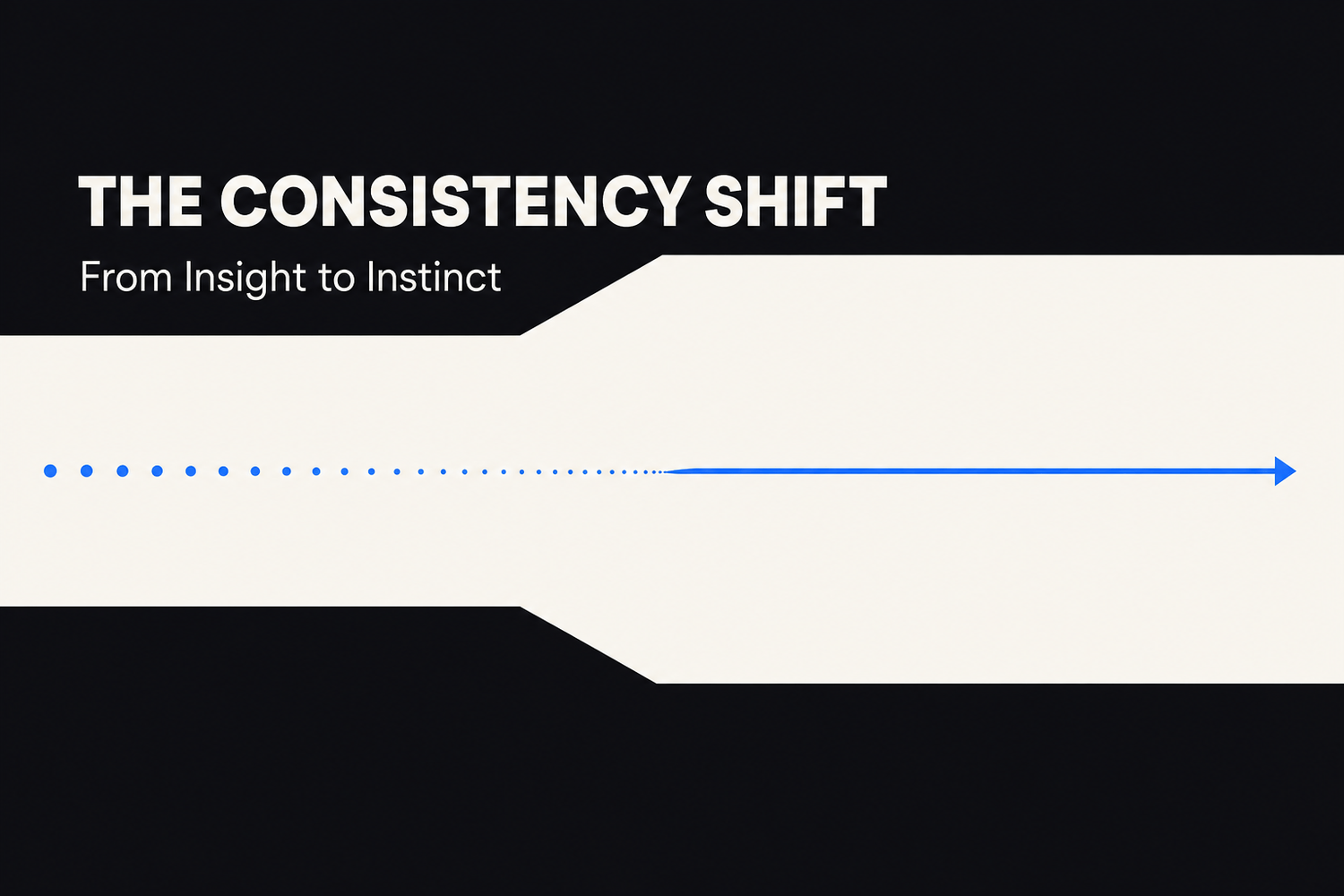
This is the work behind The Consistency Shift: From Insight to Instinct.
It's a live, guided program — not another library of mindset theory. Four live sessions on the actual defaults underneath your execution: the pattern that interrupts action, your state under pressure, self-worth when things don't land, scarcity-driven decisions, and follow-through as an identity rather than an effort.
Enrollment isn't open right now. But you don't have to wait to start.
Join the waitlist and get immediate free access to:
Lesson 1 recording — Close the Knowing-Doing Gap
Lesson 1 worksheet
The Consistency Shift Scorecard
Gumroad Community chat — between-call support and accountability
BONUS: Discipline Switch: Beat Procrastination & Follow Through (hypnosis/subliminal audio)
Early access + waitlist-only discounts when the next cohort opens
If you're done collecting insight and want to change what you default to:
FAQ
Why can't I stay consistent even when I know what to do?
Because knowing the next step doesn't remove the discomfort attached to it. When action feels risky, most people default to short-term mood repair — delaying the task to feel better now. The fix is changing your default response in that specific moment, not adding more strategy or discipline.
What is the knowing-doing gap?
The distance between a clear intention and the actual behavior. Research on the intention–behavior gap shows intentions are a weak predictor of action: a large shift in what people intend often produces only a modest shift in what they do.
How long does it take to build consistent follow-through?
There's no single number. In the most-cited study on habit formation, the median was 66 days for a behavior to feel automatic — with a range of 18 to 254 days depending on the person and the complexity of the behavior. Consistency is built by returning quickly after lapses, not by avoiding them.
About the Author
By Milan | Founder of Milan'Z Coaching | NLP & Hypnotherapy Master Practitioner | Neural Reprogramming Coach | Creator of MSIP | Helping entrepreneurs and high-achieving professionals overcome imposter syndrome, self-doubt, and limiting beliefs since 2014. [About Milan]





UNLOCK FREE MINDSET TRAININGS & EXCLUSIVE DISCOUNTS YOU WON'T FIND ANYWHERE ELSE!
Subscribe to the newsletter and join driven entrepreneurs, solopreneurs, executives, business owners, and high-achieving professionals on a mission to become unstoppable forces for good.
GET MINDSET STRATEGIES DELIVERED TO YOUR INBOX
Unlock free mindset trainings, neural reprogramming techniques, and
exclusive discounts. Join entrepreneurs, executives, and high-achievers
breaking through their mental blocks.
CONNECT WITH MILAN
Got questions about Breakthrough Coaching or Neural Reprogramming?
Send me a message—I read every email.
FREE RESOURCES
© 2026 Milan'Z Coaching