How High Achievers Rewire the Brain: Habits Without Willpower in 3 Phases
Building habits without willpower is possible, but not by adding another system. Motivation gets you started. A rewired default keeps you going when you'd rather not.
You have the calendar, the title, the track record. You also have a quiet, recurring experience: you know exactly what to do, you want to do it, and you still don't. Or you do it, but only by dragging yourself through it, and the drag costs more each month.
I lived that version of success. I managed a bar at a luxury hotel, hit every number, and felt disconnected from all of it. What finally moved things was not another system. It was understanding that my habits were not failing because I lacked discipline. They were running a different program than the one I thought I'd installed. Changing that program is mindset reprogramming at the level of belief, not behavior.
I tested every technique in this article on myself before I used it with a single client. I'm a mindset coach, not a therapist, and I'll show you exactly where that line sits.
This article lays out the three-phase model I now use with clients: Disconnect, Integrate, Generate. It explains why willpower-based habit systems stall, what each phase does, how this approach compares with NLP, hypnosis, coaching and therapy, and whether it fits you.
How Do You Rewire Your Brain for Lasting Habits Without Willpower?
Rewiring a habit without willpower takes three phases. Disconnect interrupts the automatic trigger-and-response loop. Integrate resolves the inner conflict between what you want and how you act. Generate replaces the limiting belief underneath with a new one, rehearsed until confident action becomes the default.
That is the whole model. The rest of this article is the detail behind each phase.
Can You Really Rewire Your Brain? What Neuroplasticity Means for Habits
"Rewire" is shorthand. The brain changes with repeated experience. Scientists call this neuroplasticity. No coach can watch it happen. What you can see is behavior: does the new response show up on its own, or do you have to talk yourself into it every time?

Why Do Habits Fail After the Second Week?
The first week of a new habit runs on novelty and intention. By week two, novelty is gone, and the old pattern is still sitting there, fully automatic, while the new one still requires effort. That gap is where most systems quietly collapse.
Habit research gives some context. A well-known 2009 study from University College London, led by Phillippa Lally, tracked people building a new daily habit. Some reached automatic in 18 days. Others took 254. The middle was about 66. The number matters less than the spread. Habits become automatic at different speeds, and effort alone doesn't explain why.
If you want the research on why intention and action drift apart, Why Can't I Stay Consistent Even When I Know What to Do? breaks down the knowing-doing gap and why consistency means returning faster, not never slipping.
Psychologist Wendy Wood and her colleagues point to the other side of the problem. In a 2002 study in the Journal of Personality and Social Psychology, they found that about 43% of everyday behaviors were repeated almost daily in the same setting, often while people were thinking about something else. Most of what you do is already on autopilot. A new habit has to compete with that.
Here is what I see in high achievers specifically:
The system targets the behavior, not the driver. Tracking, streaks and accountability manage the output of a pattern. They don't touch the belief or the competing motive generating it.
Part of you disagrees. The part that wants the early morning and the part that wants to protect you from failure, rejection or exposure are negotiating, and the louder one wins on a bad day.
Willpower is a consumable under load. You are already spending it on decisions, people and performance. A habit that needs it daily is competing with your job for the same resource.
Identity overrides intention. If a habit contradicts who you quietly believe you are ("I'm someone who starts strong and fades"), your behavior will tend to restore the old self-image.
If this sounds like imposter syndrome, self-sabotage or chronic overthinking, that's not coincidence. They are the same mechanism seen from different angles: a belief running underneath, a pattern firing automatically, and parts of you pulling in different directions.
That same mechanism sits underneath the pattern in How to Break the Unconscious Self-Sabotage Cycle: Why Awareness Alone Isn't Enough, which walks through the trigger, meaning, emotion, behavior, and identity sequence step by step.
If that paragraph sounded uncomfortably familiar, I put the first piece of this into a free 20-minute training: the 5 mindset shifts high performers use to get unstuck. It's built for entrepreneurs and executives who know the strategy and still hear the doubt. Watch it first, then come back for the three phases below.
Phase 1, Disconnect: How to Interrupt Autopilot Habits
You cannot change a pattern you cannot see. Disconnect is about breaking the seamless link between trigger and reaction long enough to notice it exists.
How to Identify Habit Triggers and Automatic Responses
Every pattern has a sequence: a trigger, an internal reaction (thought, sensation, emotion), and a behavior. This sequence is often called a habit loop. For high achievers, the trigger is often subtle: an unanswered email from a client, a compliment, an open block of unstructured time, a decision with no clear right answer.
Run this for one week. Each time you catch yourself doing the thing you didn't want to do (or avoiding the thing you did), write three lines:
What happened just before? The situation, the person, the time of day.
What did I feel, and where? Tight chest, a drop in the stomach, a rush of urgency, numbness.
What did I do within the next minute? Check your phone, reorganize your task list, say yes, go quiet.
After five to seven entries, the pattern usually stops looking like a personality flaw. It looks like a sequence, and sequences can be interrupted.
If your most stubborn trigger is the one important task you keep postponing, How to Stop Procrastinating on Important Tasks When You Know Exactly What to Do shows how to catch that resistance in real time.
Pattern Interrupt Techniques You Can Use Today
A pattern interrupt is any deliberate break in an automatic sequence. The goal is not to fix the habit. It is to create a gap between trigger and response.
Change the physical state. Stand up, relocate to another room, or drop your shoulders and exhale slowly before you respond. The body is often the first domino.
Name it out loud. "There's the urgency again." Labeling shifts you from inside the pattern to observing it.
Break the sequence order. If your reflex is to open email first, open the hard task first for ten minutes, once. The point is to prove the order is not fixed.
Insert a pause with a question. "What am I about to do, and is it what I want?" Ask it before the action, not after.
None of these are the rewire. They are what makes the rewire possible, because they give you something to work with.
Why Self-Awareness Comes Before Habit Change
Fresh awareness often feels uncomfortable before it feels useful. You notice how many hours a day run on reflex. You notice that some of your "decisions" were never decisions. Clients commonly describe it as a mix of relief and irritation.
The mistake is skipping this phase and going straight to affirmations, visualization or a new routine. Without awareness, you are layering a new behavior over a trigger that is still firing at full strength. That is the structure of willpower-based change, and it is why it is exhausting.

Phase 2, Integrate: How to Resolve Inner Conflict and Self-Sabotage
Once the pattern is visible, the next question is the one most habit advice never asks: why is part of you still choosing it?
How to Find the Conflicting Parts Behind Self-Sabotage
In NLP and related approaches, this is often described as working with parts: sub-personalities, each with a positive intention, that sometimes want opposite things. You don't have to treat this literally to find it useful. It simply describes a familiar experience: "Part of me wants to launch, and part of me keeps finding reasons to wait."
Ask yourself:
What does the part that resists believe it is protecting me from?
When did this protective strategy first make sense?
What would it cost that part if I succeeded?
Procrastination, over-preparing and perfectionism frequently turn out to be protection strategies against visibility, judgment or loss of belonging. Once you see the intent, the behavior makes sense, and fighting it stops looking smart.
If your protective part shows up as over-preparing, Overpreparation and Imposter Syndrome: How to Break the Cycle gives you a simple standard-or-certainty check to use in the moment.
How to Negotiate Between Inner Parts Instead of Overruling Them
Overruling a part with discipline is the internal equivalent of a manager mandating compliance. It works until the manager is tired. Negotiation looks different:
Acknowledge the protective intent. Say it plainly, to yourself or with a coach.
Find the shared goal. Both parts usually want safety, respect or freedom, just by different routes.
Define a new behavior that serves both. "I will send the proposal unfinished by Thursday, with one trusted reviewer, so I'm exposed but not alone."
Test it in a small, real situation before trusting it in a high-stakes one.
Signs That Inner Conflict Is Resolved
You won't feel a dramatic shift. You'll notice less internal noise. The argument in your head about whether to do the thing gets quieter or stops. The action that used to need a pep talk simply becomes available. If you're still hearing a loud internal debate, integration isn't finished.
Free training: The 5 Mindset Shifts High Performers Use to Get Unstuck
Integration is the phase most people can't do alone, because the parts in conflict are the hardest thing to see from inside. In this free 20-minute training, I show you the thought pattern behind imposter syndrome and the single shift that interrupts it at the source. I also show you why "think positive" fails high performers, and how the MSIP method replaces surface-level motivation with change that lasts.
It's free, no credit card needed, and you get the 5-step framework straight away.
Phase 3, Generate: How to Replace Limiting Beliefs and Make Habits Automatic
Disconnect shows you the pattern. Integrate removes the internal conflict. Generate makes the new behavior the path of least resistance.

How to Identify and Dissolve a Limiting Belief
Beneath most stuck patterns sits a limiting belief that sounds like fact: "If I'm visible, I'll be exposed." "Rest is laziness." "I'm only valuable when I'm producing." These formed for reasons. They are rarely true now, and they're usually well outside conscious awareness.
To surface one, take a behavior you want to change and keep asking: "If I did that, what would it mean about me?" Repeat on each answer. When you land on a sentence that carries emotional weight, you've found a candidate belief.
To dissolve it, you test it against real evidence, trace where it started, and loosen its grip. I often use guided imagery or hypnotic-style relaxation here. It lets you look at the belief without being overwhelmed by it.
How to Install a New Belief Through Rehearsal
A new belief only holds if the nervous system has experienced it. Reading it on a sticky note rarely does that. Effective rehearsal is:
Specific. Not "I am confident," but "I can state my price without apologizing."
Sensory. Imagine the room, your voice, your posture, the reaction.
Repeated across contexts. Rehearse it in calm, then under mild pressure, then in the situation that used to trigger you.
Followed by real action. Imagination sets the groove, behavior deepens it.
For the full method behind this step, including why affirmations stall and what to do instead, read How to Change Limiting Beliefs: Why Affirmations Backfire.
How Confident Action Becomes a Default, Not a Decision
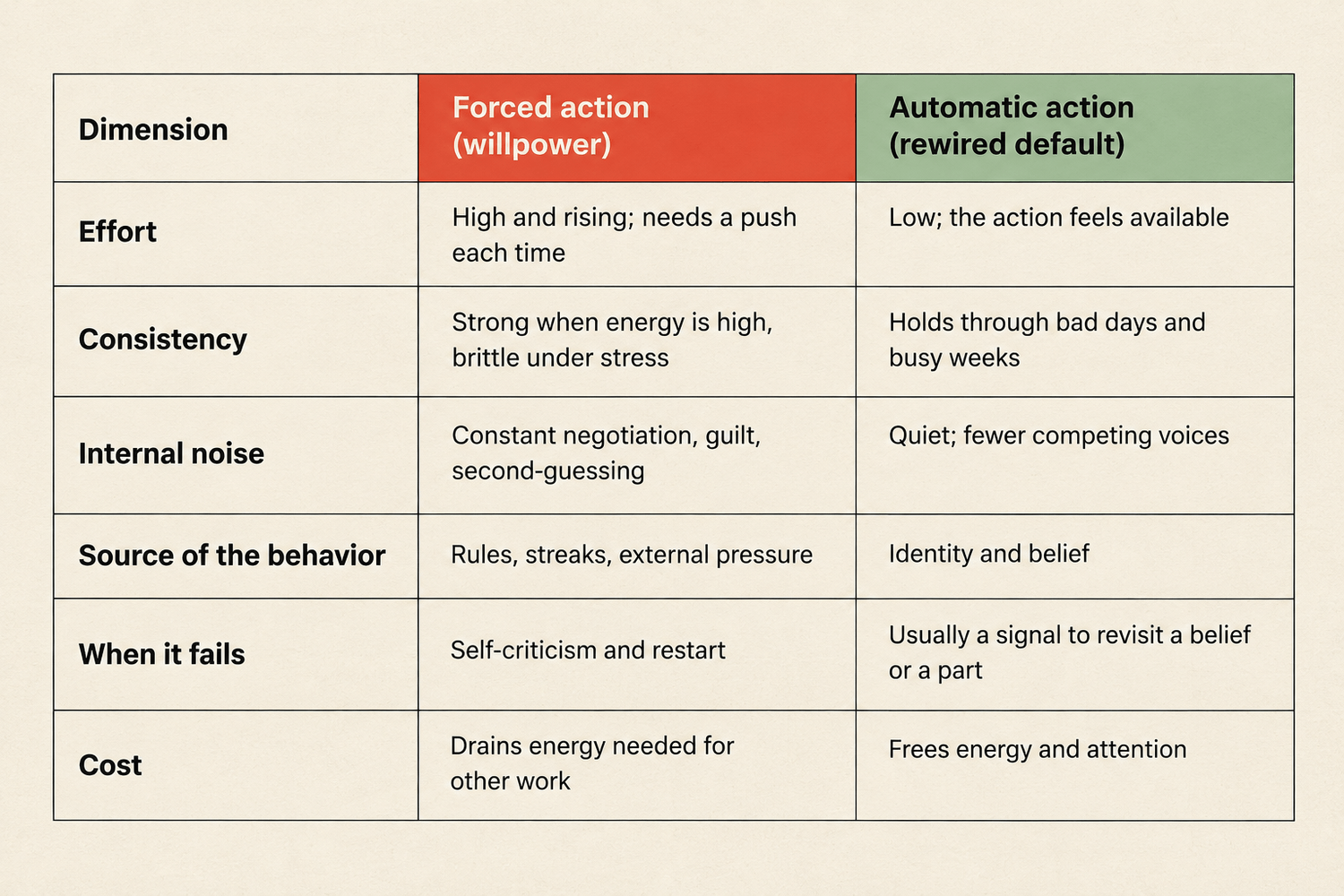
The measure of Generate is simple: you stop deciding. You don't consult a mental argument about whether you'll speak up, send the email or take the rest day. The response is already there. That is what "habit without willpower" actually means: not the absence of effort in life, but the absence of an internal fight over every step.
Forced Action vs. Automatic Action: What Changes When Habits Run Without Willpower
NLP vs. Hypnosis vs. Coaching vs. Therapy: What's the Difference?
If you're comparing approaches, here is an honest map. They overlap, they serve different needs, and none is the right answer for everyone.
Therapy (psychotherapy, counseling) is a clinical discipline for diagnosing and treating mental health conditions, working through trauma, and supporting people in acute distress. Practitioners are licensed and regulated. If you are dealing with depression, anxiety disorders, trauma or anything affecting your safety, start here. Research support for approaches like cognitive behavioral therapy is substantial.
Coaching focuses on goals, performance and forward movement for people who are generally functioning well. It is not regulated in the same way, so the quality varies widely. The strongest coaching is structured and specific rather than motivational.
NLP (Neuro-Linguistic Programming) is a set of communication and change techniques, including reframing, parts work and anchoring. Many practitioners find it effective in practice. The scientific evidence for NLP as a whole is limited and mixed, and I think that's worth saying plainly. I use specific techniques because they produce observable shifts with clients, and I treat them as tools, not as proven science.
Hypnosis uses focused attention and relaxation to work with suggestion and imagery. It has more research support than NLP, notably in areas like pain management and some anxiety applications, though its evidence for changing everyday habits specifically is more modest and depends on the person and the method.
Where my approach sits: a coaching framework that borrows from NLP and hypnotic-style methods, aimed at belief-level change in people who are functioning but stuck. It is not therapy and doesn't replace it. If we work together and I think you need clinical support, I'll tell you.
Is Mindset Reprogramming Right for You?
This is likely a fit if:
You're accomplished by outside measures but feel internally conflicted or disconnected.
You've tried productivity systems and they work briefly, then fade.
You recognize imposter syndrome, self-sabotage or chronic overthinking in your own behavior.
You know what you want to do, and the gap is in doing it consistently and without a fight.
You're willing to do honest reflection and practice between sessions.
This is probably not a fit if:
You're in acute crisis, or dealing with a diagnosed mental health condition that needs clinical treatment.
You want a quick fix or a guaranteed outcome.
You're looking for tactics or a task manager rather than a change in how you operate.
You're not ready to examine your own patterns.
Not sure which side of that list you're on? Start with the free 20-minute training. It takes less time than most podcasts, and it will tell you whether this kind of work is what you've been missing.
How Does a 6-Week Mindset Reprogramming Program Work?
Every client is different, and I make no promises about outcomes. This is the general arc of the program.
Weeks 1 to 2, Disconnect. We map your triggers and automatic responses, practice pattern interrupts, and build the awareness that makes everything else possible.
Weeks 3 to 4, Integrate. We identify the parts of you in conflict, uncover what each is protecting, and negotiate behaviors that serve both.
Weeks 5 to 6, Generate. We locate and loosen the limiting beliefs underneath, install replacements through rehearsal, and test them in real situations so you leave with a way to keep going on your own.
The work is one-on-one and private, and it includes practice between sessions. Change tends to continue after the six weeks, but how far and how fast depends on you and on how deep the patterns run.
Frequently Asked Questions About Rewiring Habits
Does Hypnosis Really Change Habits?
Hypnosis can help some people change habits by using focused attention and imagery to strengthen new responses, and research supports it more in areas like pain and certain anxiety contexts than in habit change in general. In my work it is one tool among several, used alongside awareness and belief work, not a standalone switch.
How Long Does Mindset Reprogramming Take?
There is no universal timeline. Habit research shows wide variation in how long behaviors take to become automatic, from a few weeks to many months. My program runs six weeks, which is enough to establish the core shifts and a method for continuing, though results vary and I don't guarantee specific outcomes.
Can I Rewire My Habits on My Own?
You can start alone. Tracking triggers, practicing pattern interrupts and questioning your beliefs are all self-directed. The difficulty is that the beliefs and parts running your patterns are the hardest things to see from inside, which is why many high achievers find an outside perspective speeds things up. If you try it alone and keep hitting the same wall, that's useful information.
Book a Clarity Call to Start Building Habits Without Willpower
You probably don't have a discipline problem. You have a pattern that has been running longer than any habit tracker you've tried. Habits without willpower start when someone helps you find what's actually holding the old one in place.
Bring the one habit you keep failing at to a clarity call. We'll look at it together, and you'll leave knowing whether this approach fits. If it doesn't, I'll tell you on the call.
Book your clarity call.
Not ready to talk yet? Watch the free training on the 5 mindset shifts first. It's 20 minutes, and you can book the call once you know whether the approach fits.
About the Author
By Milan | Founder of Milan'Z Coaching | NLP & Hypnotherapy Master Practitioner | Neural Reprogramming Coach | Creator of MSIP | Helping entrepreneurs and high-achieving professionals overcome imposter syndrome, self-doubt, and limiting beliefs since 2014. [About Milan]




UNLOCK FREE MINDSET TRAININGS & EXCLUSIVE DISCOUNTS YOU WON'T FIND ANYWHERE ELSE!
Subscribe to the newsletter and join driven entrepreneurs, solopreneurs, executives, business owners, and high-achieving professionals on a mission to become unstoppable forces for good.
GET MINDSET STRATEGIES DELIVERED TO YOUR INBOX
Unlock free mindset trainings, neural reprogramming techniques, and
exclusive discounts. Join entrepreneurs, executives, and high-achievers
breaking through their mental blocks.
CONNECT WITH MILAN
Got questions about Breakthrough Coaching or Neural Reprogramming?
Send me a message—I read every email.
FREE RESOURCES
© 2026 Milan'Z Coaching