
How to Change Limiting Beliefs: Why Affirmations Backfire (and the Identity-Level Fix)
If you searched how to change limiting beliefs, you’re not looking for “good vibes.” You’re looking for a real method to stop self-sabotage, reprogram subconscious beliefs, and finally feel aligned with the success you already have on paper. You’ve tried affirmations. You’ve tried mindset hacks. And somehow you still hit the same invisible ceiling—like your results move forward, but your identity won’t come with you.
Affirmations don’t fail because you’re broken. They fail because most people use them like motivational wallpaper: they paste a positive sentence over a negative core belief and wonder why their nervous system revolts.
If you’ve ever told yourself “I am confident” while your stomach tightened and your brain fired back with “No you’re not,” you’ve already found the real problem: your mind isn’t resisting positivity—it’s defending identity. And identity-level beliefs don’t change through force. They change through credibility, congruence, and repetition in the right state.
Why do affirmations backfire?
Affirmations backfire when they clash with your current identity, so your mind argues and your body tightens. The fix is to change limiting beliefs in believable steps: start with truth-based affirmations, progress gradually, check for bodily congruence, then install the belief using relaxation, repetition, and visualization. Consistent practice builds real identity change.
There’s even research pointing at this exact mechanism. A well-known Psychological Science study (Wood, Perunovic, & Lee, 2009) found that certain positive self-statements can make people with low self-esteem feel worse—because the statement collides with what their mind already believes and triggers pushback.
This article does two jobs at once: it gives you a practical method for identity-level change (the kind that sticks), and it explains—at a psychological level—why affirmations don’t work the way people are taught to use them.
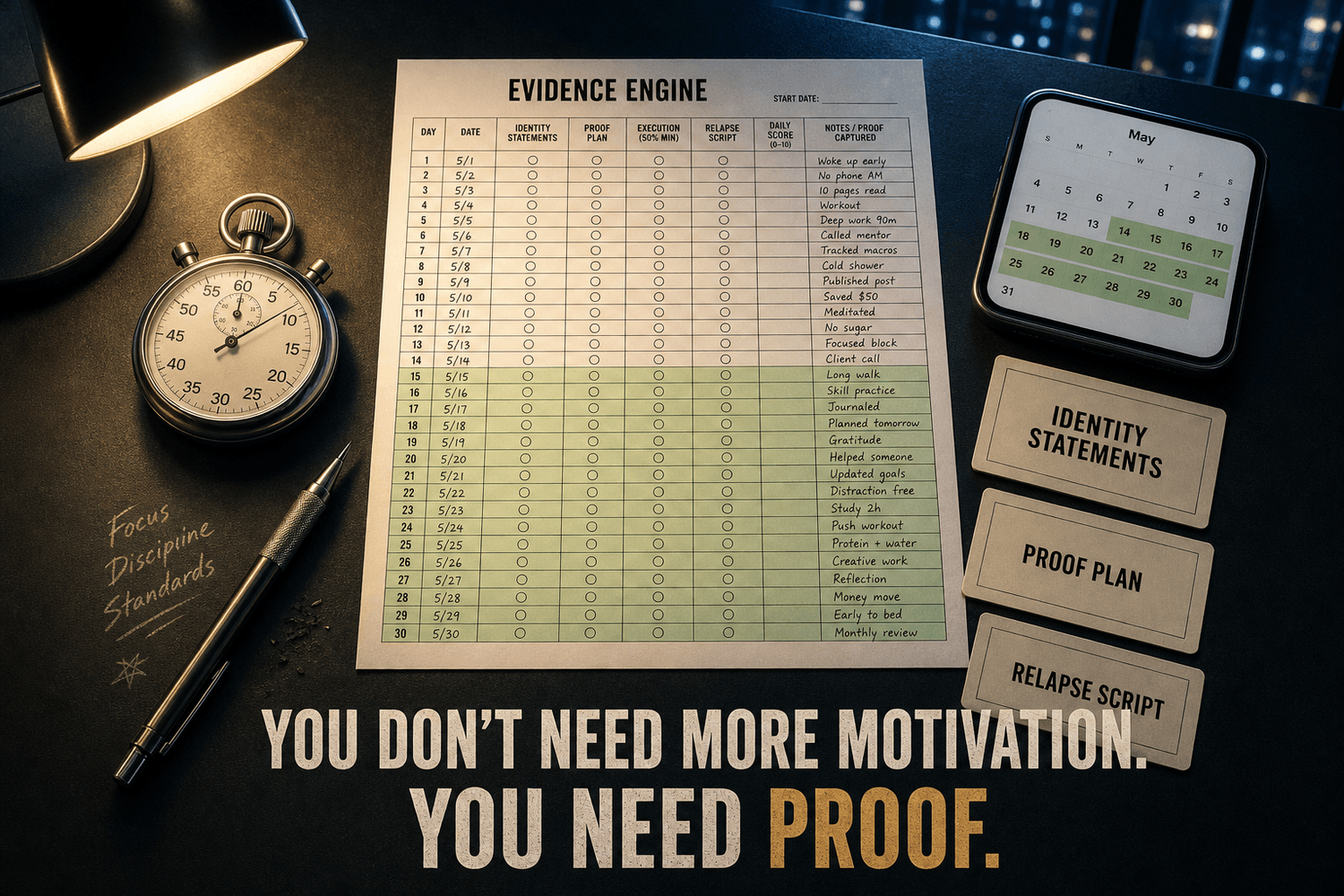
If you want to apply this without guessing, I built a guided workbook that does what most “mindset tips” never do: it isolates the exact identity-level belief running the loop, then gives you a simple proof system so the new identity becomes your default. It’s called The Identity Rewrite & Evidence Engine Workbook—and it’s designed like a strategic session you can work through in one focused sitting, then run for 14–30 days.
Download the Identity Rewrite & Evidence Engine Workbook
And if you’re ready to go beyond foundational work, my Executive Self-Talk Course is advanced—it’s for people who want to rebuild the internal dialogue that drives decisions under pressure surgically.
Explore Executive Self-Talk → HERE

How to change limiting beliefs
Limiting beliefs change when you stop arguing with your current identity and start installing new beliefs that are believable, body-safe, and repeated in a relaxed state. Traditional affirmations backfire because they create internal contradiction (“I am confident” vs. “I’m not”), triggering resistance. The fix is identity-level belief change: start with truth-based affirmations, progress gradually, check bodily congruence, and use relaxation + visualization + consistent repetition to rewire the pattern.
Why you’re really searching this
People don’t search “limiting beliefs” because they love personal development vocabulary. They search it because life looks fine on paper—but internally, something keeps misfiring.
You might recognize one (or several) of these patterns: you overthink simple decisions, then punish yourself for not acting. You do well, but you don’t feel successful. You start strong, then mysteriously stall. You set higher goals, but your behavior quietly returns to familiar limits—procrastination, perfectionism, people-pleasing, scrolling, numbing, second-guessing.
That’s not laziness. That’s a belief.
More precisely: a belief that has become an identity rule. And when a belief is an identity rule, your system will protect it—even when it hurts you—because it’s predictable.
If this pattern keeps showing up as delay, perfectionism, or pulling back right before momentum, Entrepreneur Self-Sabotage: 9 Signs will help you spot how identity conflict turns into behavior.
What is a limiting belief? (simple definition + identity-level meaning)
A limiting belief is not just a negative thought. It’s a rule your brain treats as true—about who you are, what’s safe, and what’s possible—built from experience, emotion, repetition, and interpretation.
In other words: a limiting belief is usually a core belief wearing a thousand disguises.
In real life, limiting beliefs show up as identity statements like:
“I’m not the kind of person who…”
“If I go for what I want, I’ll be judged.”
“Success always costs my peace.”
“I have to be perfect to be accepted.”
“I always mess it up in the end.”
These aren’t opinions. They’re operating instructions. They shape your decisions, your risk tolerance, and your follow-through.
Why affirmations backfire (the real mechanism)
Most affirmations fail for one reason: they create identity conflict without integration. Your system feels the gap and pushes back.
Why “positive affirmations” feel fake (and trigger resistance)
If your current self-concept is “I’m behind, I’m inconsistent, I’m not confident,” then repeating “I am unstoppable” doesn’t inspire you. It triggers a mental objection.
And the bigger the gap between the affirmation and your lived identity, the stronger the objection. You don’t get transformation—you get an internal debate.

How your body exposes belief incongruence (tight chest, tension, shutdown)
Here’s the part most people ignore: beliefs live in your body, not just your thoughts.
When you say a statement that doesn’t fit, your body often signals it immediately: tightness, heaviness, a flinch, shallow breath. That’s not “bad energy.” That’s incongruence.
The worksheet makes this practical: when you state an affirmation, check your body—a positive reaction feels good and relaxed; a negative reaction feels tense or uncomfortable. If it’s tense, adjust the statement until it becomes believable.
Why willpower fails at belief change (state beats effort)
Affirmations are not magic words. They’re input. And input only installs when the system is receptive.
The worksheet’s method is simple and specific: relax first, then repeat your affirmation slowly and mindfully, then visualize a specific moment when you embodied the trait, then repeat regularly. That sequence matters because state determines suggestibility. If you’re stressed and forcing positivity, you rehearse conflict. If you’re relaxed and credible, you rehearse identity.
The identity-level fix for changing limiting beliefs (credibility over hype)
If you want an affirmation to work, it must do three jobs: it must be believable enough that your mind doesn’t reject it, safe enough that your body doesn’t fight it, and repeated enough that your brain starts treating it as familiar.
That’s not hype. That’s how learning works—and it’s also the cleanest form of subconscious reprogramming you can do without turning it into a performance.
The worksheet lays out a four-step installation process: start with truth, progress gradually, check your body, then use relaxation + repetition + visualization + consistent practice to strengthen the belief.
Quick note before you jump into the steps: if you’ve ever done “affirmation work” and still ended up back in the same pattern, it’s usually because you didn’t build an Evidence Engine—meaning, you didn’t set up a way to collect proof that the new identity is real. That’s exactly why the Identity Rewrite & Evidence Engine Workbook exists: it walks you from the old identity belief to the new identity decision rules, then into a 14–30 day proof plan that makes the change stick.
Grab it here → WORKBOOK
How to change limiting beliefs: Truth → Tension → Transition
Step 1: Start with truth-based affirmations (credible, not fantasy)
Most people try to jump from “I doubt myself” to “I’m wildly confident.”
Your system hears: “We’re pretending.”
Instead, start where your nervous system can agree. The worksheet calls these truth-based affirmations, like changing “I am very patient” to “Sometimes, I can be patient.”
This looks small. It’s not. It’s the difference between installing a belief and starting an argument.
Examples (identity-safe upgrades):
If your pattern is imposter syndrome:
“Sometimes, I trust my judgment.”
“In some situations, I can lead clearly.”
“I have evidence that I can handle hard things.”
If your pattern is procrastination:
“Sometimes, I start even when I don’t feel ready.”
“I can take one small action today.”
“I’m learning to build momentum.”
If your pattern is overthinking:
“Sometimes, my first answer is good enough.”
“I can make decisions without total certainty.”
“I can choose progress over analysis.”
The goal isn’t inspiration. The goal is agreement.
If your affirmations keep colliding with a harsh inner voice in high-pressure moments, Negative Self-Talk at Work: What High-Achievers Get Wrong explains why the problem is often not just the words, but the way your internal dialogue is delivered.
Step 2: Gradual progression (how identity shifts in increments)
Once the statement becomes easy to say without internal pushback, upgrade it.
The worksheet gives a clean progression: “Sometimes, I can be patient” → “Often, I can be patient” → “I am usually patient.”
That’s how you build identity: small claims that become normal claims.
Step 3: Check bodily congruence (your nervous system is the lie detector)
Say your affirmation and scan your body.
If you feel a relaxed “yes,” you’ve found a belief your system can install. If you feel tension, constriction, nausea, tight chest—your system is signaling mismatch. The worksheet is direct about this: notice the positive vs. negative body reaction and modify the statement if it feels tense or uncomfortable.
Fast rule: If your body says “no,” repeating it trains resistance—not change.
Step 4: Neural Reprogramming (NR) installation (relaxation + repetition + visualization)
This is where most advice gets vague. The worksheet doesn’t.
Use this four-part NR sequence:
Relaxation: get comfortable and breathe.
Affirmation: repeat the truthful affirmation slowly and mindfully.
Visualization: visualize a specific moment when you lived the trait.
Repetition: practice regularly to strengthen the affirmation.
This works because you’re pairing the new belief with a calmer body (less threat), a credible statement (less pushback), and a memory of proof (more identity evidence).
Evidence loops: the fastest way to reprogram subconscious beliefs
Visualization isn’t about pretending you’re already perfect. It’s about remembering proof that contradicts the limiting belief.
The worksheet instructs you to visualize a specific moment when you showed the desired trait—patience, confidence, follow-through, whatever you’re reinforcing.
Keep it specific and real: the time you stayed calm in a hard conversation, the time you finished something even when you wanted to quit, the time you spoke up and didn’t collapse afterward. Those moments are identity bricks.
This is also why “motivation” doesn’t last. Identity doesn’t change because you hype yourself up. Identity changes because you collect proof and your brain starts trusting it.
And if the deeper issue is the internal picture you keep carrying about yourself, How to Improve Self-Image: 7 Steps to Build Real Confidence breaks down how self-image shapes confidence, self-trust, and what your mind will actually let you believe.
And if you’re ready to go beyond foundational work, my Executive Self-Talk Course is advanced—it’s for people who want to surgically rebuild the internal dialogue that drives decisions under pressure.
Explore Executive Self-Talk → HERE
The Law of Attention (what you focus on becomes your identity filter)
Here’s what ruins most affirmation work: people repeat a new belief in the morning, then spend all day looking for evidence they’re failing.
So the nervous system asks: “Which one are we practicing—the affirmation or the obsession?”
The worksheet calls this The Law of Attention: focus on moments of the desired trait, notice and appreciate those qualities during your day. That’s not fluffy. That’s reinforcement.
You are always training a filter. Train it on proof of growth.

7-day protocol: how to change limiting beliefs without forcing positivity
Pick one limiting belief you want to change. Not five. One.
Days 1–2: write a truth-based affirmation (credible, body-safe).
Days 3–4: upgrade to the next progression statement only if your body stays relaxed.
Days 5–7: keep upgrading only when the statement still feels congruent.
Each day, run the NR sequence:
Relax for a minute with slow breathing.
Repeat your truthful affirmation slowly and mindfully.
Visualize one specific moment you embodied the trait.
Repeat regularly—consistency beats intensity.
Then throughout the day, use the Law of Attention: notice moments you’re already doing it, even slightly. The worksheet also emphasizes building positive momentum by moving from general value statements (“It’s good to be patient”) toward personal identity statements (“I like it when I am patient”), reinforcing the direction you want to become normal.
“What if my limiting belief feels deeply true?” (the high-achiever problem)
High-achievers rarely carry the simple belief “I’m worthless.” Their beliefs are sharper. They’re built like contracts.
They sound like this:
“If I slow down, I’ll fall behind.”
“If I succeed, expectations will crush me.”
“If I’m visible, I’ll be judged.”
“If I relax, I’ll lose my edge.”
These beliefs aren’t random. They’re protective. They were built to keep you safe, accepted, or in control.
So if you attack them with aggressive affirmations, your system doesn’t transform—it defends. That’s why truth-based affirmations work: they don’t start a war. They start a negotiation.
What this looks like in real life (quick case example)
One of the most common patterns I see is the “confident on the outside, spiraling on the inside” high-achiever. They can run meetings, hit targets, and look calm—then lie awake replaying one sentence they said, convinced they sounded stupid.
When they try the classic affirmation “I am confident,” they get a punch of tension in the chest and a louder inner critic. When we switch to a truth-based version—“Sometimes I can trust myself in the room”—the body softens. From there, we build evidence loops: one real moment per day where they acted with calm authority. Within days, decision-making gets cleaner because the identity isn’t fighting the action anymore.
That’s the point. You’re not trying to “be positive.” You’re trying to become believable to yourself.
FAQ: changing limiting beliefs, affirmations, and identity change
Why do affirmations make me feel worse?
Because a statement that contradicts your current identity triggers pushback. You feel it as anxiety, irritation, or self-criticism. If your body feels tense when you repeat an affirmation, it’s a sign the statement isn’t congruent yet and needs to be more truthful and believable.
What are truth-based affirmations?
Truth-based affirmations are believable statements your system can agree with now, like “Sometimes, I can be patient,” instead of absolute claims like “I am very patient.” They reduce resistance and create a stable foundation for gradual identity change.
How do I know if an affirmation is working?
Your body is the fastest indicator. If you feel relaxed or open while saying it, that’s a good sign. If you feel tense or uncomfortable, adjust the wording until it becomes credible.
What’s the best way to use affirmations to change limiting beliefs?
Use a sequence: relax first, repeat a truthful affirmation slowly and mindfully, visualize a specific moment when you embodied the trait, then repeat consistently. That NR approach lowers resistance and strengthens the belief through practice.
How long does it take to change a limiting belief?
It depends on how ingrained the pattern is and how consistently you reinforce the new identity. The fastest path isn’t intensity—it’s credibility, repetition, and proof-building through attention and visualization.
A note on trust (what this method is—and what it isn’t)
I’ve watched the same pattern play out again and again: people don’t fail at affirmations because they “don’t want it enough.” They fail because they try to install an identity their system doesn’t trust yet. When you make the statement credible and body-safe, the fight drops and the learning starts.
This is educational coaching content, not therapy or medical advice. If you’re experiencing severe anxiety, trauma symptoms, or anything that feels unmanageable, work with a licensed professional and use these tools as a support layer—not a replacement.
If you’ve done basic mindset work before, don’t underestimate what happens when you upgrade from “repeating a statement” to building proof. The Identity Rewrite & Evidence Engine Workbook is the cleanest starting point. And if you’re ready to go beyond foundational work, my Executive Self-Talk Course is advanced—it’s for people who want to surgically rebuild the internal dialogue that drives decisions under pressure.
Get the workbook -> here
If you want the advanced layer next, explore Executive Self-Talk → COURSE LINK
Conclusion
If you want how to change limiting beliefs to stop being something you read about and start being something you can feel, stop repeating affirmations that your body rejects. Pick one belief, write a truth-based version that your nervous system can say “yes” to, run the relaxation + repetition + visualization sequence for seven days, and then book a clarity call so we can rip out the next core belief at the root instead of fighting the symptoms again.
For the full three-phase model behind belief change, see How High Achievers Rewire the Brain: Habits Without Willpower.
About the Author
By Milan | Founder of Milan'Z Coaching | NLP & Hypnotherapy Master Practitioner | Neural Reprogramming Coach | Creator of MSIP | Helping entrepreneurs and high-achieving professionals overcome imposter syndrome, self-doubt, and limiting beliefs since 2014. [About Milan]





UNLOCK FREE MINDSET TRAININGS & EXCLUSIVE DISCOUNTS YOU WON'T FIND ANYWHERE ELSE!
Subscribe to the newsletter and join driven entrepreneurs, solopreneurs, executives, business owners, and high-achieving professionals on a mission to become unstoppable forces for good.
GET MINDSET STRATEGIES DELIVERED TO YOUR INBOX
Unlock free mindset trainings, neural reprogramming techniques, and
exclusive discounts. Join entrepreneurs, executives, and high-achievers
breaking through their mental blocks.
CONNECT WITH MILAN
Got questions about Breakthrough Coaching or Neural Reprogramming?
Send me a message—I read every email.
FREE RESOURCES
© 2026 Milan'Z Coaching