
How to Stop Comparing Yourself to Others in 5 Steps
If you searched for how to stop comparing yourself to others, you are probably not looking for another soft reminder to “just focus on yourself.” You want the real fix. You want to know why someone else’s success can throw you off your center, drain your confidence, and make you feel behind even when your own life looks solid from the outside.
I know that pattern because I lived it. There was a season of my life when I looked successful on paper, kept performing, kept producing, and still felt disconnected underneath it all. What finally changed things was not more motivation, better productivity hacks, or surface-level positive thinking. It was learning how to interrupt the deeper pattern driving the comparison in the first place.
That is what this article is about. Not generic self-help. Not hustle culture. Not “be grateful and move on.” A real reset for high achievers who are tired of getting hijacked by the comparison trap.

How do you stop comparing yourself to others?
You stop comparing yourself to others by catching the trigger early, naming the meaning you attach to someone else’s success, identifying the fear underneath it, reconnecting to your own standards, and taking one immediate action that puts you back in motion.
Here is the short version:
Catch the comparison loop early.
Name what you are making their success mean about you.
Find the deeper fear or belief underneath it.
Re-anchor to your own values, pace, and definition of success.
Take one aligned action that rebuilds self-trust.
That is the reset. Not because comparison magically disappears forever, but because you stop letting it run your identity.
Before you go deeper, take The Pattern Recognition Test. It’s a short quiz that tells you your personal Mental Imposter Type—the specific pattern behind how comparison hooks you (so you stop fighting the wrong enemy).
You’ll also get access to the Inner Critic Contract Audit Workbook, built for high performers who don’t need motivation—they need their innner critic to stop sabotaging their execution.
Take the Pattern Recognition Test now →
Get your Mental Imposter Type + the Inner Critic Contract Audit Workbook delivered instantly.
Why high achievers compare themselves to others
Comparison is usually not a confidence problem first. It is an identity problem.
High achievers compare because they care. They have standards. They have vision. They know what they are capable of. But when identity gets fused with performance, someone else’s win stops feeling like neutral information and starts feeling personal.
It becomes evidence.
Evidence that you are late.
Evidence that you are not enough.
Evidence that you are wasting your potential.
Psychologist Leon Festinger, who introduced social comparison theory, explained that people naturally evaluate themselves in relation to others. That part is normal. The problem starts when comparison stops being information and becomes self-judgment. That is when ambition turns on you.
In my work with high achievers, this is almost never about laziness or lack of discipline. It is usually about conditional self-worth. The unconscious rule sounds something like this: I am valuable when I am ahead, admired, productive, chosen, visible, or winning. Once that rule is active, your brain gets very good at scanning the room for proof that you are losing.
If comparison gets loudest when you’re by yourself, this is the missing piece: how to stop negative self‑talk when you’re alone.

Why do I compare myself to others even when I’m successful?
Because success does not automatically update identity.
You can build a business, hit goals, make money, get praise, and still carry the same internal belief that your worth depends on what you achieve. External progress changes your circumstances. It does not always change the pattern underneath them.
That is why so many ambitious people feel confused by this. They think, I should be past this by now. But if the deeper belief is still intact, each new level just gives comparison a more sophisticated costume.
A lot of comparison is misdiagnosed as ‘low confidence’—this breakdown of self‑worth vs self‑esteem vs confidence shows which layer is actually getting hooked.
What comparison actually does to your mind
The biggest damage comparison causes is not low confidence. It is distorted perception.
When you compare yourself to others, you forget context. You compare your raw footage to their highlight reel. You compare your internal doubts to their public certainty. You compare your beginning, middle, and breakdowns to their polished result.
Then the spiral gets stronger.
You stop seeing your own season clearly.
You stop recognizing your own growth.
You stop trusting your own pace.
You stop focusing on your own life.
That is where comparison turns into self-sabotage.
If that pattern shows up for you in other areas too, read how to stop self-sabotage and why overthinking is really a protection pattern. They usually sit closer together than people think.
How comparison turns ambition into self-attack
Ambition is healthy when it pulls you forward.
It becomes destructive when it becomes a weapon you use against yourself.
I have seen this with founders, coaches, and high-performing professionals who looked driven from the outside but were actually living under internal attack. They were not being moved by purpose. They were being chased by shame.
One client came to me convinced she needed more discipline. On the surface, that sounded true. In reality, she was spending hours comparing herself to people in her industry, then using that emotional hit to prove she was behind. The result was not better action. It was freezing, second-guessing, and constantly changing direction. What she needed was not more pressure. She needed the pattern broken at the root.
If your comparison spiral turns into ‘I’m a fraud,’ use this practical reset: how to overcome imposter syndrome as an entrepreneur.
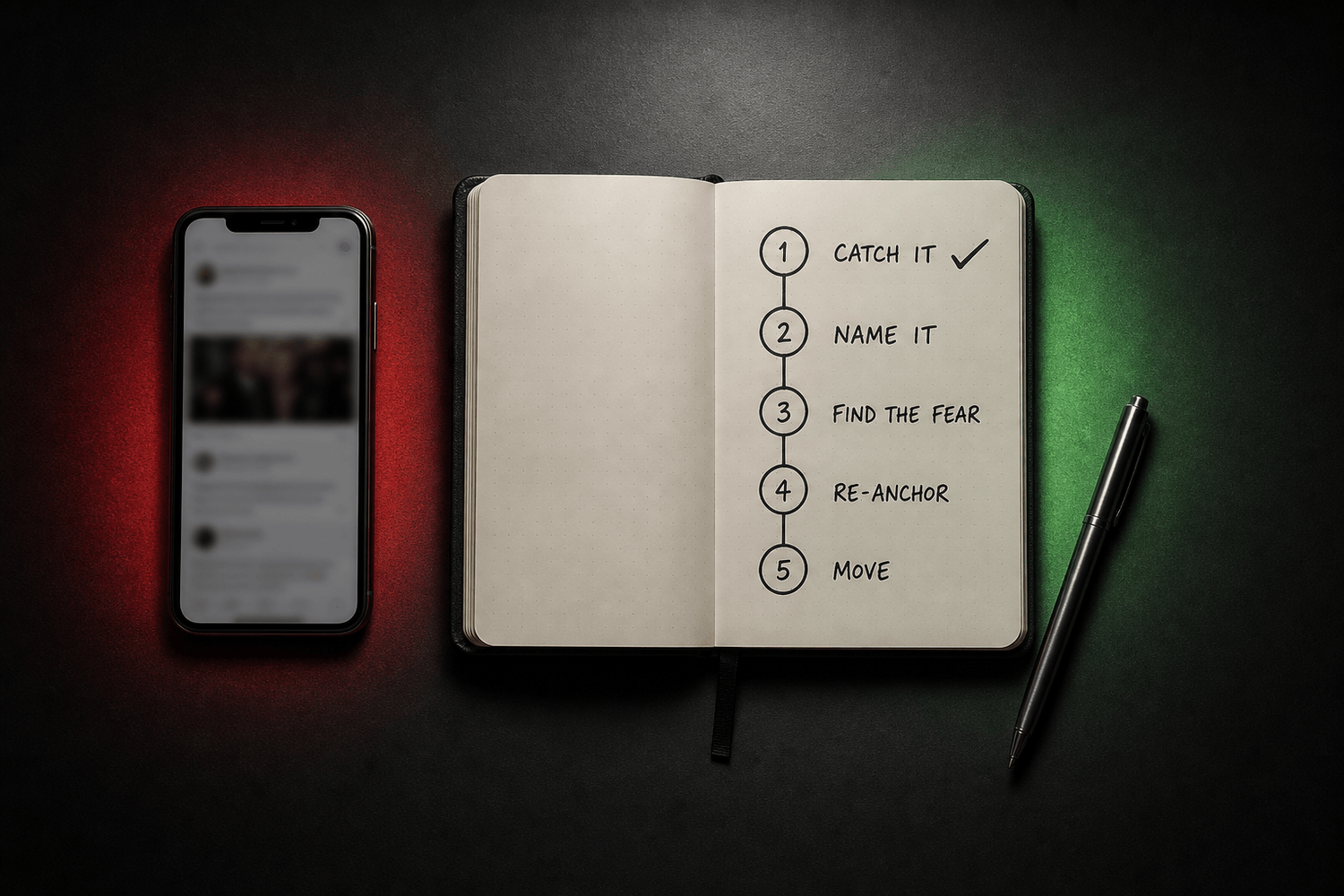
The 5-step reset for high achievers stuck in the comparison trap
Most articles stop at “practice gratitude” or “remember everyone is on their own journey.” That is not wrong. It is just too shallow to change anything that runs at the identity level.
If you want to know how to stop comparing yourself to others in a way that actually sticks, you need to work with the pattern, the belief, and the behavior.
Step 1: Catch the comparison loop before it becomes a spiral
The earlier you catch it, the easier it is to reset.
Comparison has a beginning. There is always a moment of activation before the full spiral takes over. It might happen when you scroll social media, hear someone else’s results, see a peer getting attention, or notice somebody moving faster than you in an area that matters.
The first skill is not arguing with the thought. It is naming the pattern.
Say it plainly:
“I’m in comparison right now.”
“My brain is scanning for evidence that I’m behind.”
“This feels true, but it is still a pattern.”
That separation matters. Once you can observe the pattern, you stop merging with it.
This is where the pattern usually reveals itself. If you want the fastest shortcut, The Pattern Recognition Test will pinpoint your Mental Imposter Type in minutes—so you can recognize your default comparison story before you believe it. It also unlocks the Inner Critic Contract Audit Workbook, where I show you how to rewrite the internal script that keeps turning other people’s wins into evidence against you.
Step 2: Name what you are making their success mean about you
This is the step most people miss.
Someone else’s success is rarely the real problem. The meaning you attach to it is.
You do not just see their visibility and think, good for them. You make it mean:
I’m late.
I’m invisible.
I’m not enough.
I missed my chance.
If I were really capable, I would already be there.
That is where comparison gets emotional power. Observation fuses with identity.
Use this sentence stem:
What I’m making this mean is…
Then answer it honestly.
Not the polished answer. The real one.
This is where a lot of people first realize they are not actually upset by someone else’s result. They are upset by the story their brain instantly built around it.
Step 3: Find the deeper fear underneath the comparison
Comparison is usually a surface symptom.
Under it, there is often a more vulnerable fear:
fear of being ordinary
fear of never becoming who you thought you would be
fear that you are too late
fear that no matter what you achieve, it will never feel like enough
fear that love, approval, or safety has to be earned through excellence
When you ask, Why do I compare myself to others? this is where the real answer starts.
A lot of high achievers have an internal split. One part wants growth, visibility, impact, money, and expansion. Another part is scared of judgment, rejection, exposure, or failure. Comparison becomes the perfect distraction because it keeps your attention on other people instead of on the conflict inside you.
Ask yourself:
What fear gets activated when I see someone doing what I want to do?
Then go one layer deeper:
What have I believed I need to prove in order to feel enough?
That is where the pattern stops looking random and starts looking changeable.
If this hits the same nerve as imposter syndrome in high achievers, that is not a coincidence. Comparison and imposter syndrome usually feed each other.
Step 4: Re-anchor to your own standards, pace, and definition of success
If comparison is outsourced identity, this is where you take your authority back.
You need an internal standard. Otherwise, you will keep borrowing one from the internet, your industry, your peers, your family, or whoever looks most convincing that week.
Not every goal you are chasing is still yours. Some goals were inherited. Some were copied. Some were built from ego hunger. Some were built from pain. Some came from genuine desire. Those are not the same thing.
Ask yourself:
What does success actually mean to me now?
What kind of life am I trying to build, not just what kind of image?
What pace allows me to grow without abandoning myself?
What matters more to me than looking impressive?
How do I want to feel while I build this?
This is also how to stop feeling behind in life. You stop obeying timelines that were never truly yours in the first place.
A grounded standard sounds like this:
“My job is not to be ahead of everyone. My job is to become more aligned, more honest, more effective, and more self-trusting over time.”
That standard does not make you soft. It makes you harder to destabilize.
Step 5: Take one immediate action that rebuilds self-trust
Awareness matters. But if it never turns into action, it just becomes another form of self-observation.
Comparison creates paralysis. It fills your head and drains your agency. The reset is completed when you do something that says, I’m back in my own life now.
That action should be small, specific, and real.
Publish the post you were overthinking.
Send the pitch.
Make the offer.
Finish the task in front of you.
Review your own progress from the last 90 days.
Make the decision you keep delaying.
Self-trust is not built by affirmations alone. It is built by evidence.
Researcher Kristin Neff, known for her work on self-compassion, has shown that people do not become more effective by shaming themselves into change. They change more sustainably when they can stay honest without turning that honesty into self-attack. That matters here. The goal is not to baby yourself. The goal is to stop making shame your operating system.

How to stop comparing yourself to others on social media
Social media did not invent comparison, but it scaled it.
When you are exposed to hundreds of compressed identity signals every day, it gets much easier to feel like you are constantly being measured. Money. Status. Beauty. Productivity. Confidence. Relationships. Momentum. Certainty. It is all packaged, polished, and delivered fast.
If you keep comparing yourself to others on social media, do not turn it into a willpower problem. Change the environment.
A simple social media filter that actually helps
Use these rules:
Unfollow content that consistently leaves you feeling smaller.
Mute people you admire if their content keeps pulling you out of your own lane.
Follow people who expand your thinking without triggering self-rejection.
Create before you consume whenever possible.
Decide why you are opening the app before you open it.
Here is the real test:
Does this content move me forward, or does it pull me out of myself?
If it repeatedly pulls you out of yourself, the cost is too high.
Healthy inspiration vs destructive comparison
This distinction matters because not every reaction to someone else’s success is bad.
Healthy inspiration sounds like: That expands what’s possible.
Destructive comparison sounds like: Their success proves I’m behind.
Healthy inspiration creates energy.
Destructive comparison creates contraction.
Healthy inspiration moves you toward action.
Destructive comparison moves you toward shame, hiding, imitation, or panic.
Signs you are inspired
You feel energized.
You respect their win without reducing your own worth.
You feel pulled toward your own next step.
Your standards rise without your self-respect collapsing.
Signs you are caught in comparison
You feel tight, heavy, or agitated.
You start questioning your value, timing, or ability.
You want to disappear, binge-consume, or reinvent your whole strategy.
You stop trusting your own path and start chasing theirs.
Your body usually tells the truth before your intellect does.
When comparison starts changing your behavior (hesitating, hiding, pivoting), you’re in sabotage territory—start with why your brain works against you (self‑sabotage fix).
Why gratitude alone usually does not fix the comparison pattern
Gratitude can help regulate you. It just usually does not solve the root issue.
If the real belief underneath comparison is I’m only valuable when I’m exceptional, then writing down five things you are grateful for may calm you down for ten minutes without changing the mechanism that created the spiral.
That is why surface-level advice often fails high achievers. They do not need a prettier coping strategy. They need a deeper reset.
Comparison can become useful when you stop treating it like a moral failure and start reading it as data.
It shows you:
where your self-worth is still conditional
where your identity is still externally calibrated
where you are abandoning your own values to chase borrowed validation
where your inner parts are still in conflict
That does not make comparison good. It makes it workable.
Signs comparison is turning into self-sabotage
A lot of people think they have a discipline problem when what they really have is an internal conflict problem.
Watch for these signs:
You keep changing goals because someone else’s path looks better.
You consume more advice than you apply.
You delay publishing, selling, launching, or speaking up until you feel “ready.”
You dismiss your wins the second you see someone doing more.
You confuse visibility with value.
You feel behind no matter how much progress you make.
You work hard but still feel disconnected from your own life.
If that sounds familiar, read how to build self-trust after burnout. Comparison often gets stronger when your nervous system is already overloaded.
A better reframe: comparison is misplaced desire mixed with fear
This is one of the cleanest ways to break the spell.
When you compare yourself to someone, part of you is often seeing something you want permission for.
Maybe it is their certainty.
Maybe it is their visibility.
Maybe it is their standards.
Maybe it is their willingness to be seen before they feel fully ready.
Instead of collapsing into self-judgment, ask:
What is this showing me that I want to embody, allow, or claim?
That question changes the whole experience.
Comparison stops being a verdict. It becomes information.
How to stop feeling behind in life
Most people who feel behind are not actually behind. They are measuring themselves against timelines they never consciously chose.
They are obeying an invisible script.
By this age, I should have more money.
By this point, I should be more certain.
If I were really talented, I would already be further along.
If it were meant for me, it would look easier by now.
That script is usually a mix of culture, conditioning, industry pressure, and unchallenged beliefs.
If you want to stop feeling behind, stop using someone else’s pace as evidence about your value. Build a metric that reflects your real life, your real priorities, and the kind of person you actually want to be while you build.
Frequently asked questions about how to stop comparing yourself to others
Is it normal to compare yourself to others?
Yes. Social comparison is human. The issue is not that it happens. The issue is when it becomes chronic, identity-based, and emotionally destabilizing.
Why do I compare myself to others so much?
Usually because the comparison is hooking into a deeper belief about worth, timing, capability, or belonging. The visible trigger is another person. The real charge is the meaning you attach to what you see.
How do I stop comparing myself to others at work or in business?
Catch the trigger early, name the story you are making it mean, reconnect to your own standards, and move into one concrete action. If you stay in observation too long, comparison hardens into paralysis.
Can comparison ever be helpful?
Yes, if you use it as information instead of identity evidence. It can show you what you admire, what you want, and where your self-worth still gets pulled outside of you.
The line that resets the whole pattern
Stop using other people’s progress as proof about your value. Use your own alignment, honesty, and follow-through as the metric instead.
That is how to stop comparing yourself to others in a way that actually lasts.
Final word
If you want this to change permanently, you need to know which pattern you’re running. The Pattern Recognition Test gives you your Mental Imposter Type so you can stop using generic advice on a specific problem. And if you’re ready for deeper work, you’ll also get the Inner Critic Contract Audit Workbook—designed for high achievers who are done negotiating with their own mind.
About the Author
By Milan | Founder of Milan'Z Coaching | NLP & Hypnotherapy Master Practitioner | Neural Reprogramming Coach | Creator of MSIP | Helping entrepreneurs and high-achieving professionals overcome imposter syndrome, self-doubt, and limiting beliefs since 2014. [About Milan]





UNLOCK FREE MINDSET TRAININGS & EXCLUSIVE DISCOUNTS YOU WON'T FIND ANYWHERE ELSE!
Subscribe to the newsletter and join driven entrepreneurs, solopreneurs, executives, business owners, and high-achieving professionals on a mission to become unstoppable forces for good.
GET MINDSET STRATEGIES DELIVERED TO YOUR INBOX
Unlock free mindset trainings, neural reprogramming techniques, and
exclusive discounts. Join entrepreneurs, executives, and high-achievers
breaking through their mental blocks.
CONNECT WITH MILAN
Got questions about Breakthrough Coaching or Neural Reprogramming?
Send me a message—I read every email.
FREE RESOURCES
© 2026 Milan'Z Coaching