
Why Shame Kills Entrepreneur Motivation (And What Works)
If your entrepreneur motivation runs on self-criticism, you already know the voice. It shows up at 11 p.m. when the inbox isn't empty, when the launch underperformed, when a competitor raised the round you didn't. It says you should be further along by now. It says what's wrong with you. And for a long time, it worked — or felt like it worked, because the discomfort got you moving.
That voice has a name: shame-based motivation. It's quietly one of the most common drivers of entrepreneur motivation among founders, solopreneurs, and small business owners — and according to decades of behavioral psychology, one of the least sustainable ways to build a business or a life.
This article answers the question most "hustle harder" content never asks: if shame-fueled entrepreneur motivation works in the short term, why does it eventually collapse — and what actually replaces it once it does?
If your motivation collapses hardest at night or in silence, this is the missing piece: how to stop negative self‑talk when you’re alone.
What Is Shame-Based Motivation?
Shame-based motivation is what drains entrepreneur motivation from the inside: pushing yourself to act by attacking your self-worth rather than your behavior. It sounds like "I'm not a real entrepreneur" instead of "I missed a deadline." Effective entrepreneur motivation targets actions and strategy, not identity.
The distinction matters more than it seems. Shame targets identity ("I am bad"). Guilt targets action ("I did something bad"). Criticism, when it's constructive, targets a specific, changeable behavior. Only one of those three reliably produces lasting behavior change — and it isn't shame.
Psychologist and shame researcher Brené Brown's body of work draws this line clearly: shame correlates with addiction, depression, aggression, and disengagement, while guilt — when separated from identity attack — can actually correlate with constructive behavior change. Entrepreneurship, with its public scoreboard of revenue, growth, and visible "wins," is an unusually fertile environment for shame to take root, because it's easy to mistake a business outcome for a verdict on your worth as a person.
If the shame voice is loudest in quiet moments, read how to stop negative self‑talk when you’re alone.
Shame vs Guilt: What's the Real Difference?
People often use these words interchangeably. Psychologically, they are not the same input — and they don't produce the same output for entrepreneur motivation.
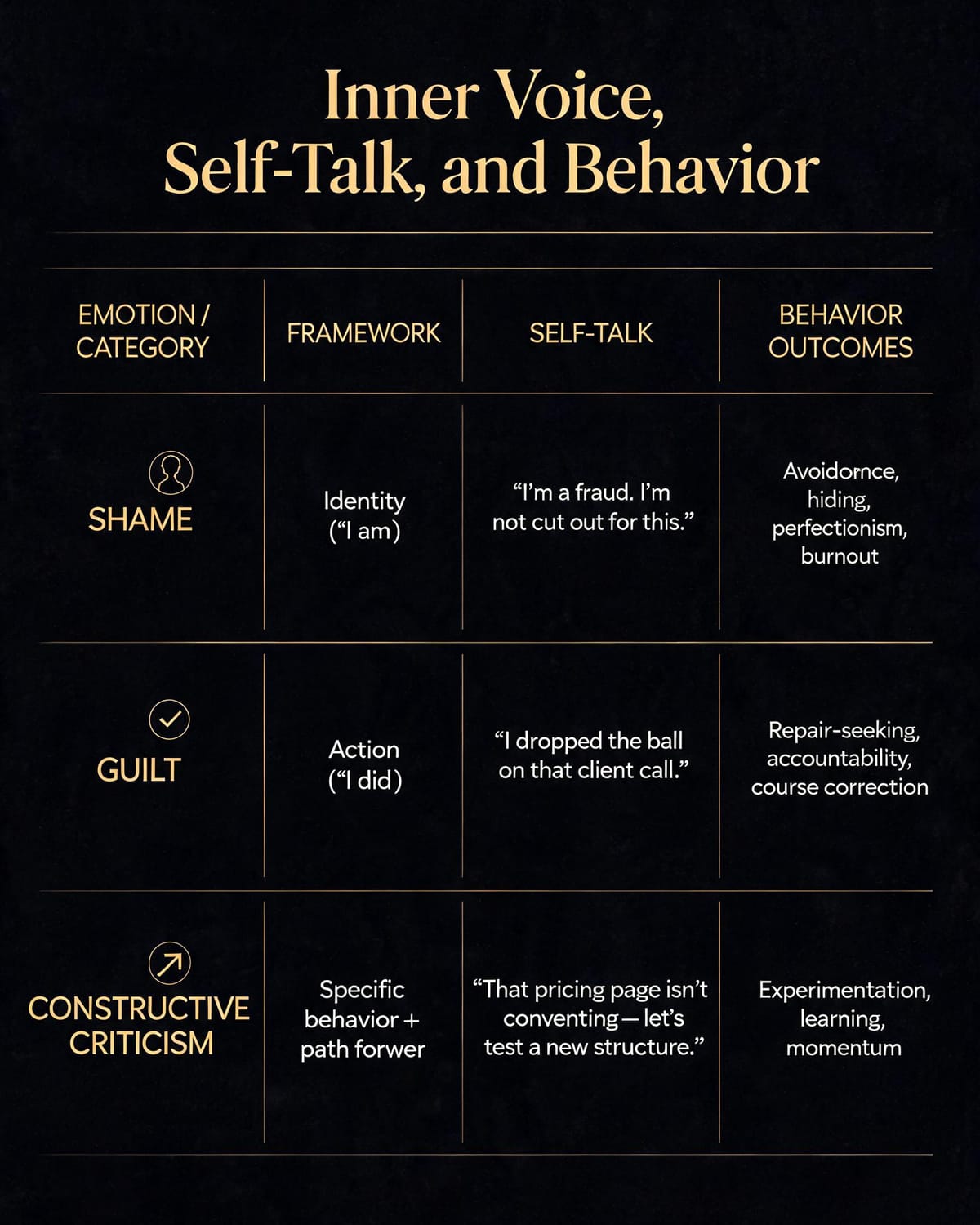
Shame is a verdict. Guilt is feedback. Criticism, done well, is a map. Only the last two leave you with something actionable. Shame leaves you with a reason to hide — and hiding is the opposite of what running a business requires.
Why Are Entrepreneurs So Prone to Shame-Based Motivation?
This isn't a personal failing limited to a few "overly sensitive" founders. The structure of entrepreneurship itself manufactures shame-prone conditions:
Identity fusion with the business. When your company is your name, your LinkedIn headline, your dinner-party answer to "what do you do," every business setback can feel like a personal one.
Public, comparable metrics. Revenue, funding, follower counts, and "overnight success" stories create a constant, visible scoreboard — and scoreboards invite comparison, and comparison invites shame.
Survivorship-bias culture. Founder content overwhelmingly highlights wins. The silent majority of struggle goes undocumented, so any individual founder's hard quarter feels uniquely shameful rather than statistically normal.
Isolation. Solo founders and small business owners often lack the peer feedback loops employees get from managers and teammates — so the internal critic becomes the loudest, and often only, voice in the room.
Conflation of self-worth and net worth. In a culture that treats business success as a proxy for personal value, a slow month can feel like an indictment of character rather than a normal fluctuation of a small business.
Imposter syndrome overlap. Shame-based motivation and imposter syndrome often travel together — both convince you that your wins are a fluke and your setbacks are proof of the "real" truth about your ability.
None of this means entrepreneurs are fragile. It means the environment is unusually good at generating the exact conditions under which shame masquerades as drive — and under which entrepreneur burnout quietly takes root.
Shame-based motivation and imposter syndrome are cousins—so if the ‘fraud’ story is part of your spiral, use how to overcome imposter syndrome as an entrepreneur as your reset.
Here's the thing about those five patterns: most founders don't run on all of them equally. One or two are usually doing the heavy lifting in your particular brand of self-sabotage — and knowing exactly which ones are yours is the fastest way to stop running them on autopilot.
Curious which pattern is driving yours?
Take the two-minute Pattern Recognition Test to find your Mental Imposter Type — and get instant access to the Inner Critic Contract Audit Workbook built specifically for it.

Why Does Shame-Based Motivation Eventually Stop Working?
Shame-based motivation is seductive because it produces short bursts of intense output. A scathing inner monologue can absolutely get you to finish the proposal at 1 a.m. The problem isn't that shame never works — it's what it costs, and when the bill comes due.
1. It borrows energy from your future self. Shame-driven sprints are often followed by avoidance, procrastination, or shutdown — the nervous system's natural response to chronic threat signaling. You don't get a sustainable cadence; you get a boom-bust cycle of intensity and collapse. This is one of the clearest early warning signs of entrepreneur burnout.
2. It narrows your thinking exactly when you need it to expand. Shame puts your brain into threat mode. That mode is great for escaping a predator. It's terrible for the creative thinking, planning, and smart risk-taking your business actually needs.
3. It trains avoidance, not ambition. When your real goal is just to stop feeling bad, your brain chases relief — not results. It optimizes for escaping a bad feeling, not building something good. This is why shame-driven founders often describe feeling busy but directionless — productive in volume, hollow in purpose.
4. It quietly erodes risk tolerance. Shame makes failure feel dangerous, not just costly. So shame-driven founders play it safe. They avoid the bold, uncertain bets that growth actually needs.
5. It is, eventually, exhausting in a way ambition is not. Values-driven effort can feel hard and still feel good. Shame-driven effort, even when productive, tends to feel like running from something — and a body can only sprint from a threat for so long before it collapses into burnout.
Founder coaches and peer-mastermind facilitators report the same pattern across hundreds of conversations: the founders who burn out fastest are rarely the least talented. They're the ones whose entire engine runs on self-criticism instead of strategy.
And if your plan is basically ‘feel bad enough to force output,’ you’ll keep burning out—replace shame with structure using why willpower fails (and the habit system that works).
What Actually Drives Lasting Entrepreneur Motivation?
If shame is a depleting, narrowing, threat-based fuel source, what's the alternative that doesn't ask you to simply "believe in yourself harder"?
Decades of motivation research — most notably Self-Determination Theory, developed by psychologists Edward Deci and Richard Ryan — point to three psychological needs that, when met, produce entrepreneur motivation that is durable rather than depleting:

Autonomy: Why Motivation Lasts Longer When It's Chosen
Motivation lasts longer when a behavior feels chosen rather than forced — even internally. The shift isn't "I have to post on social media today" but "I'm choosing to show up because I care about this audience." Same action. Radically different fuel source.
Competence: Tracking Progress, Not Just Outcomes
Shame fixates on the gap between where you are and where you "should" be. Competence-based motivation fixates on the gap between last month and this month. Tracking skill growth, not just revenue, gives your brain ongoing evidence that effort is working — which is what sustains effort.
Relatedness: Replacing Isolation With Honest Connection
Shame thrives in secrecy; it loses power the moment it's spoken aloud to someone who responds with empathy instead of judgment. Founder peer groups, mentors, therapists, and masterminds aren't just "nice to have" — they functionally interrupt the shame-isolation loop that keeps entrepreneur burnout cycling.
Layered on top of these three needs are two additional psychological levers worth naming directly:
Self-compassion. Psychologist Kristin Neff studies self-compassion — treating yourself the way you'd treat a friend who's struggling. Her research is consistently clear: self-compassion leads to more resilience and motivation after failure, not less accountability. Self-compassion is not the same as letting yourself off the hook; it's removing the identity-level attack so the actual problem can be addressed.
Growth mindset. Research led by psychologist Carol Dweck on growth mindset — the belief that ability and outcomes can be developed through effort and strategy — reframes a bad quarter from "proof I'm not cut out for this" to "data about what to adjust next." The behavior that follows a growth-mindset failure is experimentation. The behavior that follows a shame-based failure is hiding.

How to Build a Motivation System That Doesn't Run on Shame: A 7-Step Framework
Understanding the psychology is the first step. Translating it into daily practice is what actually changes the trajectory of a business and a founder's relationship to their work. Here's a sequence that works in practice, not just in theory:
Name the voice. When the internal critic activates, identify whether it's targeting your identity ("I am") or your action ("I did"). This single distinction interrupts the automatic shame spiral before it gains momentum.
Translate the attack into a request. "I'm such a failure" becomes "What does this situation actually need from me right now?" Shame asks no useful question. Translation forces one.
Separate the outcome from your worth. A launch underperforming is information about a launch. It is not a referendum on your value as a person or a founder.
Track inputs you control, not just outcomes you don't. Revenue is an outcome. Outreach sent, offers made, and skills practiced are inputs. Entrepreneur motivation sustained by inputs survives a bad month; motivation sustained only by outcomes does not.
Build a relatedness loop before you need it. A peer group, mentor, coach, or therapist isn't a crisis measure — it's infrastructure that keeps shame from operating unchallenged in your head and entrepreneur burnout from sneaking up on you.
Replace the deadline-of-fear with a deadline-of-purpose. Ask what this specific task moves you toward, not just what happens if you don't do it. Approach motivation and avoidance motivation use different neural pathways — and only one of them is sustainable at founder pace for years, not weeks.
Audit your inputs, not just your outputs, monthly. A short, honest review — what did I learn, what did I avoid, where did shame show up — keeps the pattern visible instead of invisible, which is the only way to actually change it.
This isn't about becoming permissive with yourself or lowering your standards. It's about relocating the source of your entrepreneur motivation from a threat you're running from to a future you're building toward — which, mechanically, is the only version of motivation that survives contact with a long career.
That's the framework. But frameworks land differently once you've watched someone actually run them under pressure — in the moment a launch flops, not just on paper.
The 5 Mindset Shifts High Performers Use to Get Unstuck is a free video training showing exactly how high-performing founders apply autonomy, competence, and relatedness when it counts — the slow month, the comparison spiral, the launch that didn't land.

Shame-Based Motivation vs Sustainable Motivation: A Real Example
The example below is illustrative — a composite of patterns commonly seen in founder coaching contexts, not a single real client.
Consider two founders facing the identical situation: a product launch that generates a fraction of the expected revenue.
Founder A, operating from shame, spends the week avoiding the analytics dashboard, tells no one on their team the real numbers, decides the whole business model might be a mistake, and either overworks defensively or shuts down entirely. The lesson they walk away with is vague and identity-level: I'm not good at this.
Founder B, operating from the framework above, names the disappointment without attaching it to their worth, looks at the actual funnel data the same day, brings the numbers to a mentor or peer group for a second perspective, and extracts two or three specific, testable changes for the next attempt. The lesson they walk away with is precise and action-level: the offer messaging didn't match the audience's actual objection.
Same setback. Two entirely different motivational engines. One produces avoidance and a narrative of personal failure. The other produces a hypothesis and a next move. Over a five-year horizon, the second founder simply accumulates more usable data, more resilience, and more sustainable entrepreneur motivation — not because they're more talented, but because their drive doesn't cost them their nervous system every time something goes wrong.
Frequently Asked Questions About Shame, Guilt, and Founder Burnout
Does shame ever motivate effective behavior change?
Shame can produce short-term compliance or bursts of output, but research consistently links it to avoidance, secrecy, and disengagement over time. It tends to motivate hiding the problem, not solving it — which is why shame-driven effort rarely compounds into lasting entrepreneur motivation.
What's the actual difference between shame and guilt?
Shame says "I am bad." Guilt says "I did something I regret." Guilt keeps the door open to repair and growth because it targets a specific, changeable action rather than your entire identity — which is why guilt, unlike shame, can coexist with self-respect.
Is shame-based motivation the same as imposter syndrome?
They're closely related but not identical. Imposter syndrome is the belief that your success is undeserved or about to be "found out." Shame-based motivation is the broader pattern of using that fear — and self-attack in general — as fuel to keep working. Imposter syndrome is often the thought; shame-based motivation is the behavior it drives.
Is self-compassion just a nicer way of letting yourself off the hook?
No — and this is one of the most consistent findings in the research. Self-compassion is associated with greater accountability and resilience after failure, because removing the identity-level attack frees up the mental and emotional bandwidth needed to actually address the problem, rather than spending that bandwidth on self-defense.
How do I stay driven without being hard on myself?
Replace identity-based pressure ("I have to prove I'm not a failure") with input-based, values-driven goals ("I'm choosing to show up because this matters to me"). Track effort and skill growth alongside outcomes, and build a peer or mentor relationship that catches the shame spiral before it runs unchecked.
Why do high achievers seem especially prone to shame-based self-talk?
High achievers often learned early that performance earned approval, which can fuse self-worth to output. Entrepreneurship's public, comparable metrics intensify this pattern by giving the inner critic a constant scoreboard to point to — and it's a major hidden driver of entrepreneur burnout.
What's the first step to shifting out of a shame-based pattern?
Simply naming the voice — noticing whether your internal monologue is attacking who you are versus what you did — is the single highest-leverage first step, because it interrupts the automatic spiral long enough to choose a different response.
The Bottom Line on Building Motivation That Lasts
Shame can get you through a launch. It cannot get you through a career. The founders who build something lasting aren't the ones who silenced their inner critic — they're the ones who stopped mistaking its volume for its accuracy, then built their entrepreneur motivation on something that doesn't run out: choice, competence, and people who tell them the truth.
Pick one thing from the framework above — naming the voice, tracking inputs instead of outcomes, or finding one person to say the real numbers out loud to. Do it this week. Not to prove anything. Because you're choosing to build something that's still standing in five years.
About the Author
By Milan | Founder of Milan'Z Coaching | NLP & Hypnotherapy Master Practitioner | Neural Reprogramming Coach | Creator of MSIP | Helping entrepreneurs and high-achieving professionals overcome imposter syndrome, self-doubt, and limiting beliefs since 2014. [About Milan]





UNLOCK FREE MINDSET TRAININGS & EXCLUSIVE DISCOUNTS YOU WON'T FIND ANYWHERE ELSE!
Subscribe to the newsletter and join driven entrepreneurs, solopreneurs, executives, business owners, and high-achieving professionals on a mission to become unstoppable forces for good.
GET MINDSET STRATEGIES DELIVERED TO YOUR INBOX
Unlock free mindset trainings, neural reprogramming techniques, and
exclusive discounts. Join entrepreneurs, executives, and high-achievers
breaking through their mental blocks.
CONNECT WITH MILAN
Got questions about Breakthrough Coaching or Neural Reprogramming?
Send me a message—I read every email.
FREE RESOURCES
© 2026 Milan'Z Coaching