
Hopeless vs Helpless: Meaning, Key Differences, and Why It Can Turn Into Feeling Worthless
People search “hopeless vs helpless” because they feel stuck and need the real difference—not a dictionary answer. These words look like twins, but they’re built on different mental claims, and that difference decides what actually helps. In plain terms: hopelessness is a belief about the future, helplessness is a belief about your agency, and when those stack long enough, many people slide into worthlessness—an identity-level conclusion about who you are.
I’ve seen this pattern repeatedly in high-achievers: they can keep performing at work while privately losing traction inside. The goal here isn’t to label you—it’s to pinpoint what your mind is doing so you can stop treating a temporary state like a permanent truth.
What is the difference between hopeless and helpless?
Hopelessness is the belief that the future won’t improve (“nothing will work”). Helplessness is the belief that you can’t influence the outcome (“I can’t make it happen”). When both repeat long enough, many people internalize them into worthlessness: “If nothing works and I can’t change it, something must be wrong with me.”
If you want the cleanest definition that holds up in real life, use this:
Hopelessness = a conclusion about cause and future outcomes
“My situation won’t change.” “It’s destined to stay bad.” “Nothing works.”Helplessness = a conclusion about meaning and personal power
“My actions don’t matter.” “I don’t have the ability.” “I’m at the mercy of everything.”
Notice the structure: one targets the future, the other targets the self-as-agent. This is why two people can have the same external problem and feel completely different inside. One is convinced the future is closed. The other is convinced they’re ineffective.
And here’s what most people miss: the brain treats repeated conclusions as identity evidence. If you keep concluding “nothing works” and “I can’t do anything,” the mind tries to solve the tension by creating one brutal explanation: “It must be me.”
That’s where feeling worthless begins.
If this spiral keeps ending in “something must be wrong with me,” How to Improve Self-Image: 7 Steps to Build Real Confidence is the next place to go, because worthlessness is often a distorted identity picture, not the truth about who you are.
Hopelessness vs helplessness vs worthlessness (quick comparison)

If you’ve been asking, “Why do I feel hopeless and helpless?” this is the clearest way to separate them:
Hopelessness (future): “It won’t get better.”
Helplessness (agency): “I can’t change it.”
Worthlessness (identity): “I’m the problem / I’m not enough.”
This isn’t semantics. Each one requires a different lever.
If that last line punched you in the chest, good. It means you’re not confused—you’re finally seeing the mechanism. And when the mechanism is identity-level, you don’t fix it with motivation. You fix it with a system that rewrites the identity claim and installs proof.
Get the free workbook: The Identity Rewrite & Evidence Engine Workbook
You’ll isolate the identity belief quietly running your behavior (“I’m not consistent,” “I’m not good at sales,” “I always mess it up”), uncover why it feels true, then build an Evidence Engine that creates undeniable proof—so confident action becomes your default.
Inside, you’ll build three finished deliverables you can actually use:
Identity Statement Suite (old identity → new identity → decision rules)
Evidence Engine Tracker (14–30 day proof plan + metrics)
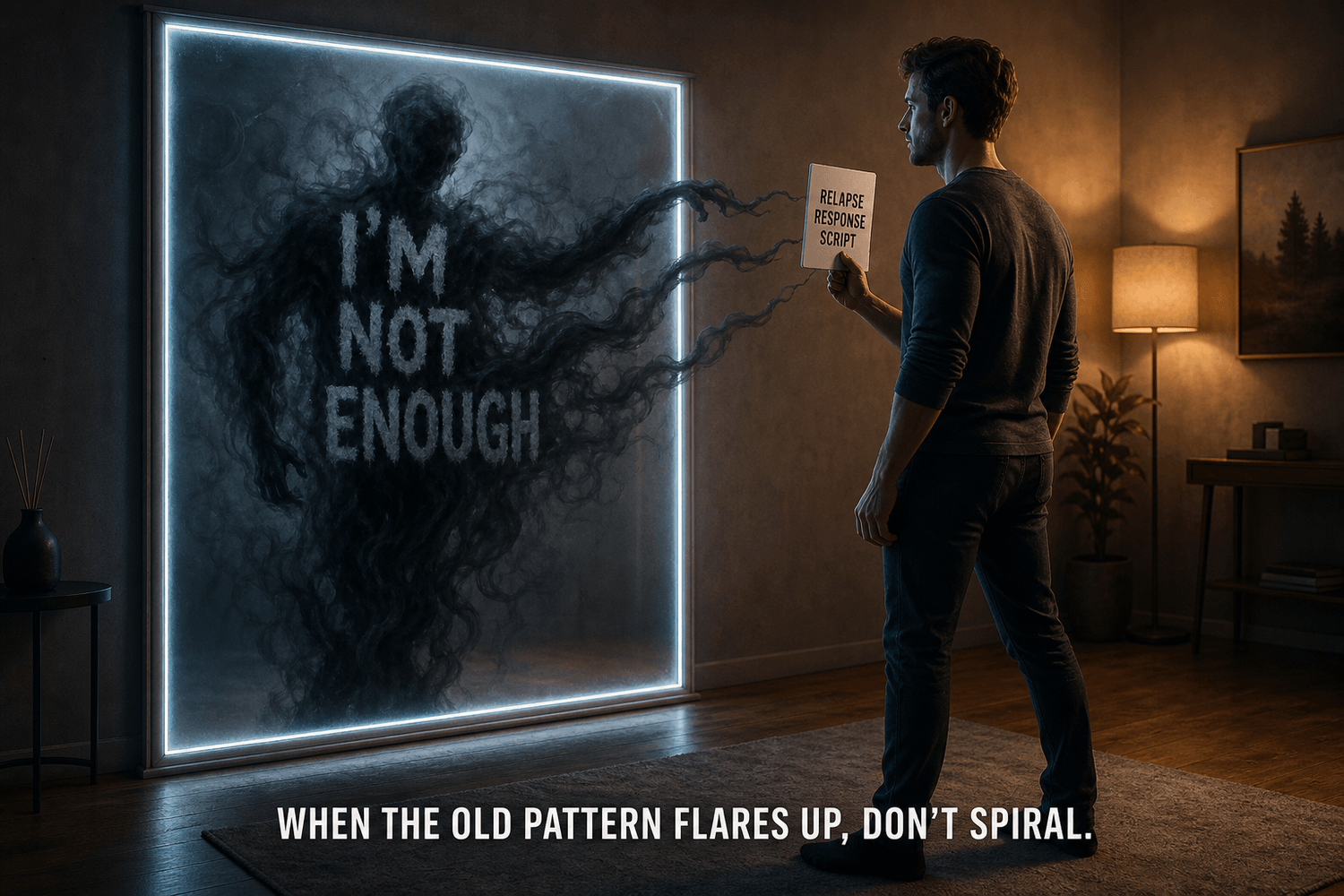
Relapse Response Script (what to do when the old pattern flares up—without spiraling)
If you’re a high-achiever who looks fine on paper but deals with overthinking, imposter syndrome, inconsistency, or self-sabotage underneath, this is built for you.
Download the Identity Rewrite & Evidence Engine Workbook here →FREE
What does hopeless mean? (Hopelessness definition and symptoms)
Hopelessness meaning (simple definition)
Feeling hopeless is the internal experience of predicting no positive future, often paired with the sense that your efforts won’t change that prediction. It’s not just sadness—it’s a forecast your mind treats as fact.
If you’re wondering about hopeless vs helpless meaning, hopelessness is the one that says: the future is closed.
Hopelessness symptoms: common signs and behaviors
Hopelessness often sounds like:
“It’s too late for me.”
“I always end up back here.”
“I don’t see a path forward.”
“Even if I try, it won’t matter.”
Behaviorally it can look like:
quitting early (because “why bother?”)
procrastinating as self-protection
numbing (scrolling, overeating, overworking)
avoiding planning (planning hurts when you don’t believe)
Limiting beliefs about cause that create hopelessness
Hopelessness is usually fed by beliefs that argue the cause is fixed—fate, past, personality, “how life works.” These are the classic “cause” beliefs that make hope feel irrational:
“I am a victim of circumstances and cannot change my life.”
“My past mistakes define my future.”
“I am destined to fail no matter what I do.”
“Life is inherently unfair and I have no control over it.”
“I am incapable of overcoming challenges or adversity.”
Read them carefully: each one makes the future feel pre-decided. When your mind buys these, it doesn’t just feel bad—it stops looking for options. And when you stop looking for options, you stop finding them. Hopelessness becomes “proven.”
That loop is how intelligent people get trapped: not by lack of capability, but by a prediction that quietly shuts down exploration.
What does helpless mean? (Helplessness meaning and signs)

Helplessness meaning (simple definition)
Feeling helpless is the internal experience of believing you have little to no effective influence, even if change might be possible in theory. Helplessness isn’t “I can’t imagine good outcomes”—it’s “I can’t produce them.”
In the difference between hopeless and helpless, helplessness is the one that says: my power doesn’t work.
Signs of feeling helpless (thoughts and behaviors)
Helplessness often sounds like:
“I don’t even know where to start.”
“I need someone/something to save me.”
“I’m stuck waiting for the right time.”
“Other people can do it. I can’t.”
Behaviorally it can look like:
freezing, indecision, analysis paralysis
over-researching instead of executing
outsourcing confidence to mentors, partners, bosses
chronic second-guessing after you take action (“Was that even right?”)
Limiting beliefs about meaning that create helplessness
Helplessness is often powered by beliefs that say your effort has no meaningful impact—your actions don’t connect to outcomes, or outcomes don’t matter:
“I have no purpose or direction in life.”
“Nothing I do really matters in the grand scheme of things.”
“My efforts will never lead to meaningful change.”
“I am always at the mercy of external forces beyond my control.”
“I am powerless to create positive change in my life and the world.”
This is subtle: helplessness isn’t always dramatic. For high-achievers, it often hides under productivity. You’re doing a lot, but it doesn’t feel like it connects. That disconnection is the giveaway—motion without agency.
Hopeless vs helpless examples (how to tell what you’re actually feeling)
Here’s the difference between hopelessness and helplessness in common scenarios:
If you lost your job
Hopeless: “The market is ruined. I’ll never recover.”
Helpless: “Even if jobs exist, I don’t have what it takes to land one.”
If your relationship is struggling
Hopeless: “This will never get better.”
Helpless: “I don’t know how to communicate without making it worse.”
If you’re burned out
Hopeless: “This is my life now.”
Helpless: “I can’t seem to change my habits, even when I try.”
If you’re chasing a goal (business, fitness, creative work)
Hopeless: “I’m too late; it’s already saturated.”
Helpless: “I can’t stay consistent. I sabotage.”
The practical reason this matters: you can’t “motivate” your way out of a belief. If the core belief is about the future being closed (hopeless), the intervention must reopen possibility. If the core belief is about agency being broken (helpless), the intervention must rebuild evidence of influence.
If helplessness shows up less as collapse and more as “I know what to do, but I still don’t do it,” Why Can’t I Stay Consistent Even When I Know What to Do? breaks down the knowing-doing gap underneath that pattern.
Why hopelessness and helplessness can turn into feeling worthless
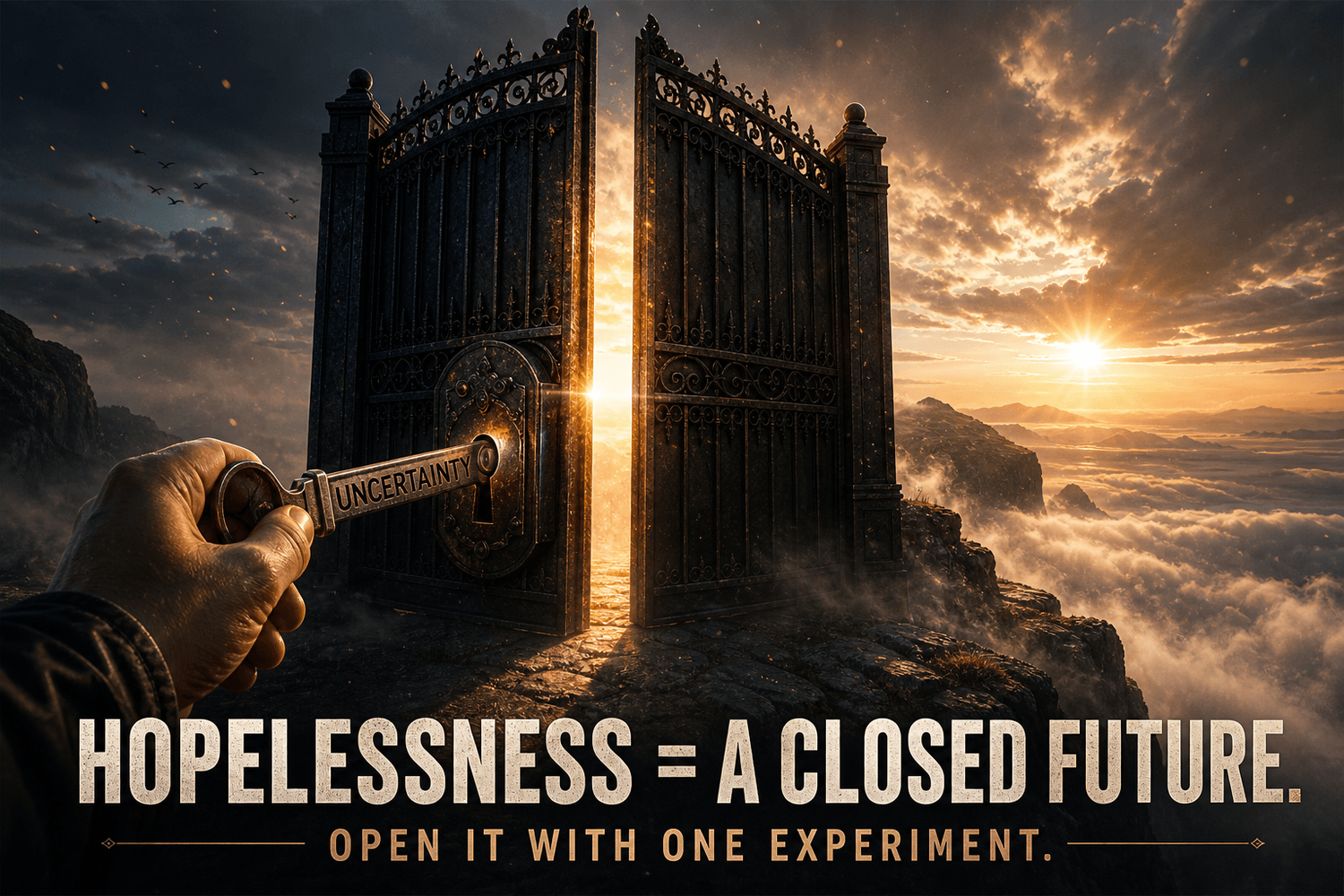
This is the chain many people live inside without realizing it:
Hopelessness (future-level): “Nothing will work.”
Helplessness (agency-level): “I can’t do anything about it.”
Worthlessness (identity-level): “So what does that say about me?”
Worthlessness isn’t merely “low confidence.” It’s an identity verdict: unworthy, flawed, inferior, defective. And it often arrives as a relief at first—because it simplifies the story. The mind loves a single cause. “I’m worthless” becomes the tragic explanation that removes uncertainty.
Limiting beliefs about identity that create feeling worthless
These are the identity statements that lock the whole system in place:
“I am inherently flawed and unworthy of love or success.”
“I am not good enough to achieve my aspirations.”
“My worth is determined by others’ opinions and judgments.”
“I am fundamentally inferior to others and do not deserve happiness.”
“I am defined by my failures and shortcomings, not my potential.”
Once these are active, you can’t “tips and tricks” your way out—because every action gets interpreted through the identity filter. Success feels like luck. Feedback feels like exposure. Rest feels like weakness. Trying feels like auditioning for acceptance.
This is why people who look successful can still feel hollow: they’re winning externally while internally running an identity program that disqualifies them.
When the pattern has already hardened into an identity rule, How to Change Limiting Beliefs: Why Affirmations Backfire shows you how to stop fighting the old belief with force and start replacing it with believable, evidence-backed change.
Why your brain chooses hopelessness (even when it ruins your life)
Hopelessness and helplessness aren’t always random. They often serve a protective function:
If I decide it won’t work, I don’t have to risk trying and failing.
If I decide I can’t do anything, I don’t have to face responsibility or regret.
If I decide I’m worthless, I don’t have to keep negotiating my worth with every outcome.
That’s the trap: the belief hurts, but it lowers emotional risk in the short term. It closes the loop. It ends the argument.
The cost is that it also ends your movement.
Hopeless vs helpless vs worthless: how these concepts connect
Think of your inner experience like a linked system:
Hopelessness (Outcome Forecasting)
Related entities: pessimism, futility, despair, demotivation
Cognitive patterns: global predictions, “always/never” language, future foreclosure
Behavioral outputs: quitting, numbing, avoidance, disengagement
Helplessness (Agency Appraisal)
Related entities: powerlessness, learned helplessness, freeze response, indecision
Cognitive patterns: low self-efficacy, external locus of control, “I can’t”
Behavioral outputs: procrastination, analysis paralysis, dependency, passivity
Worthlessness (Identity Verdict)
Related entities: shame, inferiority, unlovability, impostor feelings
Cognitive patterns: identity fusion (“I am…”), self-labeling, internalized failure
Behavioral outputs: self-sabotage, perfectionism, people-pleasing, isolation
Key bridge concepts that connect the whole chain
Self-efficacy (belief that your actions matter)
Locus of control (internal vs external)
Cognitive distortions (“always,” “never,” mind-reading)
Shame vs guilt (identity vs behavior)
Nervous system states (fight/flight/freeze/collapse)
If you’re building self-awareness, this structure matters because it makes the problem specific. And once it’s specific, it stops being a fog.
Self-check quiz: am I hopeless, helpless, or feeling worthless?
Answer these fast—don’t overthink.
If your dominant thought is
“It won’t get better.” → hopelessness
“I can’t change it.” → helplessness
“I’m the problem / I’m not enough.” → worthlessness
If your dominant emotion is
grief + dread → often hopelessness
anxiety + freeze → often helplessness
shame + numbness → often worthlessness
If your dominant behavior is
quitting → often hopelessness
stalling → often helplessness
self-sabotaging right before progress → often worthlessness protecting you from exposure
You can feel all three. But you usually have a primary. Finding it matters because the lever is different.
How to stop feeling helpless or hopeless (without platitudes): the three-level reset
You don’t need a quote. You need a different internal sequence.
1) If you feel hopeless: reopen the future (cause level)
Hopelessness turns your whole future into one story: “Because it was like this, it will stay like this.” The fix isn’t fake positivity. The fix is uncertainty—on purpose.
A useful reframe is:
“I don’t know that it won’t work. I know I’m scared it won’t.”
Then build one piece of disconfirming evidence:
a micro-experiment (10 minutes, not a life overhaul)
a smaller target (reduce scope until action is possible)
a different variable (method, environment, support, pacing)
Hope returns when your brain sees variance again—proof that outcomes can change.
2) If you feel helpless: rebuild agency fast (meaning level)
Helplessness is “my actions don’t connect.” The fix isn’t bigger goals. It’s faster feedback.
Ask:
“What is one action I can take that produces an observable effect in under 24 hours?”
You’re not proving you can control life. You’re proving you can influence something. Agency comes back when you can see impact.
3) If you feel worthless: separate identity from outcomes (identity level)
Worthlessness is a fusion: “If I fail, I am failure.” The goal is distance between who you are and what happened.
Try:
“I’m experiencing shame. That doesn’t mean shame is telling the truth.”
“My worth isn’t a performance review.”
Then watch for the telltale pattern: worthlessness often spikes right before a stretch of growth—because growth threatens the identity story. If you become the person who can, the old identity loses its job. Part of you may resist that.
This is where deeper integration work becomes non-negotiable: you don’t just push through. You resolve the inner conflict that’s been running your behavior.
If you want a clean way to do that without guesswork, the FREE Identity Rewrite & Evidence Engine Workbook walks you through it like a guided strategic session. You’ll leave with a 14–30 day proof plan, decision rules for the new identity, and a relapse script for when the old pattern flares up.
Grab the workbook and build your Evidence Engine →FREE
Why feeling worthless shows up after burnout, failure, or rejection
Worthlessness loves high standards. It feeds on environments where:
your value feels conditional (love, attention, money, praise)
you learned to equate safety with performance
you were rewarded for results and ignored for emotions
mistakes meant criticism, withdrawal, or humiliation
So when you burn out or hit a wall, your nervous system doesn’t just say “I’m tired.” It says: “If I can’t perform, I might not be safe.” That’s why it feels existential.
Understanding that doesn’t magically remove it, but it does something critical: it turns worthlessness from “truth” into “pattern.”
Patterns can be changed.
FAQ: hopeless vs helpless meaning (quick answers)
Is hopelessness the same as depression?
Not always. Hopelessness can be a symptom of depression, but people can also feel hopeless due to prolonged stress, grief, burnout, chronic uncertainty, or repeated setbacks. If hopelessness is persistent, worsening, or paired with thoughts of self-harm, it’s important to seek professional support.
What is learned helplessness?
Learned helplessness is a pattern where repeated experiences of lack of control teach the brain that effort won’t change outcomes—even when control becomes possible later. The term is strongly associated with psychologist Martin Seligman’s work on how perceived lack of control can shape behavior. It can show up as passivity, freezing, or giving up quickly.
Can you be hopeless but not helpless?
Yes. You might believe you can do things (agency intact) but believe the situation is structurally doomed (future closed). Example: “I’m capable, but this industry is dead.”
Can you be helpless but not hopeless?
Yes. You might believe change is possible in general, but not accessible to you. Example: “Other people can get healthy, but I can’t stick to anything.”
Why do I feel worthless when I fail?
Because failure can trigger an identity-level interpretation—especially if your worth has been linked to performance, approval, or being “the competent one.” The mind turns a behavior event (“I failed”) into a self verdict (“I am a failure”).
What’s the fastest way to shift out of helplessness?
Create one small action with a visible outcome quickly (within hours or a day). Helplessness shrinks when your brain sees a direct cause-effect loop again.
Safety note (because this topic can get heavy fast)
If you’re in immediate danger or thinking about self-harm, call or text 988 in the US (Suicide & Crisis Lifeline) or contact local emergency services—right now. You don’t have to “figure it out” alone before you get support.
Conclusion
Hopeless vs helpless isn’t a word game—it’s the difference between “the future is closed” and “my power is missing.” If you keep treating either one like a fact, it can harden into feeling worthless. Do this next: write one sentence—“I feel hopeless because ___” or “I feel helpless because ___”—then take one 24-hour action that creates visible impact and proves your mind wrong.
About the Author
By Milan | Founder of Milan'Z Coaching | NLP & Hypnotherapy Master Practitioner | Neural Reprogramming Coach | Creator of MSIP | Helping entrepreneurs and high-achieving professionals overcome imposter syndrome, self-doubt, and limiting beliefs since 2014. [About Milan]




UNLOCK FREE MINDSET TRAININGS & EXCLUSIVE DISCOUNTS YOU WON'T FIND ANYWHERE ELSE!
Subscribe to the newsletter and join driven entrepreneurs, solopreneurs, executives, business owners, and high-achieving professionals on a mission to become unstoppable forces for good.
GET MINDSET STRATEGIES DELIVERED TO YOUR INBOX
Unlock free mindset trainings, neural reprogramming techniques, and
exclusive discounts. Join entrepreneurs, executives, and high-achievers
breaking through their mental blocks.
CONNECT WITH MILAN
Got questions about Breakthrough Coaching or Neural Reprogramming?
Send me a message—I read every email.
FREE RESOURCES
© 2026 Milan'Z Coaching