Free Imposter Syndrome Test: Explore the 5 Types and Your Execution Gap
You know what to do. You still over-prepare, second-guess, or delay. Explore the execution gap between what you’re capable of and what you actually put into motion.
You have evidence that you’re capable. Real evidence. Results, responsibility, wins, trust. Yet before the next important move, you act as if you have to prove it all over again.
That’s the part I care about.
Not whether you’re secretly competent. You are. The better question is what happens in the moment your work becomes visible, consequential, or irreversible. Do you research more? Rewrite again? Delay publishing? Avoid asking for help? Dismiss the win you already earned so you can keep chasing certainty?
The Pattern Recognition Test™ is a free, three-minute educational self-assessment that helps you explore patterns of self-doubt. Your Mental Impostor Profile appears immediately on screen, with no opt-in required. It is not a clinical diagnosis.
Two facts set the frame. Pauline Clance and Suzanne Imes first described the impostor phenomenon in 1978 in high-achieving women who struggled to internalize success despite strong external evidence of competence. A 2020 systematic review in the Journal of General Internal Medicine reviewed 62 studies with 14,161 participants and found prevalence estimates ranging from 9% to 82%, depending largely on the screening tool and cutoff used.
That spread matters. “Impostor syndrome” is not in the DSM-5. It has no single diagnostic threshold. Which means a score on any quiz, including mine, describes a pattern in your answers, not a condition in your brain.
Here is the clearest way to understand the problem: the execution gap is the measurable distance between the action a high performer intends to take and the action they actually take, often because over-preparation is functioning as a safety behavior rather than a strategic one.
Prefer to start with your own pattern?
Take the free 3-minute test →
Instant on-screen results. No opt-in required.

When self-doubt becomes an execution gap
The execution gap appears when the move is clear, but the action stalls.
You know the move. You don’t make the move.
A founder delays publishing the offer because one line of the landing page still feels off. An executive rewrites an update that was already clear enough for the audience. A business owner keeps holding a task they should delegate because handing it over feels riskier than absorbing the overload.
This is not always impostor syndrome. Sometimes the delay is rational. The brief is unclear. The stakes are high. The team is thin. You genuinely need more information. But high performers often miss the moment when useful preparation quietly turns into psychological protection.
That’s where the pattern matters.
Preparation stops helping when it keeps replacing action. The extra pass through the deck, the extra article, the extra model, the extra round of reassurance can feel productive because it reduces tension in the short term. It gives you the feeling of movement without the exposure of commitment.
A useful question is not, “Why am I so bad at discipline?” It’s this: What information would actually change this decision, and what am I hoping more information will make me feel?
That question cuts through a lot. It separates strategic thinking from self-protective delay.
If your self-doubt looks more like endless revising, rehearsing, or researching than obvious insecurity, Overpreparation and Imposter Syndrome: How to Break the Cycle will help you tell when extra work is serving the standard and when it is just protecting you from exposure.
Why a generic imposter syndrome quiz can leave you stuck
A generic imposter syndrome quiz can create recognition. That matters. Sometimes seeing the pattern named on the page is a relief. It tells you that what you experience is not random and not uniquely yours.
But recognition alone does not always create movement.
If a result tells you only that you have “high impostor feelings,” you may feel seen without learning what the pattern actually does to your work. You still don’t know how it shows up in decisions, communication, delegation, timing, or recovery after a mistake. You have a label, but not a mechanism.
The more useful question is what self-doubt makes you do.
Here is the sequence I want readers to notice:
Trigger → interpretation → response → short-term relief → possible longer-term cost
That sequence is what cognitive therapy calls a safety behavior. A safety behavior is something you do to reduce threat in the moment: checking, re-reading, rehearsing again, asking one more person, waiting for a little more certainty. It lowers anxiety now, but it also prevents the belief from being fully tested. That is why the behavior survives. It works in the short term.
An important presentation lands on your calendar. You think, I can’t afford to miss anything. You revise the deck again and again. That gives you a brief sense of control. But now you have less time to rehearse, less room to think strategically, and more cognitive strain when you enter the room.
That is a pattern. Not a personality sentence. Not a diagnosis. A pattern.
There is another wrinkle here. Decision research on maximizers and satisficers has shown that people who chase the best possible choice tend to experience more regret and lower satisfaction than people who accept a strong enough choice and move. In other words, the urge to reopen a decision can feel intelligent while quietly making your performance worse.
The five types give you a language for the standard you’re trying to meet. Next, look at how that standard affects your behavior.
And if you want to see how these patterns show up behaviorally once they leave your head, Entrepreneur Self-Sabotage: 9 Signs maps the real-world ways high-achievers block their own momentum.

What are the 5 types of imposter syndrome?
The five types of impostor syndrome, often associated with Valerie Young’s framework, describe different standards people use to judge whether they are competent: Perfectionist, Expert, Soloist, Natural Genius, and Superhuman. That matters because the standard you use shapes the pressure you create.
If you arrived here looking for a 5 types of imposter syndrome quiz, this is the distinction worth understanding: the five types help explain the rulebook behind your self-evaluation. They do not automatically tell you how that rulebook affects your decisions at work. That is where behavioral patterns matter.
Here’s a compact view:
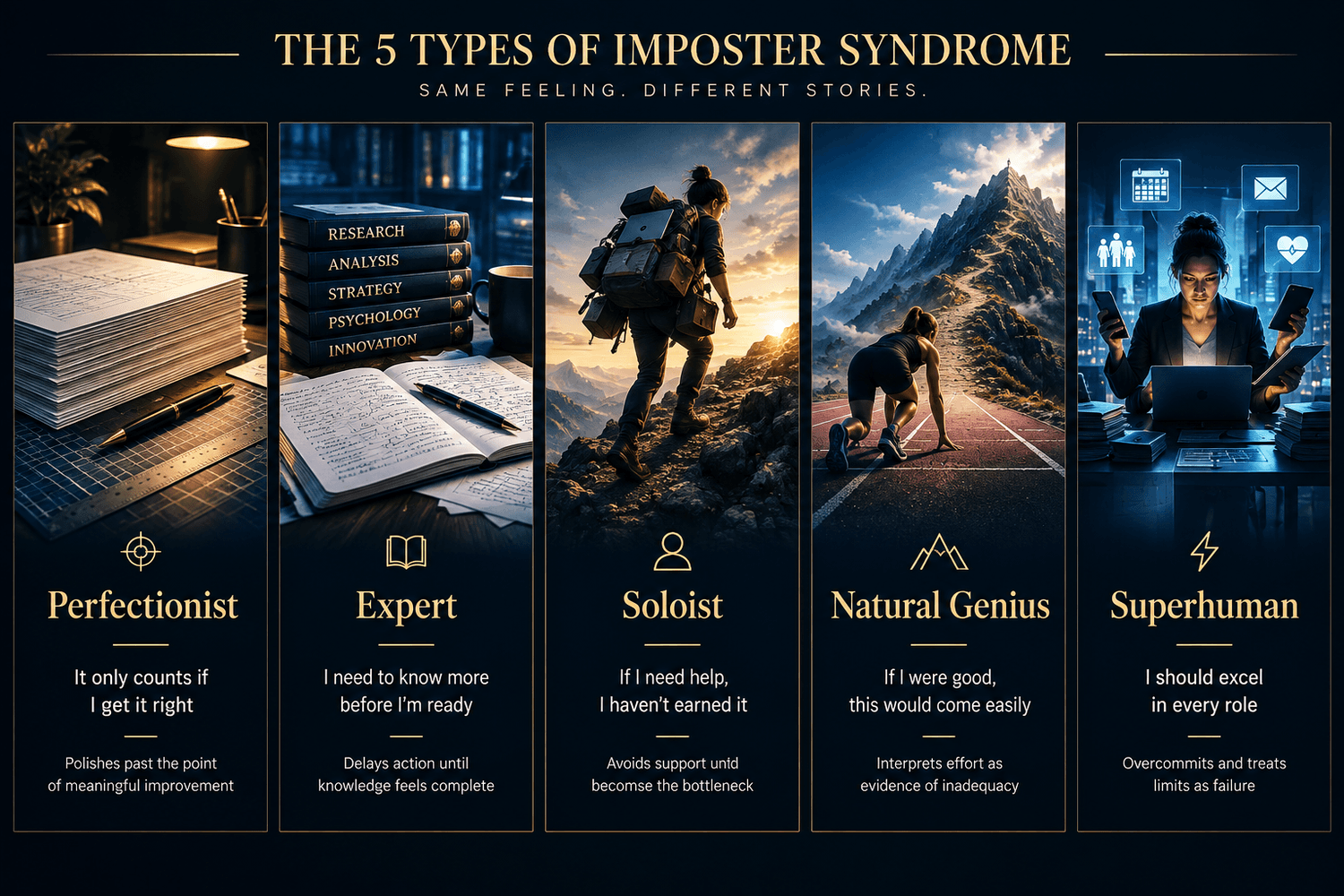
The Perfectionist: “It only counts if I get it right.”
For the Perfectionist, competence depends on flawless execution. A proposal can be strong, persuasive, and commercially sound, and still feel unfinished because one sentence could be tighter or one risk could be reduced further.
The question is not whether quality matters. It does. The question is whether you are improving the outcome or trying to eliminate every possibility of criticism.
There is a wider cultural context here too. Curran and Hill’s 2019 meta-analysis in Psychological Bulletin found that socially prescribed perfectionism rose significantly among young people in the US, UK, and Canada between 1989 and 2016. So if your internal standard feels relentless, it may not be only personal. It may also reflect a broader climate that rewards image, performance, and comparison.
Ask yourself: Am I improving the outcome or trying to eliminate every possibility of criticism?
The Expert: “I need to know more before I’m ready.”
For the Expert, competence depends on having enough knowledge to feel fully legitimate. In practice, that often means enough becomes a moving target.
The course gets bought. The podcast gets saved. The research expands. The launch stays parked.
This pattern can look responsible from the outside. It often earns praise. You seem thoughtful, serious, rigorous. But rigor becomes avoidance when knowledge gathering replaces contact with the market, the room, or the real decision.
Ask: What specifically do I still need to know?
The Soloist: “If I need help, I haven’t earned it.”
For the Soloist, needing help can feel like disqualification. The work counts more if it is carried alone.
This is costly in leadership. It slows teams. It blocks delegation. It turns competence into private suffering. The leader who prides themselves on being dependable quietly trains the organization to depend on them too much.
The issue is not independence. It is the meaning attached to support.
Ask: What meaning am I attaching to needing help?
The Natural Genius: “If I were good, this would come easily.”
For the Natural Genius, competence depends on speed and ease. If it takes effort, the internal conclusion is often brutal: maybe I’m not built for this.
That belief punishes learning. It makes the first ugly draft, the awkward first attempt, the messy first delegation feel like proof of mismatch rather than part of mastery.
Ask: Am I treating learning as evidence that I don’t belong?
The Superhuman: “I should excel in every role.”
For the Superhuman, competence means sustaining excellence across roles at once. Operator. Leader. Partner. Parent. Founder. Friend. Problem-solver. Stabilizer. Visionary.
No human can do that without trade-offs. Yet many high performers respond to competing demands by increasing pressure instead of revising expectations.
Ask: Which expectation assumes I have unlimited capacity?
You may recognize more than one. Use these descriptions as reflection prompts, not boxes you have to fit into.

What The Pattern Recognition Test™ helps you explore
The Pattern Recognition Test™ helps you explore how self-doubt shows up in decisions, not just how it feels in your head.
I use three concepts to make that concrete. They are coaching descriptions, not clinical diagnoses or replacements for the five competence types.
The point is not to give you another identity to carry around. The point is to help you notice the structure of the loop.
The Discounting Loop—why your wins don’t settle the doubt
The Discounting Loop is a pattern of explaining away positive evidence while treating mistakes as more meaningful.
You close the deal, but you tell yourself the timing was lucky. You lead well in a difficult quarter, but you explain it as overwork rather than ability. Someone credible praises your thinking, and you convert it into politeness. Then the next challenge arrives, and you start from psychological zero.
This is how capable people can accumulate proof and still feel unconvinced.
The problem is not a lack of accomplishments. It is a skewed evidence filter. Positive feedback gets downgraded. Imperfections get upgraded. You become highly persuasive to yourself in exactly one direction.
Attribution theory has a name for this. Bernard Weiner’s framework sorts explanations for success and failure along dimensions like locus, whether the cause is internal or external, and stability, whether the cause is fixed or changeable. When you credit a win to luck or timing, you file it as external and unstable. When you credit a mistake to a flaw in you, you file it as internal and stable.
The evidence doesn’t change. The filing does. And the filing is what determines whether a win produces durable confidence or evaporates by Tuesday.
That matters because confidence is not built only by achievement. It is built by how you interpret achievement.
The Execution Gap—when doubt interrupts the next useful action
The Execution Gap is a recurring mismatch between the action you intend to take and the behavior that follows.
You decide. Then you reopen the decision. You outline the post, then revise the angle three times. You ask for feedback, receive enough, and ask three more people. You know the next useful step, but you substitute a safer step in its place.
This is where analysis paralysis, reassurance seeking, and over-preparation often live. Not because thoughtfulness is bad, but because the pursuit of certainty can become endless when certainty is being used to regulate fear.
The test helps surface whether your pattern is less about inability and more about what happens between intention and exposure.
If the test shows you know the move but still hesitate at the moment of action, Why Can’t I Stay Consistent Even When I Know What to Do? goes deeper on what interrupts follow-through under pressure.
The Willpower Trap—trying to outwork the rule driving the pressure
The Willpower Trap shows up when you respond to recurring self-doubt by applying more force without examining the expectation underneath it.
You tighten the routine. You raise the standard. You cut rest. You tell yourself to stop overthinking and push harder. Sometimes that creates a burst of performance. Often it recreates the same cycle with more exhaustion and less self-trust.
Effort matters. Habits matter. Skill matters. But effort alone cannot solve a pattern built on a hidden rule you never question.
There is a reason this matters intellectually as well as practically. The popular idea that willpower works like a draining tank took a major hit when a large registered replication report in 2016 failed to find the classic ego depletion effect. That does not mean effort is irrelevant. It means “push harder” is a weaker explanation than many people assumed. If the real issue is an unexamined rule, more pressure was never going to fix it.
If the rule is “I should always feel certain before I act,” no amount of pressure will produce durable change. It will produce temporary compliance, then another loop.
How the free imposter syndrome test works
The free imposter syndrome test is designed to be practical, fast, and frictionless.
Set aside three minutes
Answer from your actual behavior, not from the version of you that sounds disciplined in your head. Think about recent decisions, recent reactions, recent work. The useful answer is usually the honest one, not the aspirational one.
See your Mental Impostor Profile immediately
At the end of the test, your Mental Impostor Profile appears on screen right away. The profile is meant to describe a response pattern based on your answers. It is there to support reflection, not to hand down a verdict about who you are.
No payment. No opt-in required.
The test is free to take. Your results appear on screen. You do not need to enter your email to see them.
That matters. If the point is genuine self-recognition, there should be no friction between the question and the first useful insight.
What your result means—and what it doesn’t
Your result is a reflection of your answers, not a verdict on your identity.
It depends on self-report. It does not prove a single root cause. It does not explain every delay, every bout of hesitation, or every period of lower performance. Workload, unclear expectations, skill gaps, business conditions, and real-world constraints still matter.
What a useful result can do is narrow your field of attention.
Instead of saying, “I need to become a different person,” you can ask a sharper question: What pattern do I run when pressure rises?
Use the profile against one real decision.
Name a recent situation. Identify the expectation attached to it. Describe what you did next. Then choose one small, observable alternative.
Not a grand reinvention. A bounded next step.
That is how self-trust gets rebuilt in practice. Not by waiting to feel transformed. By interrupting one loop where it usually runs.
Free imposter syndrome test: common questions
Is this imposter syndrome test online free?
Yes. The Pattern Recognition Test™ is free to take online and is designed to be completed in about three minutes.
Do I need to enter my email to see my results?
No. The result appears on screen without an opt-in requirement.
Is an impostor syndrome quiz a clinical diagnosis?
No. This is an educational self-assessment. It can help you recognize patterns that may be contributing to overthinking, hesitation, or self-doubt, but it is not a clinical diagnosis.
Can I recognize myself in more than one of the five types?
Yes. Many high performers see themselves in more than one type. These frameworks are best used as lenses, not rigid categories.
How does this differ from a 5 types of imposter syndrome quiz?
A 5 types of imposter syndrome quiz typically focuses on which competence rule you identify with most strongly. The Pattern Recognition Test™ is designed to help you explore how self-doubt may be affecting your behavior in real decisions, especially around discounting wins, delaying action, or trying to solve the problem with more pressure.
Is this the same as the Clance Impostor Phenomenon Scale?
No. The Pattern Recognition Test™ should be treated as an independent educational assessment unless its methodology explicitly states otherwise. It is not the same as the Clance Impostor Phenomenon Scale, and it should not be assumed to be equivalent or validated in the same way.
Before you push yourself harder, examine the pattern
Before you demand more discipline from yourself, look at what happens between knowing your next move and taking it.
That is often where the real story lives. Not in your ambition. Not in your intelligence. In the rule, interpretation, or protective behavior that keeps replaying under pressure.
If you keep trying to solve a pattern with more force, you will keep getting a stronger version of the same struggle. The better move is to identify the loop.
I created The Pattern Recognition Test™ to help you explore that pattern, not hand you another label.
Take The Pattern Recognition Test™ →
Get your Mental Impostor Profile in three minutes. Free. Instant on-screen results. No opt-in required.
About the Author
By Milan | Founder of Milan'Z Coaching | NLP & Hypnotherapy Master Practitioner | Neural Reprogramming Coach | Creator of MSIP | Helping entrepreneurs and high-achieving professionals overcome imposter syndrome, self-doubt, and limiting beliefs since 2014. [About Milan]





UNLOCK FREE MINDSET TRAININGS & EXCLUSIVE DISCOUNTS YOU WON'T FIND ANYWHERE ELSE!
Subscribe to the newsletter and join driven entrepreneurs, solopreneurs, executives, business owners, and high-achieving professionals on a mission to become unstoppable forces for good.
GET MINDSET STRATEGIES DELIVERED TO YOUR INBOX
Unlock free mindset trainings, neural reprogramming techniques, and
exclusive discounts. Join entrepreneurs, executives, and high-achievers
breaking through their mental blocks.
CONNECT WITH MILAN
Got questions about Breakthrough Coaching or Neural Reprogramming?
Send me a message—I read every email.
FREE RESOURCES
© 2026 Milan'Z Coaching